Skip to content
Subscribe

\New Era\ In State-Defense Department Cooperation

Published:

Credit: AP

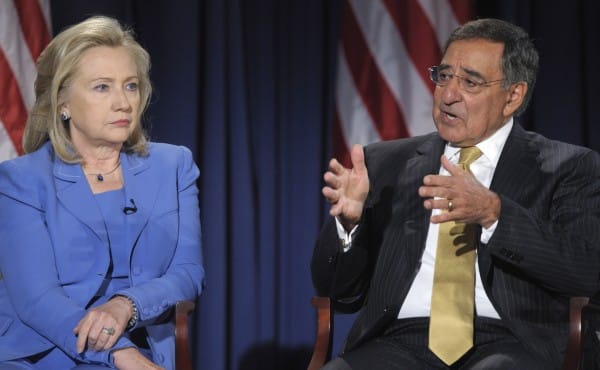
Hillary Clinton Leon Panetta

Assistant Secretary of State for Political-Military Affairs Andrew Shapiro spoke at the Center for Strategic and International Studies today on the improvements to inter-agency cooperation between the State Department and the Department of Defense.

The two agencies have not always enjoyed a productive relationship.

"In previous administrations - both Republican and Democratic - relations between the two departments were often characterized by suspicion and distrust," Shapiro said. "The cooperation between the State Department and the Pentagon is truly unprecedented and I think this will be remembered as one of Secretary Clinton's lasting legacies."

With two war fronts and countless strategic international issues to attend to, the past decade has been particularly challenging for both departments. The State Department has also grappled with budget cuts, while counterparts at the Pentagon largely watched their coffers swell.

“State Department is a national security agency, too,” said Shapiro. “We are helping to save lives every day.”

Despite differences in department strength, when pursuing American interests abroad, the State Department and Defense Department have an important mandate to work together. Shapiro's remarks highlighted an inter-agency relationship that has improved in several aspects during Secretary of State Hillary Clinton's tenure.

He also cited an early statement by Secretary of Defense Leon Panetta on the essentialness the State Department budget. Shapiro's speech today serves as an opportunity to highlight State Department achievements and importance to the country at a time when the department will likely face additional cuts.

“Unfortunately, there remains a lingering misperception out there that funding for the State Department isn’t as essential to strengthening our country’s national security,” he said. “Of course, our defense colleagues know better…They understand that investments in development and diplomacy today will make it less likely that we ask our troops to deploy tomorrow.”

The Defense Department's itself faces serious cuts to funding given the scheduled budget sequester. Washington is grappling with $1.2 trillion in automatic cuts to defense and domestic programs, if a compromise to reduce the national deficit is not found.

See below for Assistant Secretary Andrew Shapiro's full comments at CSIS:

http://vimeo.com/47186848#t=288

Adhere to the IVN etiquette

By posting a comment, you agree to adhere to our etiquette rules: No partisan attacks, no personal attacks, substantiate your sources, no self-promotion.

Contact IVN

Questions about this article or our coverage? Send us a message. A free IVN member account is required.

Message sent

Thanks, we’ll review it and get back to you if needed.

Message not sent

Sorry, something went wrong. Please try again.

Sign in to send a message

Messages are tied to your IVN member account. Signing in is free and takes a few seconds.

Republish this article

Republishing guidelines

Republish IVN articles for free. Independent Voter News articles may be republished online or in print under a Creative Commons BY-NC-ND 4.0 license, on these terms:

  1. Credit the author and IVN. Keep the byline ("By Author Name, Independent Voter News") and the attribution note at the end, which links to the original.
  2. Keep the meaning. You may update time and place references and apply your house style. You may trim for length, as long as the cuts don't change the meaning or misrepresent the author. Keep the headline. Mark any additions as your own (for example "Additional reporting by ...").
  3. Translations are welcome. Translate faithfully, add "Translated from English by [your outlet]", and tell us at editor@ivn.us.
  4. Keep the links, including the link to the original article.
  5. Keep the tracking image. The HTML includes a 1-pixel image that counts readers on your page. It collects no personal information.
  6. Photos and illustrations. Images credited to IVN may be used with this article only. Images credited to others (AP, Getty, Unsplash, Wikimedia and so on) stay under their owners' terms. Secure the rights or switch "Include images" off.
  7. Don't sell it. You can't sell our articles or sell ads specifically against them. Your normal site advertising is fine.
  8. No implied endorsement. Don't suggest that IVN or the author endorses you, your candidates or your causes, or that donations to you support IVN.
  9. Keep labels. Opinion or analysis pieces keep that label.
  10. Point search engines to the original. Where your CMS allows, set the canonical URL to the original IVN article.
  11. No bulk or automated republishing, and don't submit our articles to aggregators (Apple News, Google News, MSN) as your own.
  12. Corrections and removals. Update your copy when we correct it, and remove it promptly if we ask. We'll contact you at the email you give us.
  13. Questions or print republication: editor@ivn.us.

IVN staff: fill in who you're inviting above, then create the invite.

Preparing the article

\New Era\ In State-Defense Department Cooperation

Choose a format
  • HTML
  • Email HTML
  • Markdown
  • Formatted (.docx)
  • Plain text
  • WordPress blocks
  • PDF
Choose a platform

Photos credited to others need their owners' permission.

To for

Republishing somewhere else? Questions? editor@ivn.us