Credit: fairimmigration.org

A Gallup poll released Monday found neither Democrats' nor Republicans' views on immigration closely align with that of self-described independents. Almost a third of independents fell between Democrats (37%) and Republicans (35%). Yet, over one-fourth (28%) did not identify with either major party on the immigration issue. Credit: Gallup
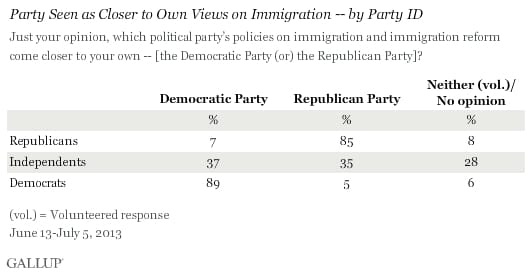
Conversely, a significant majority of Democrats and Republicans, 89 and 85 percent respectively, agree with their party's immigration policy.
Overall, the Gallup poll found that, "Americans are more likely to say their views on immigration and immigration reform align with the Democratic Party's than with the Republican Party's policies, although fewer than half relate to either party on the issue."
Although specific policy disagreements remain particularly polarizing, provisions that would establish a path to citizenship have broad support.
When examined outside of the partisan context, the large majority of Americans do support a path to citizenship in some form. From Gallup, "[Most] conservatives (83%) support a plan that ultimately allows illegal immigrants to become citizens; moderate (92%) and liberal (91%) support is only slightly higher."
Right now, all eyes lay on the House of Representatives as Democrats hope to sure up enough Republican votes by beefing up border security to overcome the Hastert Rule. A rule which came into existence less than 20 years ago and technically doesn't really exist, has significantly slowed progress on an immigration package.
Over the last decade, Americans' priorities on immigration have flipped. Before 2012, about 55 percent of voters preferred to halt the influx of illegal immigrants. Whereas post-2012 55 percent now favor "developing a plan to deal with immigrants who are currently in the U.S. illegally."
While the plurality of unaffiliated voters preferring one side over the other remains within the margin of error, over a quarter of independents do not feel represented by either party in Washington. Ultimately, it remains to be seen whether or not Congress will be able to pass substantive reform, even with sizable support for one of the most contentious issues of the bill.