Credit: PPIC
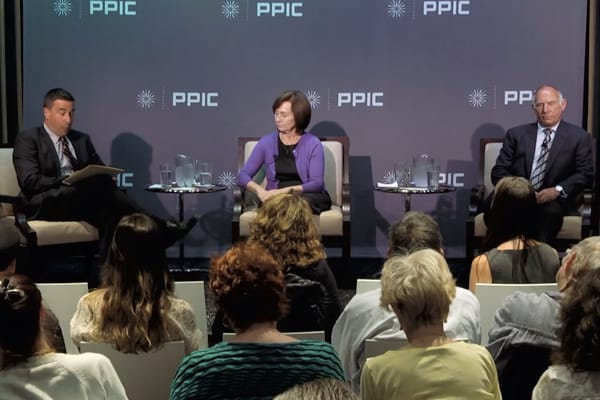
The Public Policy Institute of California's latest Speaker Series installment comprised a panel of prominent voices in California's campaign finance environment. The panel included Ann Ravel from the Fair Political Practices Commission, Allan Zaremberg, president for the California Chamber of Commerce, and was moderated by Scott Shafer, reporter for KQED's California Report.
Held Tuesday, the theme of 'Improving California's Elections' laid the foundation for the guests to outline their assessment of what challenges lie ahead for money in California elections. Both Ravel and Zaremberg concluded that big money in elections was here to stay, and in all likelihood would continue to grow.
Their discussion of campaign finance reform in California focused on three areas: independent expenditures, disclosure and transparency and contribution limits.
Independent Expenditures
Although the prominence of unlimited independent expenditures in California predates the 2010 Supreme Court ruling in Citizens United v FEC, the problem as identified by Zaremberg, lies in candidates not being able to control campaign messaging.He emphasized competition as a primary concern, arguing that when candidates can no longer appeal to voters free of extensive third party interference, voters are unable to make informed decisions. Specifically pointing to the complications of campaign ads run by independent groups such as Super PACs, Zaremberg added, "When somebody else does the ad for ... probably isn't all that good, because you have a third party, I dont care who that third party is, telling you the message about what they think about that candidate."
Ravel too was concerned with independent expenditures, but was more interested in reigning in large contributions coming from organizations that don't disclose donors like Americans For Responsible Leadership, also known as 'dark money' organizations.
Disclosure and Transparency
Ravel emphasized how not knowing where large sums of money come from should be the primary target for campaign finance reformers. "The major problem in campaigns... has to do with the large amount of money that is not disclosed." She continued, "At least a third to forty percent of those independent expenditures are from sources that nobody knows who they are."
Zaremberg was less worried by the the amount of money in an election, but rather who it was going to. "You can overspend in certain city council races. We saw this in the Mayors race in Los Angeles to some extent. There is a diminishing return on how much money you spend and I think that can hurt a candidate."
Contribution Limits
Both panelists agreed the donation limits for candidates were much more restrictive when compared to the nation. For Zaremberg this issue should be a leading priority for reformers.
"The problem to me is the campaign limits for candidates are so restrictive that all the money is driven underground... The constraints on how much a candidate can raise are so limited and the problem is that the candidate doesn't run the race."
However, Ravel argued that increased participation in elections could offer candidates a way around the tighter contribution limits. "The thing that is going to solve some of this problem is to get more people interested in the political system. I think it's really unfortunate how few people are involved and how few people vote. And there needs to be greater access and involvement in voting."
The FPPC has sponsored multiple bills in the legislature including AB 1090 and AB 552 sponsored by Assemblyman Paul Fong (D-Cupertino), ABs 914 and 800 sponsored by Richard Gordon (D-Menlo Park), and the DISCLOSE Act package from Sens. Jerry Hill (D-San Mateo) and Mark Leno (D-San Francisco).
Ultimately, whether or not money in politics results in corruption comes down to the candidate his/herself. Convinced that California's elections were going to get more competitive in part due to the new nonpartisan primary system, Zaremberg put his faith in the candidates.
"Money is corruptible, but it's the people, I think the people who are leaders... They're the ones who determine whether or not money corrupts them."
Check out the full panel below.
http://www.youtube.com/watch?v=g0kBPO5KNow&list=PLE43F1E7301CAC1B4