Credit: TIME.com
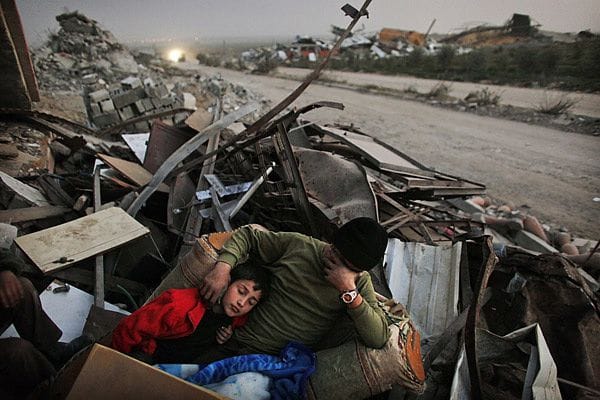
On Thursday Hamas launched over 80 missiles from the Gaza Strip into Israeli territory, injuring at least six civilians. Israeli forces retaliated immediately with air strikes, leaving a reported four Hamas members dead.
This dramatic resurgence of violence came on the coat tails of two heavily symbolic agreements specific to this volatile region. The first came on Tuesday, after Qatar’s emir Sheik Hamad bin Khalifa al-Thani visited the Gaza Strip. This marked a historic arrival as al-Thani became the first head-of-state to visit the hotly-contested Palestinian territory since Hamas took political control of the area in 2007.
The Qatari emir boldly exposed his intentions, promising $400 million to improve infrastructure in the region. Qatar’s funding comes at a time when Palestinian territories are starving for foreign aid. Among other projects, the money will be invested in repairing three major roads, building two housing complexes and a prosthetic center.
Later that same evening, Obama’s administration signed a timely financial agreement with their Middle Eastern ally. Finance Ministry Director General Doron Cohen and US Treasury Secretary Timothy Geithner signed a guarantee, which promises Israel access to $3.8 billion dollars until 2016.
Following last week’s heightened cross-border violence, it was Egyptian authorities who spearheaded peace talks between the two long-volatile parties. Both the US and Qatar failed to show up at the negotiating table. On Friday, Cairo reported it had received a verbal confirmation from Hamas that the conservative Islamic party would honor a Gaza ceasefire with Israel.
Russia chimed in on the recent proceedings in Israel, expressing support for the way Egypt handled the conflict mediation. In a briefing in Moscow, Russia’s Foreign Ministry spokesman Alexander Lukashevich explicitly stated that only diplomatic solutions will improve the situation in the Palestinian-Israeli conflict resolution process.
"We sincerely hope that the sides will return to the lull that existed between them and this situation will prove sustainable."
Lukashevich’s cautious optimism with yet-another attempt at an Israeli/Palestinian settlement is understandable. A statement from the Israeli Defense Force claimed nearly 550 rockets have been launched from Hamas-controlled Gaza Strip into southern Israel since January.
The most recent bout of Israeli/Palestinian violence erupted not even a week after the final US presidential debate, in which both front-runner candidates explicitly stated their views on Israel. Now, with Election Day just around the corner, this instability within America's strongest Middle Eastern ally provides an opportunity for some sobering self-reflection.
Mitt Romney restated his willingness to blindly support Israeli allies. This policy has remained a consistent point of his throughout the entirety of his campaign. Romney’s camp frequently boasted of his close relationship with Israel’s Prime Minister, Benjamin Netanyahu. Romney promised that, when elected president, he would stand fearlessly by Israel, not just financially and diplomatically, but militarily.
Suggesting military action or involvement of any kind goes contrary to the strategies Lukashevich advised last week.
Romney’s allegiance to Israel is definitely a hardline, and more conservative-leaning than the current administration’s. He has repeatedly harped on Obama for maintaining a fair-weather relationship with Israel. “The people of Israel deserve better treatment,” than they have received from Obama, Romney said recently.
Many times over, Romney has highlighted the president’s willingness to negotiate with Iran on nuclear development as apologetic and weak-spined examples of the government’s questionable loyalty.
So far, Romney’s claims haven’t seemed to hurt Obama’s support among America’s Jewish voters. In most pre-debate polling, Obama was consistently pulling a hefty 65-70 percent of Jewish support.
“Our bond with Israel will be unbreakable,” Obama told Romney during the third presidential debate in Boca Raton. “As long as I am president of the United States, Iran will not get a nuclear weapon.”
The jury is still out on how exactly the US will be able to do that peacefully, given such high-tension in the region.