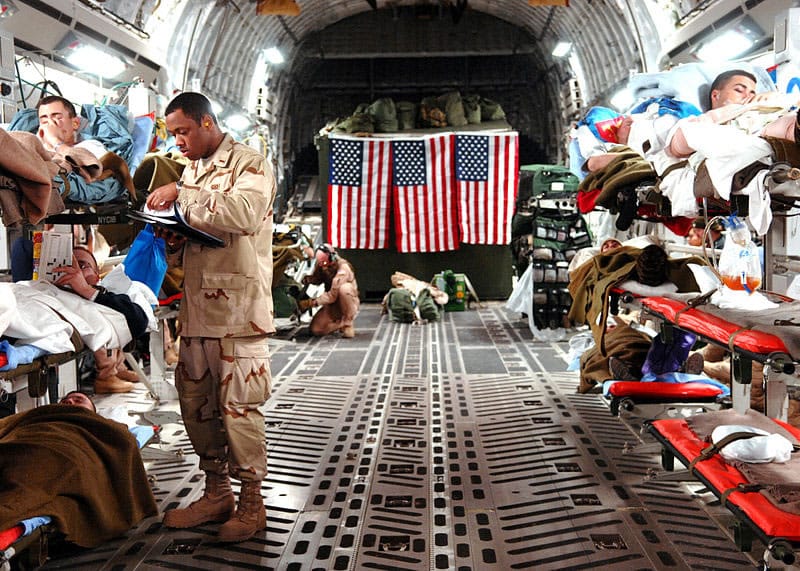
Photo: US Air Force / Author: Master Sgt. Scott Reed
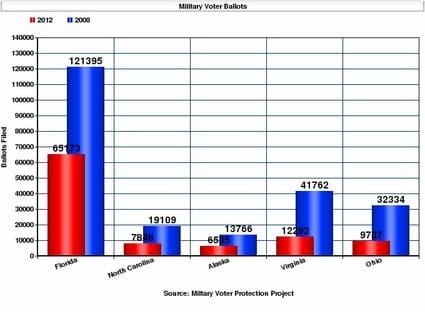
Despite a law passed by Congress in 2009 after low absentee voter turnout in the 2008 elections among US military personnel deployed overseas, the Military Voter Protection Project released statistics earlier this month which revealed that requests by military voters for absentee ballots had dropped significantly since 2008 to a record low.
The most significant drops were in the key battleground states of Virginia and Ohio, which both saw requests for absentee ballots by military personnel deployed overseas drop 70 percent: Graph: usnews.com / Info: Military Voter Protection Project
The drop in military voter ballot requests happened despite the Military and Overseas Voter Empowerment Act (or MOVE Act), which Congress passed in 2009 following the 2008 election's low military voter turnout. The law created a program called the Federal Voting Assistance Program, tasked with creating voting assistance services for active duty military members serving at overseas military installations.
But the FVAP hasn't set up a single military voter assistance office at a number of military installations overseas according to findings in an August DOD Inspector General report. Part of the problem is a bureaucratic tangle of funding hurdles, but US News and World Report published an article this month reporting that part of the problem is resistance from the Department of Defense itself.
The Pentagon's failure to implement the 2009 act of Congress will likely leave thousands of military voters disenfranchised in the 2012 election. Some Republicans are charging the Obama Administration with active voter suppression of military voters, who tend to lean Republican. Strong turnout among military voters overseas could make all the difference in swing states where the poll numbers are close. Over the weekend, The Hill reported:
"However, congressional Republicans have hammered the Pentagon for not following through on the requirements outlined in the 2009 legislation, leaving thousands of military personnel unable to cast their vote.The military vote tends to sway Republican, and with recent polls showing President Obama and GOP presidential nominee Mitt Romney in a virtual dead heat, strong voter turnout by American service members could be the difference between a second term for Obama or a Romney White House."
In response to the military voter disenfranchisement controversy, US Senator John Cornyn (TX) said in a letter to Defense Secretary Leon Panetta:
"The price of DoD’s failure to follow the law will likely be paid this November by military service members and their families, whose voting rights were to have been safeguarded by this provision."
Cornyn described the hurdles deployed military personnel face to vote in elections back home:
"Many overseas service members are forward-deployed in units with high operational tempos and in austere environments, both of which make it harder for them to hand-carry their completed ballots to a post office or postal clerk by the deadline."
The 2009 MOVE Act holds the Pentagon responsible for making sure America's soldiers have ballot access while working in this high-stress, dangerous environment overseas. Just in time for the 2012 election, the public is learning that the law has not been implemented, leaving thousands of military voters disenfranchised despite the universal refrain from policymakers and power players in both parties that it's a priority to "Support the Troops."