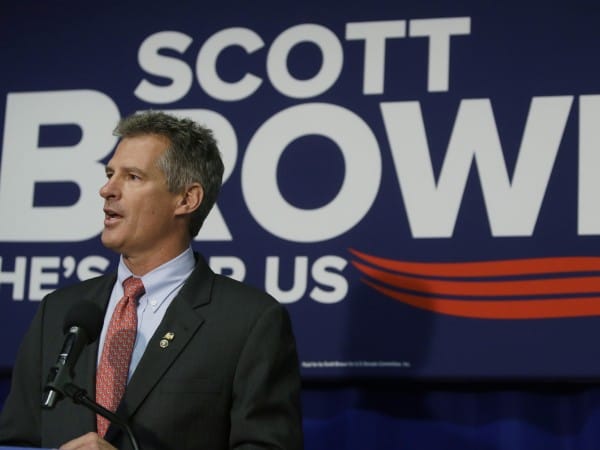
Scott Brown, the incumbent candidate for the Massachusetts senate seat, has often referred to himself as an “independent voice,” possibly hoping to gain votes from the stronghold of voters who identify as “independent voters” in his home state. However, in his latest debate against opponent Elizabeth Warren on NBC’s “Meet the Press,” Brown, a Republican, shocked many by naming the ultra conservative, ever controversial Antonin Scalia as his “model” Supreme Court Justice. This recent association with the far right begs the question of whether Brown truly performs on a bipartisan platform or whether he is simply doing his best to win over the key independent demographic in Massachusetts.
Brown’s claims to be an independent voice and nonpartisan voter are evident in everything from his campaign video to his website, where being an “independent voice” even falls under the category of issues. As an independent voice, Brown claims he will "approach each issue... with an open mind and willingness to compromise work with anyone of goodwill to move our country forward." Brown goes further to state,
Once again I won't have the political establishment behind me … All I will have going for me is my independent record as your United States Senator, and the independent spirit of the Massachusetts voter. I'll take those advantages any day over the political machine, and with your help in this campaign we will beat the odds again together.” Essentially, Scott Brown portrays himself as an independent senator who has worked and will work with both parties to “get things done.
Massachusetts, a nearly entirely blue state in terms of presidential elections (Obama captured MA votes by a significant 26% in 2008), has a surprisingly large number of voters who identify themselves as independent. In fact, at around 51%, independents are the majority voter population in the state. This is mainly attributed to the fact that the state performs on “a closed primary basis.” In other words, if you are registered as a Democrat or Republican, you must vote along your party lines in the primary. The only exception to this is to register as an “unenrolled,” an independent. This is where Brown’s strategy of claiming nonpartisanship comes into play.
In his last term in the Senate, voting records show that Brown voted 80% of the time along party lines. However, in comparison to his entire Senate voting history, the percentage fell to about 66%. With nearly every senator voting 80-90% along respective party lines, this data alone may convince many that Brown’s non-partisan claims are in fact true. However, Scott Brown has been accused by opponents of actively obstructing bipartisanship during his tenure in the Senate.
Upon further analysis of his voting record, Scott Brown did in fact vote with his party for every key measure except one in the most recent session of Senate voting. One such measure was Senate Act 63, where Brown voted along the Republican line. The measure intended to repeal certain tax benefits for major oil companies while extending a number of energy efficiency and renewable energy tax credits. The act seems like a reasonable and effective measure that accounts for both environmental sustainability and honest budget spending (both issues Brown claims to support), yet Brown voted against the measure.
With his voting record in mind, it seems that it would be difficult to label Scott Brown as an “independent voice.”
That being said, the collective data of Senate voting seems to indicate that nearly every senator works on a partisan basis. With only a handful of Senators voting less than 75% among party lines (8 to be exact) and one brave soul working on an incredibly low 40% “bias,” no Senator seems to have the right to claim the title of being an “independent voice.”
Whether a mere slipup or calculated response, Brown’s conservative response to the “model supreme court” question seems immaterial in a Senate where party lines guide nearly every course of action.