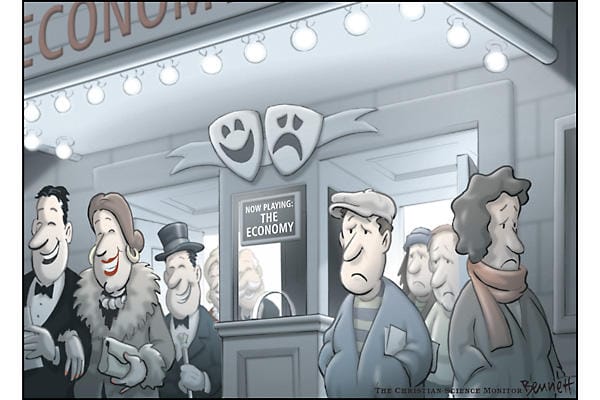
Credit: Christian Science Monitor
Governor Jerry Brown's proposed budget plan read like most budgetary analyses, a mostly dry explanation of projected revenue and expenditures. However, this line stood out:
"The increasing concentration of income has made tax revenues dependent to a greater degree on the income and decisions of a relatively small population of taxpayers."
California has the ninth largest economy in the world with a Gross Domestic Product (GDP) of nearly two trillion dollars, yet the state faces billion dollar budget deficits every year. Despite having the largest economy of any state, California's economy only grew at a rate of two percent during the last fiscal year, and it has the second lowest credit rating due to its high rate of debt to GDP. Despite another year of steep budget cuts for public services, the state still currently faces a nearly $16 billion budget deficit for the next fiscal year.
The best anecdote to the vicious cycle of stagnating income, falling revenues, painful budget cuts, billion dollar deficits and growing debt is robust economic growth. As David Leonhardt writes in the New York Times, "It is certainly true that strong economic growth helps solve almost every challenge the country faces: the deficit, unemployment, the income slump, even the rise of China."
As the line quoted from the budget proposal indicates, income inequality in California has been on the rise for several decades. According to a report by the Legislative Analyst's Office in 2000 using tax return data from 1975 to 1998, income for the top 20 percent of Californians grew, while it declined for the bottom 80 percent of taxpayers. A decade later, according to a study by the California Budget Project, income inequality had only worsened in California despite gains in productivity.
Thus, the claim that income has become more concentrated at the top in California is factually correct. However, widening income inequality also appears to have been the cause of the massive recession that struck the nation and California in 2008, as well as the ongoing weak post-recession recovery.
According to Ragurham Rajan, a Professor of Finance at the University of Chicago Booth School of Business, income inequality fueled the housing crisis that led to the brutal nationwide recession which hit California particularly hard. According to Rajan, the political solution to growing economic inequality was to make credit easily available for housing purchases. While that strategy led to more consumption in the short-term, the bill eventually came due, and because of stagnating wages many people were unable to afford the debt they had accumulated on their homes—leading to the housing crisis and recession.
With wages for the majority of Californians stagnating due to globalization, technological advancement, an influx of immigrants and younger workers and various other factors combined with increasing health care, energy, education and other costs, overall demand has been weakened and has not recovered since the brutal recession struck in 2008.
A return to the easy credit that fueled the Great Depression and the Great Recession is not the solution according to Rajan. Nor is following the Greek path of redistributing wealth through increased government borrowing and taxing to spend money supporting the middle class a palatable solution. According to Rajan, the only solution is to tackle the root causes of income inequality.
Until California begins to find a solution to growing income inequality, economic growth will remain tepid, leading to continuous budget deficits, budget cuts and high rates of debt. In the end, the growing income at the top of the spectrum simply has not fueled California's economy with the demand necessary to fuel robust growth.