To wrap our minds around violence in America, we must step back and look at the whole.
Violence has many forms: child neglect and abuse, spouse and partner rage, school bullying, sexual assaults on campus and in the military, violent incidents with law enforcement, harassments and humiliations at work.
At the same time, institutional violence impacts our lives as federal policies destroy local economies, poison our air and water, incarcerate unreasonable numbers of people of color, and damage millions of children and families every year through wrong-headed decisions about foster care and child custody.
Our government continually underserves our veterans, seniors, people with disabilities and still after hundreds of years violates trust and treaties with our Native American sisters and brothers.
Failed schools impose an authoritarian structure that generates resentment and destroys the self-confidence of our young people who graduate high schools without the skills needed to be successful in the 21st century.
The media surrounds us with images of violence while industry rolls out military-grade weapons.
Stepping back and seeing the whole also takes in the full range of programs that work – programs that change perceptions and attitudes to turn lives around and reduce violence. The core of what works is gut-wrenching honesty and a range of services from different government agencies and non-government partners.
Problems cross boundaries and so must solutions.
Personal responsibility for choosing aggression is always a factor in violence, and our easy access to guns makes restraint more difficult for those unable or unwilling to control their rage.
This article holds that underneath the widespread anger of America is an extraordinary amount of pain and a pervasive sense of injustice that far too often flows from the trauma of broken government.
Reducing anger-driven violence means transforming and coordinating agencies to deliver better results.
The guiding principle is one of connection as I noted in Performance Networks: Transforming Governance for the 21st Century:
The basic building blocks of democracy in the 21st century are networks of teams and partnerships that leverage wisdom and resources to deliver better results for more of us.
This daunting task is eased by lessons from the gold standard in complex, multi-partner planning and implementation: aviation’s Next Generation Air Transportation System (NextGen).
The first practical lesson from NextGen is writing all plans and documents in plain language with lots of graphics so different agencies and various technical specialists have a common language to work together. A conceptual lesson from aviation is to separate out the strategic plan from the enterprise architecture.
A strategic plan includes mission, vision, values, core goals, strategic activities to achieve those goals and performance measures to track progress. Even with roadmaps and timelines, the plan is linear – it can be laid out step after step in a straight line. Reality is not linear and blueprints for complex social change must be multi-dimensional.
In aviation, the framework for the complicated effort to upgrade technology is called the National Airspace Enterprise Architecture. It covers every aspect of our airspace and contains multiple views to show different systems. The architecture is way more than a strategic plan; it is a framework that guides multiple partners from the current state to the future state.
Addressing violence in America calls for better agency strategic plans and a multi-level architecture that connects many different partners. We can improve individual schools or law enforcement agencies or any other agency with a strategic plan for change.
Working toward a vision for a vibrant, diverse, and violence-free America requires a larger framework -- an enterprise architecture for social justice.
A basic format for a complex architecture includes levels (aspects of community life that touch violence) and views (ways to look at progress towards goals).
For teams delivering actual services, seeing the connections across agencies and solutions improves performance and allows everyone to see how their individual and group work fits into the overall plan.
A Social Architecture of Violence and Justice
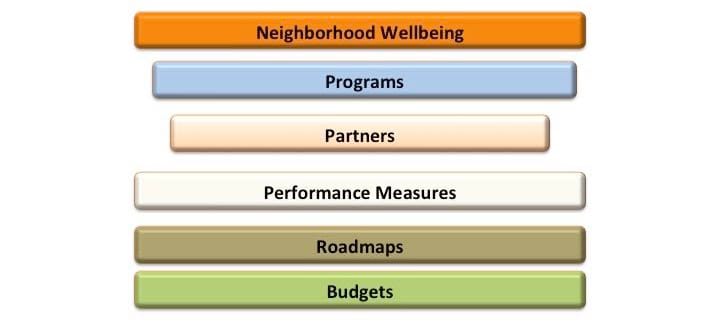
We can start building this architecture by looking at government from the community perspective: what do communities need to be strong not just what one particular agency does. The basic levels of that architecture would include:
- Neighborhood Wellbeing: How do we map and describe our neighborhoods? The picture includes crime, violence, poverty, employment, housing, hunger, schools, healthcare and “protective factors” such as strong community involvement.
- Programs: What works? What specifically reduces and prevents violence and crime, lowers incarceration, or improves relations between law enforcement and communities. What programs restore trust?
- Partners: Who is involved? Successful violence-prevention programs rely on the widest possible network of neighborhood-based groups.
- Performance Measures: What does success look like? Is crime going down? Are abuse and assaults decreasing? Are fewer people going into the criminal justice system and far more coming out? Have we stopped the school-to-prison pipeline and the foster care to jail pipeline?
- Roadmaps: Clear timelines with deliverables and interdependencies (such as training staff before starting a new program) must align all partners.
- Budgets: In aviation, to get funded, new programs must fit into the NextGen architecture.
A Social Architecture of Violence and Justice: Start Here
Government is a living system where safety and security, violence and justice, jobs, health care, schools, resources to build stronger neighborhoods, and the will to repair our environment are all connected.
The basic assumption of this short essay is that the failures of government in the United States have contributed to an epidemic of social violence. Problems cross agency and neighborhood boundaries and so must solutions.
We know what works. Good research shows us what programs truly impact crime and violence. The challenge is to bring agencies and neighborhoods together in a multi-dimensional framework that will focus efforts and deliver results beyond expectations.