 Shawn Griffiths

WASHINGTON, D.C. - A news item in recent days that was overshadowed in the media by SCOTUS and the One Big Beautiful Budget Bill was a U.S.-brokered peace agreement that was signed between Rwanda and the Democratic Republic of Congo (DRC) – which if it holds will end a conflict between the two countries that has killed thousands and displaced hundreds of thousands of people.
This agreement, along with the recent ceasefire between Iran and Israel, have led to an uptick in talk over the Nobel Peace Prize and if Trump has made his case for it and held up his campaign promise to be a “peacemaker and unifier.” While partisan-driven media spins this topic to fit a particular narrative, here is a breakdown of what has transpired.
First, Here’s What Happened with Rwanda and the DRC
Rwanda Foreign Minister Olivier Nduhungirehe and DRC Foreign Minister Thérèse Kayikwamba Wagner signed the peace agreement during a ceremony in the White House, finalizing negotiations that were facilitated by the Trump administration. Secretary of State Marco Rubio sat with the foreign ministers during the signing.
They later joined President Donald Trump and Vice President JD Vance in the Oval Office.
The current conflict between Rwanda and the DRC dates back to 2022 and erupted when Rwanda sent troops into Congo to aid the M23 rebel group, though it is worth noting that the geopolitics at the center of tensions between the two countries go back decades.
There are multiple factions and militias involved, including Rwanda and M23’s accusation that the DRC was working with the Democratic Forces for the Liberation of Rwanda – which took part in the 1994 Rwanda genocide. The UN has called the conflict “one of the most protracted, complex, serious humanitarian crises on Earth.”
The peace agreement brokered by the Trump administration is the third attempt at negotiations between Rwanda and the DRC, including a ceasefire agreement in August 2024 that was honored until fighting resumed in October. A critical part of the latest agreement is the re-implementation of the 2024 deal, which means:
- Rwanda to withdraw ~4,000 troops aiding M23 rebels within 90 days
- Hostilities to cease; both nations to halt support for armed factions.
- The creation of joint security coordination and reintegration programs for ex-combatants
Additionally, the deal adds a U.S.-backed mechanism that ensures monitoring, enforcement, and eventual Western investment tied to accessing critical minerals like cobalt, lithium, and copper -- minerals critical to tech manufacturing industries.
Trump’s strategy has been framed as a “deal-maker” approach. His administration helped facilitate a peace deal in exchange for U.S. access to mineral rights in the DRC. Further, the administration has promised increased investment into the region by the U.S. government and U.S. businesses.
This is largely seen as a way to counter China, which has expanded its influence in the region as the U.S. has lost much of its sway in recent decades.
Now, What About the Nobel Peace Prize?
The agreement between Rwanda and the DRC did not, on its own, bring up conversations about the Nobel Peace Prize and the Trump administration’s continued involvement and/or mediation in conflicts around the world, including between Israel and Iran and Pakistan and India.
Following the U.S.’s June 21 airstrikes on three Iranian nuclear facilities, Israel and Iran formally agreed to a ceasefire on June 24, ending – at least for now – an escalating exchange of attacks between the two countries that went on for about two weeks. The conflict was considered so severe that involvement was going to plunge the globe into a third world war.
However, very few people are talking about WWIII anymore.
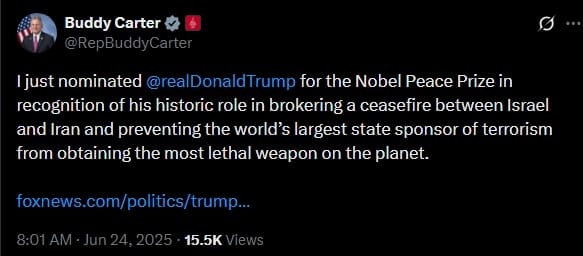
Republican U.S. Rep. Buddy Carter of Georgia soon after nominated Trump for the Nobel Peace Prize, citing “his historic role in brokering a ceasefire between Israel and Iran and preventing the world’s largest state sponsor of terrorism from obtaining the most lethal weapon on the planet.”
Pakistan also formally nominated Trump for the Peace Prize for the administration’s diplomatic outreach in its conflict with India.
“At a moment of heightened regional turbulence, President Trump demonstrated great strategic foresight and stellar statesmanship through robust diplomatic engagement with both Islamabad and New Delhi,” Pakistan’s government said in a statement.
While Pakistan officials condemned U.S. airstrikes in Iran, they have – as of now – not rescinded Trump’s Peace Prize nomination. Meanwhile, India has given a contradictory account of negotiations with Pakistan and says the White House played no role in mediation.
All of this happened before the Rwanda-DRC agreement, which is something that will no doubt be added to the conversation. African reporter Hariana Veras told Trump that if peace lasts, DRC President Felix Tshisekedi said he will nominate Trump for the Peace Prize.
Like with many topics, issues, and debates surrounding the Trump administration, this conversation has been divided into polarizing perspectives.
The Washington Post published an op-ed titled “Trump’s Nobel Peace prize odds are bombing” at the same time Newsweek published an op-ed titled “Trump's Chances of Winning Nobel Peace Prize Skyrocket.”
The dichotomy in the headlines alone shows how partisan-driven media has pushed narratives to the point of existing in two separate realities.
The Seattle Times published an op-ed titled, “Did Trump just earn the Nobel Peace Prize?” It says what the Trump administration “has done in the name of peace is masterful,” while former National Security Advisor John Bolton says Trump is only campaigning for the Peace Prize.
Other Presidents That Have Received The Nobel Peace Prize
If Trump receives the Nobel Peace Prize, he will be the fifth U.S. president in history to do so, and the fourth to receive it during their presidency (Jimmy Carter received the Nobel Peace Prize in 2002).
The Peace Prize was first awarded in 1901 to two people: Frédéric Passy of France, who founded the French Peace Society, and Henry Dunant of Switzerland, who founded the International Committee of the Red Cross (ICRC) and initiated the first Geneva Conventions.
Five years later, Theodore Roosevelt became the first U.S. president to receive it.
Theodore Roosevelt
- Year: 1906
- Contribution: For mediating the end of the Russo-Japanese War (Treaty of Portsmouth in September 1905).
- Also worth noting: He also supported international arbitration and helped resolve disputes between other nations.
Woodrow Wilson
- Year: 1919
- Contribution: For founding the League of Nations after World War I.
- Historical Note: The U.S. never joined the League. However, Wilson’s vision shaped the future of international diplomacy.
Jimmy Carter
- Year: 2002
- Contribution: Given for decades of peaceful conflict resolution, human rights work, and promotion of democracy through the Carter Center.
- Fun Fact: Only U.S. president to receive the Peace Prize after his presidency.
- Also Worth Noting: The Norwegian Nobel Committee cited his “untiring effort to find peaceful solutions to international conflicts.”
Barack Obama
- Year: 2009
- Stated Reason: For “extraordinary efforts to strengthen international diplomacy and cooperation between peoples.”
- Controversy: Obama’s Nobel Prize is considered one of the most controversial in history as it was awarded 9 months into his first term for promises and tone more than a specific achievement.
Former President Barack Obama’s Peace Prize remains a subject of controversy, and not just with Republicans, conservatives, and his political opponents. Whether they liked him or disliked him, many people believed Obama received it prematurely, even the man himself:
To be honest, I do not feel that I deserve to be in the company of so many of the transformative figures who have been honored by this prize, men and women who've inspired me and inspired the entire world through their courageous pursuit of peace.” - Barack Obama
It became even more controversial throughout his presidency with the escalation of the War in Afghanistan (sending an additional 30,000 troops) and an increase in drone strikes in Pakistan, Yemen, and Somalia that resulted in many civilian casualties.
Looking back, the debate around Obama’s Peace Prize and what it means for future laureates rests on two questions: Should the Peace Prize be awarded for intentions and inspirational leadership? Or should it be reserved for concrete, measurable outcomes?
What Now?
The latest Trump nominations for the Nobel Peace Prize will be considered by the Norwegian Nobel Committee in 2026. The deadline for 2025 nominations was January 31, 2025, and a shortlist of potential Peace Prize laureates was formed between February and March.
This means there is a lot of time to see how situations evolve in Israel, Iran, Rwanda, the DRC, India, and Pakistan and what more we learn about U.S. involvement in these areas. There are other regions that will likely be considered as well, like Gaza and Ukraine.
The critical thing that will make a case for Trump is if peace lasts in any of the regions where the administration has been involved, especially since the countries have long histories of conflict – whether it is Israel and Iran, Pakistan and India, or Rwanda and the DRC.
It will also be important for the U.S. to remain involved in the peace process in these countries.