Skip to content
Subscribe

Green-on-Blue Violence Rising in Afghanistan

Published:

Credit: CSmonitor.com
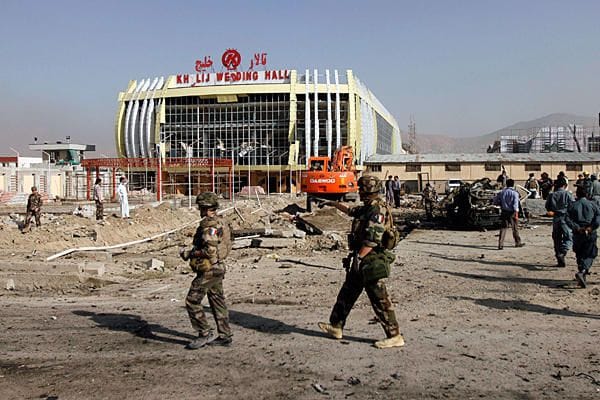
NATO forces targets of green-on-blue violence

Afghanistan is becoming an increasingly dangerous place for US and NATO forces due to green-on-blue violence. Green-on-blue violence includes attacks against coalition forces by Afghanistan police, the same police that coalition members are training.

These green-on-blue attacks have become more prevalent within the past two years, accounting for 16% of coalition casualties this year alone.

The centerpiece of coalition strategy today is training police forces to secure Afghanistan, as coalition forces withdraw from the region. Since President Obama announced his plan to withdraw surge forces, the frequency of these attacks has increased.

Naturally, a discussion centered on the motivations of green forces in these attacks has begun. The senior commander of coalition forces in Afghanistan, Gen. John Allen (USMC), has pointed to infiltration of Afghan security forces by Taliban operatives. He estimated that approximately 10 percent of green-on-blue attacks are made by Taliban members posing as Afghan security personnel.

The Long War Journal has compiled data on the location and frequency of green-on-blue attacks in Afghanistan. In 2012, 40 attacks have been carried out, up from 15 in all of 2011.

The most recent green-on-blue attacks occurred on Tuesday, when two members of NATO forces were killed by a man wearing an Afghan police uniform. The killer escaped and is presumed to be a Taliban member.

These attacks are contributing stress to already strained relationships between Kabul and western countries that have grown weary of the conflict in Afghanistan. For observers, a clear question arises surrounding the ability of Afghan forces to take over the security role that international troops have played for the past several years.

A complete transition will occur soon, with American troops likely to leave the area, and an Afghan election set for 2014. Members of the academic nation-building community point to the importance of consecutive, successful elections on the road to long-term stability.

What is equally important is a secure country where people are able to work without the fear of violence. For Afghanistan to be rebuilt well, Afghan police forces will need to be adequately trained and sufficiently competent to decrease green-on-blue violence and provide for the safety of the Afghan people.

Adhere to the IVN etiquette

By posting a comment, you agree to adhere to our etiquette rules: No partisan attacks, no personal attacks, substantiate your sources, no self-promotion.

Contact IVN

Questions about this article or our coverage? Send us a message. A free IVN member account is required.

Message sent

Thanks, we’ll review it and get back to you if needed.

Message not sent

Sorry, something went wrong. Please try again.

Sign in to send a message

Messages are tied to your IVN member account. Signing in is free and takes a few seconds.

Republish this article

Republishing guidelines

Republish IVN articles for free. Independent Voter News articles may be republished online or in print under a Creative Commons BY-NC-ND 4.0 license, on these terms:

  1. Credit the author and IVN. Keep the byline ("By Author Name, Independent Voter News") and the attribution note at the end, which links to the original.
  2. Keep the meaning. You may update time and place references and apply your house style. You may trim for length, as long as the cuts don't change the meaning or misrepresent the author. Keep the headline. Mark any additions as your own (for example "Additional reporting by ...").
  3. Translations are welcome. Translate faithfully, add "Translated from English by [your outlet]", and tell us at editor@ivn.us.
  4. Keep the links, including the link to the original article.
  5. Keep the tracking image. The HTML includes a 1-pixel image that counts readers on your page. It collects no personal information.
  6. Photos and illustrations. Images credited to IVN may be used with this article only. Images credited to others (AP, Getty, Unsplash, Wikimedia and so on) stay under their owners' terms. Secure the rights or switch "Include images" off.
  7. Don't sell it. You can't sell our articles or sell ads specifically against them. Your normal site advertising is fine.
  8. No implied endorsement. Don't suggest that IVN or the author endorses you, your candidates or your causes, or that donations to you support IVN.
  9. Keep labels. Opinion or analysis pieces keep that label.
  10. Point search engines to the original. Where your CMS allows, set the canonical URL to the original IVN article.
  11. No bulk or automated republishing, and don't submit our articles to aggregators (Apple News, Google News, MSN) as your own.
  12. Corrections and removals. Update your copy when we correct it, and remove it promptly if we ask. We'll contact you at the email you give us.
  13. Questions or print republication: editor@ivn.us.

IVN staff: fill in who you're inviting above, then create the invite.

Preparing the article

Green-on-Blue Violence Rising in Afghanistan

Choose a format
  • HTML
  • Email HTML
  • Markdown
  • Formatted (.docx)
  • Plain text
  • WordPress blocks
  • PDF
Choose a platform

Photos credited to others need their owners' permission.

To for

Republishing somewhere else? Questions? editor@ivn.us