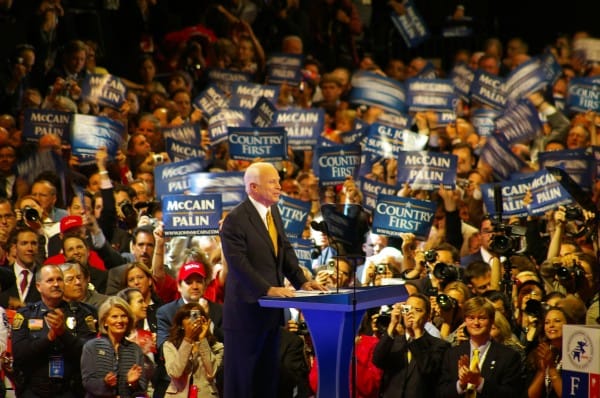
Sen. John McCain speaks at the 2008 Republican National Convention
With both the Democratic and Republican National Conventions taking place in the coming weeks, it begs the question, is it much ado about nothing? From an independent perspective, the partisan presidential conventions can seem like a gigantic echo chamber.
In fact, evidence shows majority of independents will not tune in to the events and will not pay attention to the campaign messages, because in general, they ignore those things.
“Independents were the least likely to watch the speeches in their entirety, a finding consistent with decades of research indicating that those without partisan affiliation are the least likely to pay attention to campaigns," writes researchers in a new study.
The study, Polls and Elections: The Conditional Effects of Competing Messages during Presidential Nominating Conventions, examines presidential conventions and their effect on the overall presidential race offers interesting insights on the influence of the touted events.
“Conventions appear to be times when the parties, through brute-force media saturation, maximize their roles as social-psychological group rallying points," writes researchers from University of Wisconsin—Milwaukee. "The easy accessibility of partisan affiliation during conventions allows partisanship an increased role in individual-level judgment of candidate traits.”
The effect of party conventions further drives a wedge between the political opinions of those engaged with the messages and political independents.
"As the convention atmosphere activates partisanship as a more salient decision basis, and as the convening party's dominance in the convention atmosphere sways political independents, we expect the opinions of opposition partisans to significantly separate from the opinion of independents and convening partisans." Credit: Tom Holbrook
The study shows a least a small advantage to the convention candidate scheduled to go first. This year the Republicans and Mitt Romney, as the presidential challenger, will host their national convention August 27-August 30.
The researchers found the tendency for the first convention candidate to fare better, linked to two things. First, the general public is not usually as informed about a presidential challenger compared to the sitting president. Although the total time allotted to the events has decreased in recent decades, national political conventions get a considerable amount of exposure on television. For many Americans, it might be the first time they actual pay attention to who Mitt Romney is and the messages of his campaign.
Another reason first convention candidates experience a bigger upside as a result of the conventions, concerns opinions.
"…even after holding opinion prior to convention B constant, we expect those who took in more information during convention A to hold opinions after convention B less favorable to convening candidate B," says the study.
This would predict those tuning in this year to both the Republican and Democratic National Conventions will hold a more positive view of Mitt Romney than of President Obama, a cause of formulating and holding opinions.
"Speeches by the candidates provide easily accessible avenues for members of the electorate to engage in political learning through direct observation and unmatched opportunities for candidates to make positive impressions on viewers."
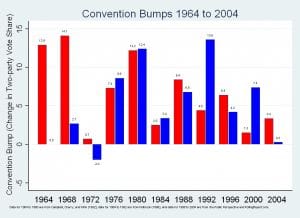
The coveted "convention bump" is also a source of discussion. Both conventions offer the chance to positively effect polling numbers for candidates, but for how long?
While evidence shows the existence of a "convention bump", it doesn't always give candidates enough to win the race entirely.
The Wall Street Journal recently examined the "convention bump", offering examples of recent candidates:
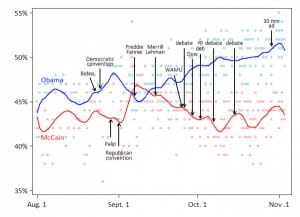
Going back all the way to 1964, nearly every party has gotten a lift from its pre-election powwow. And a few have given their candidates jolts that propelled them to victory in November: Ronald Reagan in 1980, and Bill Clinton in 1992 are the prime examples.But as Mr. McCain in 2008, or Al Gore in 2000, can attest, surges of post-convention support can quickly fade. Within barely a week of his bounce, Mr. McCain had sagged to second place and never retook the lead.
And then there are times when conventions provide very little positive influence on public opinion.
"John Kerry's minuscule bump in 2004 might be attributed to the fact that he announced his vice-presidential choice in early July rather than during the week prior to the convention (which is what most candidates do), or to the fact that the Swift Boat ads were on the air within days of the end of the convention," says Tom Holbrook, professor of political science at the University of Wisconsin-Milwaukee. Credit: The Monkey Cage
If recent history is any indication, the nastiest of campaign ads may be released just after the conventions in an effort to stunt any positive gains made by either candidate. The researchers found, however, during national conventions positive messaging is much more impactful compared to negative messaging. From previously announced schedules and speakers, both the Democrats and Republicans seem to be planning largely positive events. Both parties will showcase up-and-comer's like San Antonio Mayor Julian Castro on the Democrat's side.
After all, if 2004's Democratic convention was ineffective for Sen. John Kerry, it did also showcase a young senator from Illinois: Barack Obama.