Skip to content
Subscribe

Energy Policies Unlikely To Change Under Obama's Second Term

Published:

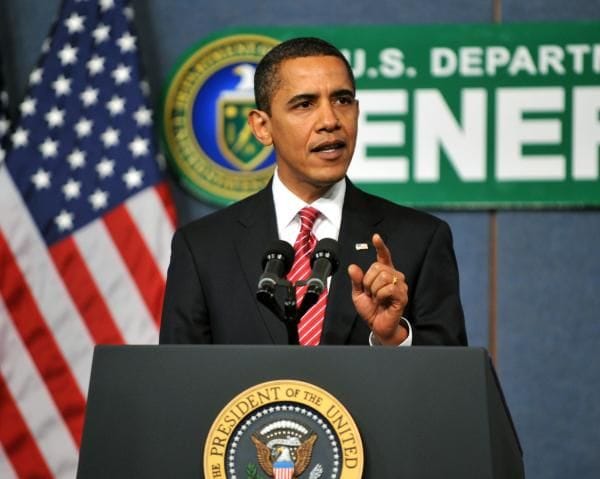
After the re-election of President Barack Obama, national energy policy will likely continue without drastic changes, but questions still loom on the future of energy policy in the United States. Will oil and coal companies be further strained by regulations? Will alternative energy companies have the means to displace reduced production of fossil fuels?

Stricter limitations on greenhouse gas emissions has been a high priority for the Environmental Protection Agency (EPA) and President Obama. Regulations have put the coal industry in a tough spot between production and compliance of federal regulations. Heritage Foundation's energy expert David Kreutzer said, "We'll see the continuation, and perhaps the acceleration, of anti-fossil fuels regulations."

President Obama's job security may give him more inclination to act on his energy policies. The administration is expected to renew renewable energy tax credits but not for fossil fuel producers. Politico reported the swiftness of action:

[The EPA] quickly sent proposed technical changes to its regulation governing mercury and air toxics pollution from power plants to the White House Office of Management and Budget for review the day after Obama won re-election.

Robert Murray, CEO of Murray Energy Corporation, announced a layoff of 160 workers in immediate reaction to the president's re-election. Murray responded with a 'prayer' where, in part, he said:

We are a Country in favor of redistribution, national weakness and reduced standard of living and lower and lower levels of personal freedom.

The Center for American Progress Fund estimates that $270 million was spent on the behalf of fossil fuel groups during the course of the election season. Murray Energy Corp. has put forward $1.4 million to Republican candidates since 2007.

The crude oil industry is anticipating President Obama's approval of the Keystone XL pipeline project. TransCanada, the administrator of the project, will build the pipeline from Alberta to the Gulf Coast. The pipeline is expected to flow 830,000 barrels of oil a day directly to the United States. Dan Kammen, an energy advisor to President Obama, stated:

It’s important for the U.S. government to look at the science behind the project and evaluate all the alternatives to enable a sustainable, low-carbon economy by 2050 and beyond.

President Obama's energy policies are not a complete win for environmentalists. Environmental activists from 350.org are scheduled to have a demonstration in Washington on November 18 to oppose the Keystone XL pipeline project. The Keystone XL pipeline is estimated to cost $5.3 to $7.6 billion.

Adhere to the IVN etiquette

By posting a comment, you agree to adhere to our etiquette rules: No partisan attacks, no personal attacks, substantiate your sources, no self-promotion.

Contact IVN

Questions about this article or our coverage? Send us a message. A free IVN member account is required.

Message sent

Thanks, we’ll review it and get back to you if needed.

Message not sent

Sorry, something went wrong. Please try again.

Sign in to send a message

Messages are tied to your IVN member account. Signing in is free and takes a few seconds.

Republish this article

Republishing guidelines

Republish IVN articles for free. Independent Voter News articles may be republished online or in print under a Creative Commons BY-NC-ND 4.0 license, on these terms:

  1. Credit the author and IVN. Keep the byline ("By Author Name, Independent Voter News") and the attribution note at the end, which links to the original.
  2. Keep the meaning. You may update time and place references and apply your house style. You may trim for length, as long as the cuts don't change the meaning or misrepresent the author. Keep the headline. Mark any additions as your own (for example "Additional reporting by ...").
  3. Translations are welcome. Translate faithfully, add "Translated from English by [your outlet]", and tell us at editor@ivn.us.
  4. Keep the links, including the link to the original article.
  5. Keep the tracking image. The HTML includes a 1-pixel image that counts readers on your page. It collects no personal information.
  6. Photos and illustrations. Images credited to IVN may be used with this article only. Images credited to others (AP, Getty, Unsplash, Wikimedia and so on) stay under their owners' terms. Secure the rights or switch "Include images" off.
  7. Don't sell it. You can't sell our articles or sell ads specifically against them. Your normal site advertising is fine.
  8. No implied endorsement. Don't suggest that IVN or the author endorses you, your candidates or your causes, or that donations to you support IVN.
  9. Keep labels. Opinion or analysis pieces keep that label.
  10. Point search engines to the original. Where your CMS allows, set the canonical URL to the original IVN article.
  11. No bulk or automated republishing, and don't submit our articles to aggregators (Apple News, Google News, MSN) as your own.
  12. Corrections and removals. Update your copy when we correct it, and remove it promptly if we ask. We'll contact you at the email you give us.
  13. Questions or print republication: editor@ivn.us.

IVN staff: fill in who you're inviting above, then create the invite.

Preparing the article

Energy Policies Unlikely To Change Under Obama's Second Term

Choose a format
  • HTML
  • Email HTML
  • Markdown
  • Formatted (.docx)
  • Plain text
  • WordPress blocks
  • PDF
Choose a platform

Photos credited to others need their owners' permission.

To for

Republishing somewhere else? Questions? editor@ivn.us