The Office of Civil Rights (OCR), a sub-division of the Department of Education, released a report last month titled "Helping to Ensure Equal Access to Education." The OCR is in charge of resolving disputes of discrimination within educational institutions. Its recent report spans from FY 2009 to FY 2012, covering four years of operation. While resolving more cases than in previous years, the OCR has also experienced a larger case load. Credit: ed.gov
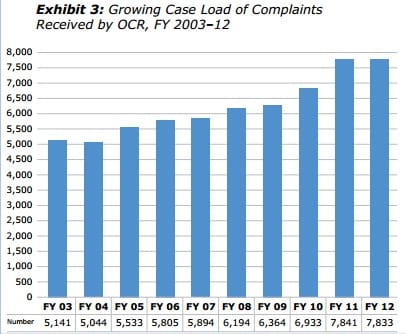
In the course of four years, the OCR has dealt with 28,971 cases of civil rights violation complaints. This constitutes a 24 percent increase from the last four year span. However, the OCR also states that it sports efficiency, having closed 28, 577 cases from FY 09 to FY 12. The report explains its process for case resolution:
"The OCR closes complaints through a number of means, including dismissal based on lack of jurisdiction, closure after the parties reach a mediated agreement through OCR’s Early Complaint Resolution process, or closure through a resolution agreement between the recipient and OCR, either before or after a finding of violation by OCR."
It's stated that the OCR revamped its ability to handle legal operations in 2009 by refining policy and employing nearly 600 legal personnel. Recent additions to resolving cases include, "collaborations with the institution in question to identify policies and procedures that need to be revised and training and orientation programs that need to be provided."
In 2009, the office also streamlined its data collection method with a comprehensive online tool, aptly named Civil Rights Data Collection (CRDC). The information gathered improves transparency by providing raw data that is publicly available. The footnote disclaimer states that CRDC data, "ultimately depends on accurate collection and reporting by the participating districts."
The rise in case load of complaints can be attributed to the development of CRDC and online reporting. The report shows, "Many complaints are filed electronically as opposed to in person—in FY 2012, for example, about 70 percent of complaints (about 5,530)." Instead of concluding more frequent violations, one could conclude that emphasis on technological tools produces easier reporting. This helps bring cases to light that would not have been reported otherwise.
Complaints can be filed through mail, e-mail, or online at the Department of Education website.
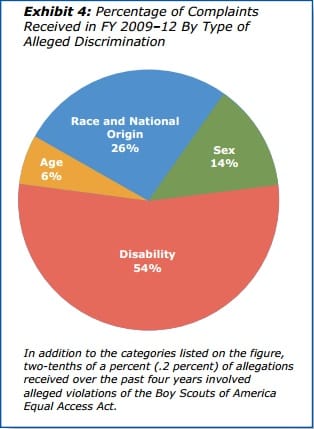
In the four year span of the report, complaint types fell into four main categories of discrimination: Disability, Ethnicity, Gender, and Age: Credit: ed.gov
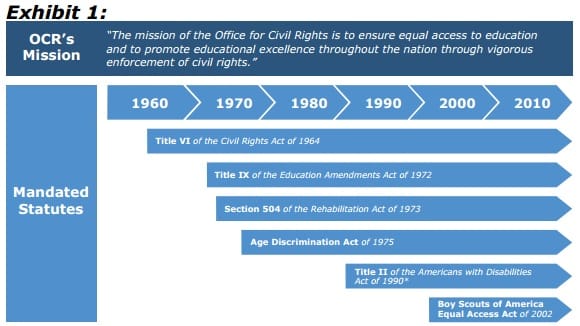
The OCR has assumed several responsibilities over the years. These are the statutes the office enforces and monitors: Credit: ed.gov
The Office of Civil Rights cannot resolve every act of discrimination that occurs in educational facilities. However, from its report, significant progress seems to have been made. By incorporating technology into the process of filing civil rights complaints, the federal government saw an increase in overall reports and resolved most cases.