San Diego, CALIF. - Arguably, the most intensely contested and important measures to go before the voters of the City of San Diego on November 8 are C and D.
Unless you’ve been living under a rock, you’ve gotten the gist of what these two important civic decisions entail. Measure C would create a convadium in the East Village of downtown and create a joint powers authority for tourism. Measure D is a tourism reform plan that would invest in the City’s infrastructure and help with police, fire, and other city services. It also reimagines Mission Valley, adding higher education and parkland expansion where Qualcomm Stadium currently sits.
Beyond these general concepts, there are critical differences that voters should understand before going to the ballot box. Here is a quick breakdown of the fine print.
Key Terms
TOT – Transient Occupancy Tax. More commonly referred to as “hotel room tax.” The City of San Diego currently taxes tourists 10.5% of their lodging costs. C and D want to raise the TOT, but they have different rates and different plans for where the money will go.
TMD - Tourism Marketing District. Tourists are currently taxed an additional 2% by the hotel-created TMD. TMD funds are used strictly by the hotels and go towards marketing efforts, tourism promotion activities, and special events and programs. C and D would both eliminate the TMD.
Key Differences Between C and D
What would the TOT become?
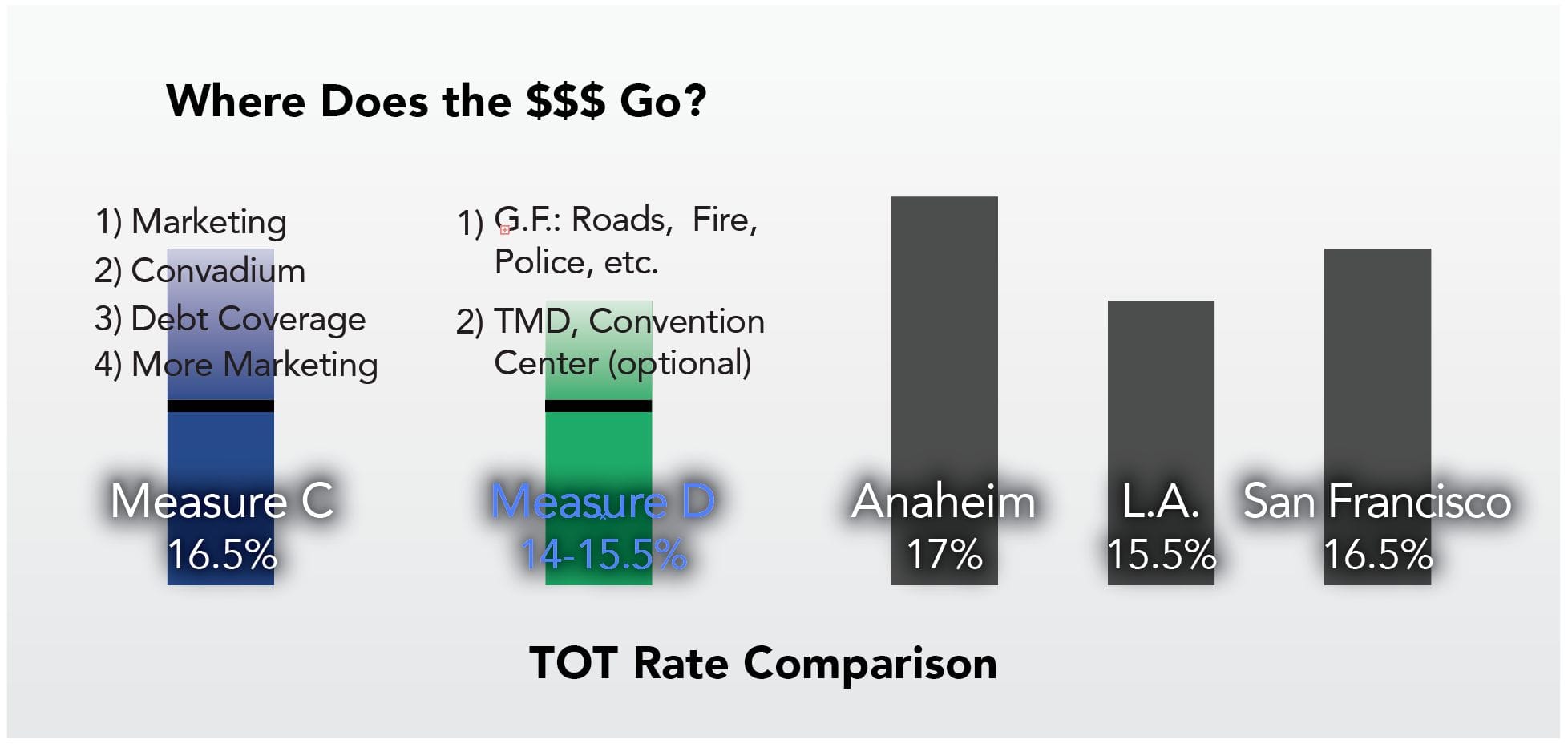
Measure C: 16.5%
Measure D: 14% or 15.5%. Bigger hotels get the bigger tax. Hotels with less than 30 rooms pay 14%. Note: 15.5% was the hoteliers own figure they wanted to pass four years ago.
What would replace the Tourism Marketing District?
Measure C: Eliminates the TMD and promises 1% of the TOT collections + any money left over to be used for the marketing and tourism of San Diego in a new Joint Powers Authority.
Measure D: Eliminates the TMD and gives hotels the option to retain up to 2% of the TOT for tourism marketing purposes. Additionally, Measure D gives hotels the option to deduct another 2% to construct a non-contiguous convention center expansion.
Where would the money go?
Measure C: The bulk of the revenue would be used to finance the construction of a joint stadium and convention center (“convadium”) in San Diego’s East Village downtown. Some would also be directed towards tourism and marketing, and some would be used for the City of San Diego’s debt coverage.
Measure D: All dollars go directly into the General Fund. The City could use the money for general governmental purposes (e.g., roads, parks, fire, police, etc.). The hoteliers could also deduct a portion.
What is not allowed?
Measure C: No contiguous expansion of the Convention Center.
Measure D: No contiguous expansion of the Convention Center.
D bans the use of public money for a downtown stadium without having a public vote.
What About Mission Valley?
Measure C: Mission Valley is not contemplated under the Chargers’ Initiative.
Measure D: Measure D authorizes the City of San Diego to sell the land to San Diego State University, UC San Diego, a local community college, and/or the San Diego River Conservancy. Measure D authorizes protection of the park land and a 40,000 seat stadium for the Aztecs and MLS Soccer uses.
What happens if both C and D are passed?
The one with the more votes will override the other. Measure C requires a 2/3 vote to be passed and Measure D requires 50% of votes. If C and D both fulfill their criteria, the one with more votes will be implemented.
What happens if neither C nor D is passed?
Nothing changes.