 Shawn Griffiths
On Wednesday, CBS News published an article titled, “Alaska's top 4 primary means a felon and 2 candidates with the same name will be on November ballot.” It’s a provocative headline that sounds like it’s for an op-ed piece. But it isn’t. It is written like a news piece.
It also comes at the same time President Donald Trump is criticizing ranked choice voting in Alaska and a second repeal campaign is underway to undo the election reforms approved by voters in 2020.
Does this mean there is a connection between Trump’s position and CBS’s choice in headlines? Not necessarily. The CBS headline isn’t technically wrong about the outcome.
There are two Dan Sullivans in the US Senate race, including a Daniel J. Sullivan who Republicans accuse of being a Democratic plant, and a convicted felon in the at-large US House election.
Alaska's nonpartisan primary advances the four candidates who receive the most votes, regardless of party, which means multiple Republicans, multiple Democrats, or candidates with no party affiliation can all advance together.
But there is an important distinction between who is allowed to run and who advances from the primary. And this distinction is getting lost as a result of a narrative that blames nonpartisan primaries and ranked choice voting for the particular oddities in this year’s elections in Alaska.
President Trump, who has endorsed repeal in Alaska, attacked ranked choice voting again Wednesday while discussing the Senate race. He called it a “crooked form of voting” and “totally dishonest.”
Trump then offered a description bearing little resemblance to how ranked choice voting actually works: “They throw everybody into a hat and somebody backstage that nobody knows picks a winner.”
Earlier this year, he called the voting reform “disastrous, and very fraudulent.”
Against that backdrop, a national headline suggesting Alaska's Top Four system “means” voters are getting a felon and two Dan Sullivans risks reinforcing the same narrative: Look at these bizarre candidates. Look at this bizarre election system.
Except the “bizarre” candidates aren't a product of ranked choice voting. Notably, when CBS News published the article, it had a headline that said "ranked-choice voting," not "top 4 primary."
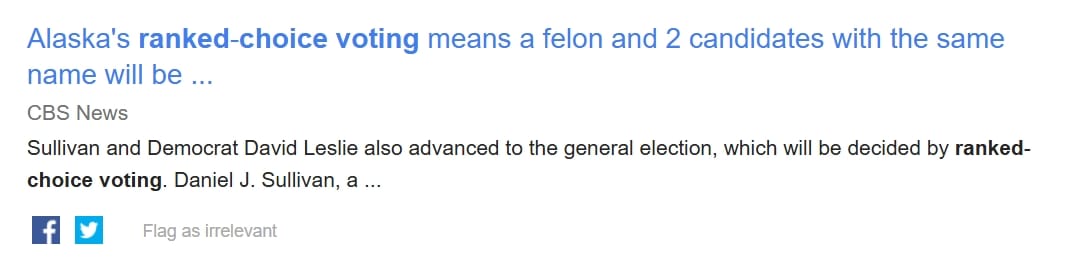
The story was then updated.
Ranked choice voting (RCV) is not used in Alaska's nonpartisan primary. All voters and candidates participate on a single ballot. Voters choose one candidate. The four candidates who receive the most votes advance.
RCV comes afterward, in November. Voters may rank the four candidates in order of preference. If no one receives a majority of first-choice selections, the candidate in last place is eliminated and their voters’ next choices are transferred accordingly.
This process continues until one candidate has a majority. Since there are 4 candidates, this means at most two rounds of elimination.
RCV has nothing to do with candidate eligibility. And when it comes to the specific things that the CBS News headline points at (a felon, same names), neither does the type of primary system used.
For example, Democratic US House candidate Eric Hafner is currently serving a 20-year federal prison sentence in New York. His felony conviction is eye-catching. But the Constitution establishes only three qualifications for the House:
- A representative must be at least 25,
- A US citizen for 7 years; and
- An inhabitant of the state in which they are running when elected.
Neither federal nor state law explicitly states that felons are not allowed to run for Congress or any federal office (e.g. we have a president convicted of felonies). In fact, when it comes to Hafner, the more significant constitutional question is his residency, not his conviction.
What primary system Alaska has or the voting method it uses in the general election doesn’t change any of this.
Hafner could have sought a party nomination under Alaska's previous system. Before Top Four, Alaska also allowed candidates who were not party nominees to qualify directly for the general election through nominating petitions.
For statewide federal office, that required signatures equal to 1% of the voters who participated in the preceding general election.
Two Dan Sullivans Aren't a Top Four Invention Either
Then there is Republican Sen. Dan Sullivan and challenger Daniel J. Sullivan (also a Republican). The state initially attempted to disqualify the latter Sullivan after concluding his candidacy was intended to confuse voters. But the courts disagreed.
The Alaska Supreme Court ordered the state to put him on the ballot, upholding a lower-court finding that election officials could not create an additional “good faith” qualification that wasn't found in the Constitution, state law, or election regulations.
That is a candidate-qualification issue, not an election-system issue.
Under Alaska's old partisan election system, two people named Dan Sullivan could have run against each other in a Republican primary. Or, the second Sullivan could have qualified directly for the general election through the state’s petition process.
Top Four changes how they advance. Ultimately, it is not the parties that decide. It is the voters. Every voter is guaranteed the right to vote in the primary, including the state’s independent majority (63% of the electorate).
And they can choose anyone they want on the ballot. They can vote for a Republican in the US House race and a Democrat or independent or third-party candidate for US Senate. They are free to make those types of choices.
This is the issue being overlooked by the press.
The Press Isn’t Talking About the Real Voting Rights Issue at Stake
The bizarre-candidate storyline obscures what Alaska's nonpartisan primary actually changed.
Before 2022, Alaska used separate party ballots under a closed system, which restricted independent voter access. A majority of voters didn’t have the freedom to participate or have the choices they do today.
And their right to vote in these taxpayer-funded elections was not guaranteed. One party allowed it. The other didn’t. And for the parties that did allow it, voters could only choose from candidates of that party in every single contest.
That is the difference between a nonpartisan voter-nominated system and a partisan primary system. The first is founded on the principle that the right to vote derives from citizenship. The latter requires voters to first pick a party in order to have a meaningful say in elections.
In other words, if Ballot Measure 2 passes in November, 63% of registered voters officially listed as undeclared or nonpartisan will no longer be guaranteed the right to vote in elections they fund.
That should be the headline story.