

There are 164 statewide ballot measures in 2026. According to Ballotpedia, campaigns for and against them have raised more than $1.2 billion, which is closing in on the $1.33 billion raised during the entire 2024 presidential election cycle.
And one state accounts for the overwhelming majority of the money.
California Dominates the Spending
The money flowed in California this election cycle. According to Ballotpedia’s data, ballot measure campaigns in the state raised $798.9 million. This accounts for more than two-thirds of the national total.
It is also a new state record, surpassing the $763.7 million raised in 2020.
The two most expensive campaigns are:
- Proposition 40, which would impose a one-time 5% wealth tax that the ballot measure says will fund health care, food assistance, and education. It has attracted $173.7 million total. Opponents have raised $140.5 million, more than four times the $33.2 million raised by supporters.
- Proposition 42, which would prohibit certain new and retroactive taxes on personal assets, savings, and retirement holdings. It is essentially a counter to Prop 40 and has attracted another $172.7 million.
Notably, Google co-founder Sergey Brin contributed $102 million to the campaign opposing Proposition 40 and supporting Proposition 42.
Ballotpedia also reports that the Service Employees International Union–United Healthcare Workers West contributed $32 million to the opposite sides of those campaigns.
Outside California, Virginia ranks second with $107.6 million raised, followed by Missouri ($67.9 million), Colorado ($43.1 million), and Kansas ($29.4 million).
The Price of Getting on the Ballot Has Never Been Higher
The biggest takeaway from Ballotpedia's analysis for grassroots reform organizations isn’t the money spent persuading voters. It’s the money spent simply qualifying for the ballot.
A cost that is getting steeper each election cycle.
According to Ballotpedia, initiative campaigns spent a record $193.4 million on signature gathering in 2026, surpassing the previous record of $172.2 million in 2024.
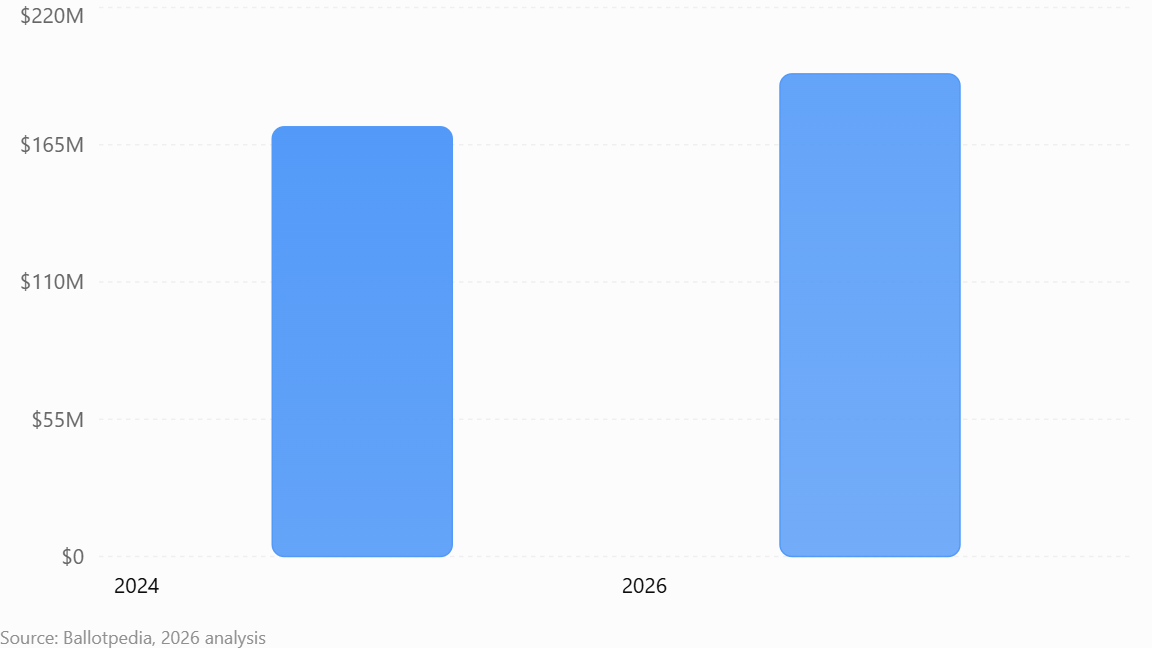
On average, a successful petition drive cost $4.3 million compared to $3.25 million in 2024.
Once again California is a standout. Statewide campaigns spent $152.7 million collecting signatures, which is nearly 79% of the national total.
This highlights a growing challenge for political and election reform advocates without wealthy donors. Even when voters have the power to change laws directly, exercising that power requires millions of dollars before a single ballot is cast.
This is a reality that could prevent potential donors from committing before a campaign gets off the ground. It's a lot of money to gamble on something that could ultimately fail.
There are some exceptions. Ballotpedia identified five initiatives that qualified through volunteer signature-gathering efforts without reported petition-drive costs.
Still, the broader trend points to an uncomfortable reality about direct democracy in the US:
While the citizen initiative process was intended to give ordinary voters a way to drive policy change, getting an issue on the ballot is increasingly dependent on who can afford the small fortune needed to finance the effort.
And these aren’t even the final numbers for 2026.