Skip to content
Sign up free
Open Primaries

Oklahoma Supreme Court Grills Secretary of State over Rejected Top Two Signatures

Oklahoma Supreme Court Grills Secretary of State over Rejected Top Two Signatures
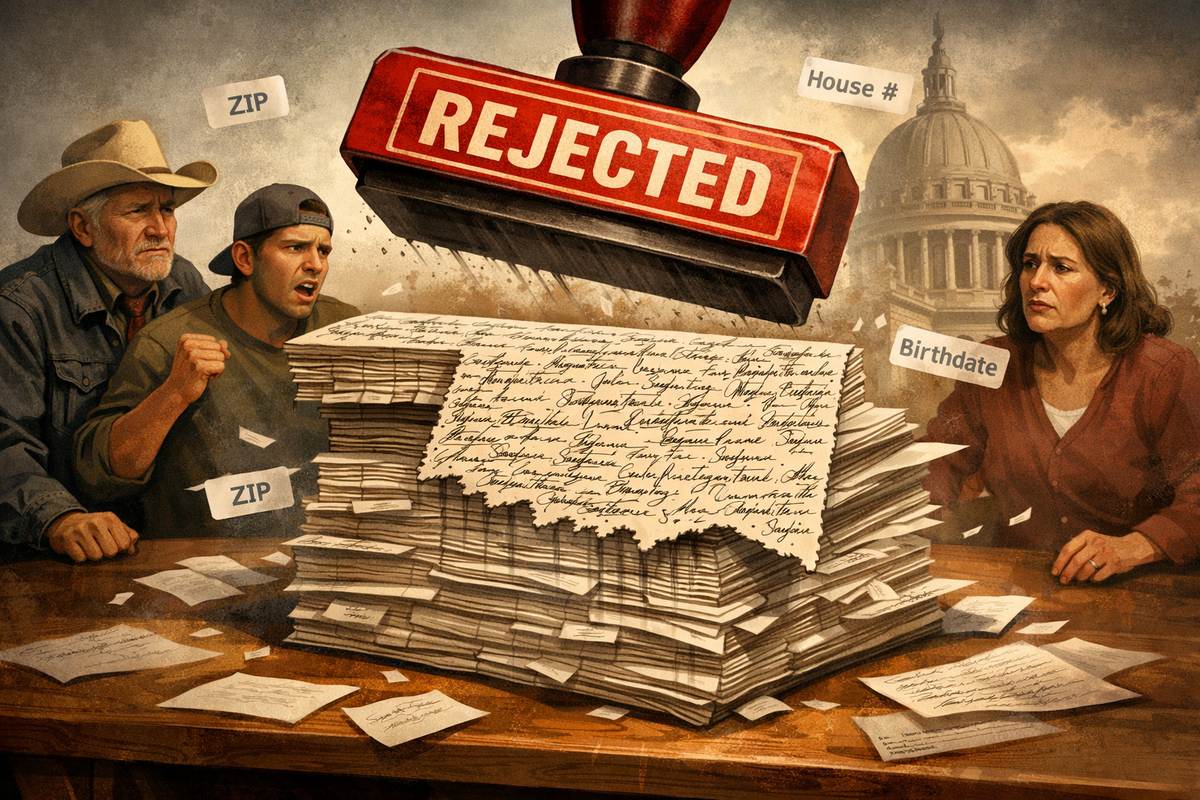
Image Credit: Mykhailo Polenok on Alamy. License obtained and used exclusively by IVN Editor Shawn Griffiths.

The court wanted to know why Secretary of State Benjamin M. Lepak did not explain why he rejected nearly 58,000 signatures in support of nonpartisan open primaries.

By Shawn Griffiths

2-minute read

There is a statewide measure to adopt a nonpartisan Top Two open primary in Massachusetts. However, it wasn't the only one that tried to get on the ballot.

In Oklahoma, SQ 836 proposed a similar system in which all voters and candidates participate on a single primary ballot and the top two vote-getters advance to the general election.

If approved by voters, it would replace a partisan primary system that was completely closed to independent voters in the 2026 cycle because the parties decided to lock them out.

However, Oklahoma Secretary of State Benjamin M. Lepak rejected nearly 58,000 petition signatures, which kept SQ 836 off the November ballot.

The campaign behind the proposal says Lepak refused to be transparent about why so many signatures were rejected and proponents filed suit.

Did New Petition Rules Kill Oklahoma’s Open Primaries Initiative?
Last week, the Oklahoma campaign to put a nonpartisan all-voter and all-candidate nonpartisan primary initiative on the ballot was informed that it did not collect enough signatures to be certified. This means state voters won’t get a say on the matter in 2026.

The Oklahoma Supreme Court heard oral arguments in the case Monday, in which the justices asked Lepak why he didn't give SQ 836 proponents the information they requested.

Oklahoma Voice reports:

“'I always didn’t like it when my math teacher told me I had to show my work,' Kuehn said. 'I just wanted to write the answer, and you had to take me for my word that I knew how to do the math. So why don’t you all want to show your work? Can you show your work?'

"Cedric Bond, an attorney representing Lepak, said the office does not object to providing a report of which specific signatures were rejected if the court orders it, nor does it object to allowing the proponents to review individual signature data.

"He said some older artificial intelligence technology was used to help verify signatures, but the process had human oversight at 'every step of the way' and still couldn’t match 57,841 signature lines with 80% confidence."

The campaign for SQ 836 submitted 209,616 petitions to advance its initiative. It needed 172,993 to be verified. Lepak rejected 29% of the signatures gathered.

“If it were 5%, we probably wouldn’t be here," said Frederic Dorwart, an attorney for the plaintiffs.

“If it were 5%, we would probably live with the result. But it was 29%, and that is an implausible number to think that those 57,841 people were not legal voters when they signed that petition.”

Follow IVN for more updates on this story.

From IVN’s live election coverage.

Adhere to the IVN etiquette

By posting a comment, you agree to adhere to our etiquette rules: No partisan attacks, no personal attacks, substantiate your sources, no self-promotion.

Get IVN’s Free Weekly Newsletter:Get IVN’s Free Newsletter

Get IVN’s Free Weekly Newsletter:Get IVN’s Free Newsletter

Nonpartisan Issues. Diverse Perspectives.

Check your inbox and click the link to confirm.

Republish this article

Republishing guidelines

Republish IVN articles for free. Independent Voter News articles may be republished online or in print under a Creative Commons BY-NC-ND 4.0 license, on these terms:

  1. Credit the author and IVN. Keep the byline ("By Author Name, Independent Voter News") and the attribution note at the end, which links to the original.
  2. Keep the meaning. You may update time and place references and apply your house style. You may trim for length, as long as the cuts don't change the meaning or misrepresent the author. Keep the headline. Mark any additions as your own (for example "Additional reporting by ...").
  3. Translations are welcome. Translate faithfully, add "Translated from English by [your outlet]", and tell us at editor@ivn.us.
  4. Keep the links, including the link to the original article.
  5. Keep the tracking image. The HTML includes a 1-pixel image that counts readers on your page. It collects no personal information.
  6. Photos and illustrations. Images credited to IVN may be used with this article only. Images credited to others (AP, Getty, Unsplash, Wikimedia and so on) stay under their owners' terms. Secure the rights or switch "Include images" off.
  7. Don't sell it. You can't sell our articles or sell ads specifically against them. Your normal site advertising is fine.
  8. No implied endorsement. Don't suggest that IVN or the author endorses you, your candidates or your causes, or that donations to you support IVN.
  9. Keep labels. Opinion or analysis pieces keep that label.
  10. Point search engines to the original. Set the canonical URL of your copy to the original IVN article (the HTML we give you includes the tag).
  11. No bulk or automated republishing, and don't submit our articles to aggregators (Apple News, Google News, MSN) as your own.
  12. Corrections and removals. Update your copy when we correct it, and remove it promptly if we ask. We'll contact you at the email you give us.
  13. Questions or print republication: editor@ivn.us.

IVN staff: fill in who you're inviting above, then create the invite.

Preparing the article

Oklahoma Supreme Court Grills Secretary of State over Rejected Top Two Signatures

Choose a format
  • HTML
  • Email HTML
  • Markdown
  • Formatted (.docx)
  • Plain text
  • WordPress blocks
  • PDF
Choose a platform

Photos credited to others need their owners' permission.

To for

Republishing somewhere else? Questions? editor@ivn.us