Skip to content
Subscribe

Corporate Political Spending Report Could Signal New Trend

Published:

source: Center for Political Accountability
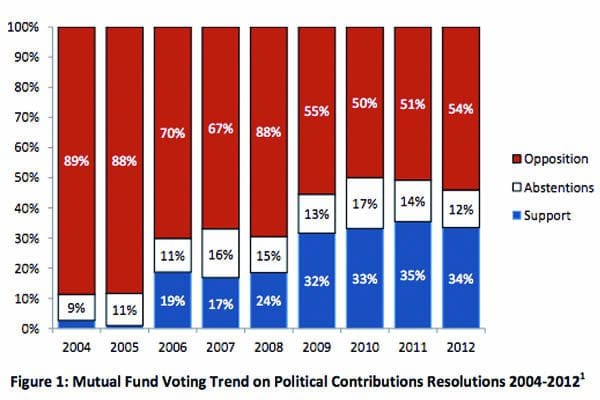
The Center for Political Accountability analyzed a study this month revealing a slight decrease in shareholder support for greater transparency regarding corporate political spending. Though support remains just below the all time high of 35 percent, the slight trend reversal could signal a shift in the near decade-long trend.

The study tracks 40 of the largest mutual funds in the United States and their proxy voting record on disclosure regulations for corporate political contributions. When considered as one, the funds represent about $2.7 trillion in securities. When the Center for Political Accountability began looking at this data nine years ago, support for greater disclosure requirements was almost nonexistent amongst big financial names like Morgan Stanley, Wells Fargo, and TIAA-CREF. Of these big names, votes in favor of greater transparency has risen to 88 percent, 82 percent, and 38 percent, respectively. However, the majority of mutual fund families, 54 percent do not favor greater disclosure practices for their companies.
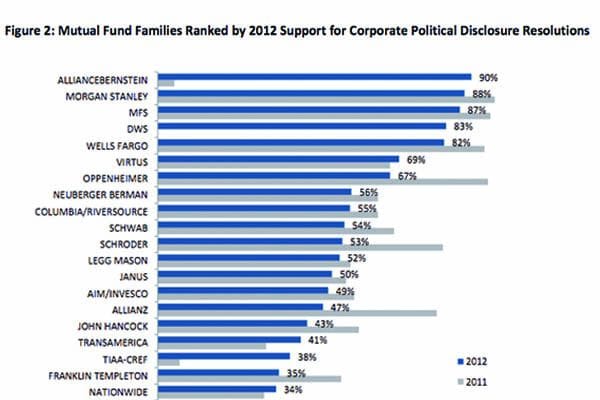
These CPA-modeled resolutions would require corporations to update shareholders semiannually on any new policy resulting in various forms of political spending. This includes monetary and non-monetary contributions given to a candidate or organization intended to “influence the general public, or segments thereof, with respect to elections or referenda.” If such resolutions were adopted they would contain: an itemized listing with the identities of those receiving the contributions, the amount given, and the individual or individuals responsible for the decision.

After reaching a low of 1 percent in 2005, overall support for greater disclosure of corporate political spending increased annually until 2011, dropping one percent this year to 34 percent.

The slight drop compared to last year could be a reaction to greater public scrutiny of corporate campaign contributions, given this year’s record-setting spending. The larger, 9-year trend towards greater transparency is epitomized in TIAA-CREF’s voter guidelines cited in the study:

“Without effective oversight, excessive or poorly managed corporate political spending may pose risks to shareholders, including the risk that corporate political spending may benefit political insiders at the expense of shareholder interests. Given increased public scrutiny of corporate political activities, we believe it is the responsibility of company boards to review and disclose the use of corporate assets to influence the outcomes of elections.”

It’s difficult to tell if the 9-year trend will continue, or if 2012 represents the beginning of a downward spiral for corporate support for transparency in election spending. The one percent dip in 2012 is indicative of receding support from most mutual fund families. However, the 2008 report showed a spike after a two percent drop the year prior.

Looking past the data, many corporations have exhibited sensitivity to the issue of corporate influence in politics. As popular support builds for increased transparency in election donations shareholders seem to be asking similar questions of their board members as well.

Adhere to the IVN etiquette

By posting a comment, you agree to adhere to our etiquette rules: No partisan attacks, no personal attacks, substantiate your sources, no self-promotion.

Contact IVN

Questions about this article or our coverage? Send us a message. A free IVN member account is required.

Message sent

Thanks, we’ll review it and get back to you if needed.

Message not sent

Sorry, something went wrong. Please try again.

Sign in to send a message

Messages are tied to your IVN member account. Signing in is free and takes a few seconds.

Republish this article

Republishing guidelines

Republish IVN articles for free. Independent Voter News articles may be republished online or in print under a Creative Commons BY-NC-ND 4.0 license, on these terms:

  1. Credit the author and IVN. Keep the byline ("By Author Name, Independent Voter News") and the attribution note at the end, which links to the original.
  2. Keep the meaning. You may update time and place references and apply your house style. You may trim for length, as long as the cuts don't change the meaning or misrepresent the author. Keep the headline. Mark any additions as your own (for example "Additional reporting by ...").
  3. Translations are welcome. Translate faithfully, add "Translated from English by [your outlet]", and tell us at editor@ivn.us.
  4. Keep the links, including the link to the original article.
  5. Keep the tracking image. The HTML includes a 1-pixel image that counts readers on your page. It collects no personal information.
  6. Photos and illustrations. Images credited to IVN may be used with this article only. Images credited to others (AP, Getty, Unsplash, Wikimedia and so on) stay under their owners' terms. Secure the rights or switch "Include images" off.
  7. Don't sell it. You can't sell our articles or sell ads specifically against them. Your normal site advertising is fine.
  8. No implied endorsement. Don't suggest that IVN or the author endorses you, your candidates or your causes, or that donations to you support IVN.
  9. Keep labels. Opinion or analysis pieces keep that label.
  10. Point search engines to the original. Where your CMS allows, set the canonical URL to the original IVN article.
  11. No bulk or automated republishing, and don't submit our articles to aggregators (Apple News, Google News, MSN) as your own.
  12. Corrections and removals. Update your copy when we correct it, and remove it promptly if we ask. We'll contact you at the email you give us.
  13. Questions or print republication: editor@ivn.us.

IVN staff: fill in who you're inviting above, then create the invite.

Preparing the article

Corporate Political Spending Report Could Signal New Trend

Choose a format
  • HTML
  • Email HTML
  • Markdown
  • Formatted (.docx)
  • Plain text
  • WordPress blocks
  • PDF
Choose a platform

Photos credited to others need their owners' permission.

To for

Republishing somewhere else? Questions? editor@ivn.us