Sacramento News & Review, October 17 – A growing body of 21st-century philsophical thought recognizes that the 98 episodes of Gilligan’s Island ask and answer all the Big Questions.
So, amid this recent flurry of mouth-frothing and hand-wringing over debt, it should be no surprise The Skipper and Mary Ann slice straight to the bottom line.
“Neither a borrower nor a lender be. Do not forget: Stay out of debt!” sings The Skipper’s Polonius to Mary Ann’s gender-bending Laertes in the castaways’ musical version of Hamlet.
http://www.youtube.com/watch?v=bXId5jOTxdg
What more need be said? Bill Shakespeare’s lines, set to Georges Bizet’s “Toreador Song,” tag every base—in a profoundly allegretto kind of way. Given the number of simpleminded folk involved in D.C. politics, The Skipper’s straightforward admonishment seems like it would be, well, simple to comprehend.
Nope.
Even Thurston Howell III’s fortune doesn’t come close to the $16.7 trillion limit on debt federal politicians have imposed on themselves. While such self-restraint is certainly commendable—the ceiling has only been raised 78 times since 1960—$16.7 trillion still constitutes seriously major debt.
If The Skipper were here, he’d be pissed off—a reaction he would share with scads of other Americans. Pissed off not only at the fiscal excesses needed to create a $16.7 trillion ocean of red ink, but also at the irresponsibility of elected officials not getting their gripes off their collective chests and then getting over themselves and getting on with cobbling together some face-saving compromise that gets the J-O-B done.
“Rational people would have solved this problem before now,” California’s treasurer,Bill Lockyer tellsSN&R. “Slightly more rational people would solve it before the deadline.”
Lockyer is the statewide office holder whose principal job is managing the Golden State’s debt, which stands at about $130 billion. For a refreshingly rational contrast to D.C.’s scapegoating and tinny schoolyard threats, read Lockyer’s recent “Debt Affordability Report.” (At least the cover letter.)
The between-the-lines vibe of the 30-page opus thrums with responsibility and maturity and their inevitable love child, collaboration. Skipper-simple: California gets debt.
Next to the feds, California is a piker when it comes to running up its credit card. A little less than 7.7 percent of the state’s $100 billion general fund pays the annual interest on California’s outstanding debt, which primarily comes from the sale of bonds to build or repair highways and other important public structures, expand transit and preserve wild spaces.
Lockyer has taken advantage of bargain-basement interest rates to refinance some of the state’s nut, lowering those annual payments and freeing up more money for other smart investments, like a kick-ass public-education system.
Gov. Jerry Brown is battering down what he calls California’s “Wall of Debt,” a series of loans, payment deferrals and cheesy fiscal sleights of hand that in 2011, totaled $34.7 billion. With the support of the Legislature, Brown has chipped away at the wall, knocking it down to $24 billion by next July. The plan is to shrink the balance to $4.7 billion by mid-2017.
Not exactly headline-grabbing, go-viral stuff. But it’s the kind of conscientiousness taxpayers should prize if only because, at a minimum, it saves money.
Predictions as recently as two years ago said California’s annual debt payment would be 10 percent of the general fund. Lockyer’s refinancing reduced that number. So did the governor and Legislature’s responsible behavior, which led the folks who rate the risk of investing in debt to proclaim California way less of a crapshoot than before. Elected officials acting like grown-ups saved more than $2 billion—without breaking a sweat.
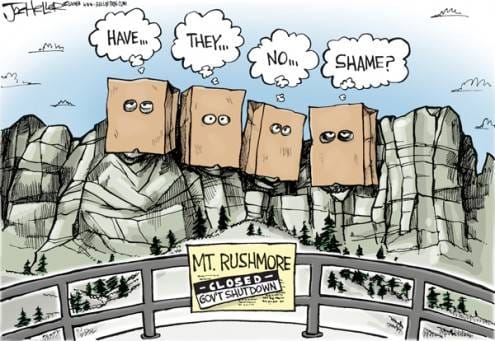
It means one thing—and one thing only—when the D.C. knuckleheads shutter the government they’re supposed to be operating more efficiently, imperil the value of the dollar and risk the timely issuance of safety-net checks to millions of needy Americans just to boost the audience forced to hear their impotent whining about a law that’s already taken effect: They aren’t listening to The Skipper like his little buddy California is.
This article was originally published by California's Capitol on October 17, 2013.