Skip to content
Subscribe

CBO: Post Ruling, Health Care Reform Still Reduces Deficit

Published:

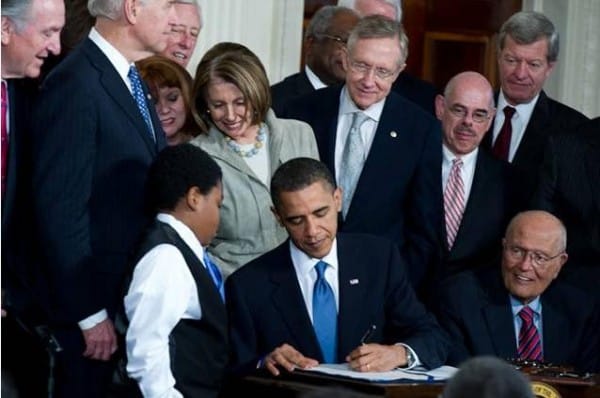
President Obama signs the Affordable Care Act in 2009. Credit: reid.senate.gov
health-care-reform

The Affordable Care Act, as upheld by a June Supreme Court decision, will cost $84 billion less than expected due to Medicaid opt-outs, according to the Congressional Budget Office. A recent analysis by the non-partisan CBO found the health care reform law will reduce the national deficit in light of decreased costs.

On the same hand, 3 million fewer people will gain coverage under the Medicaid expansion due to various states opting out of the program.

"For the average person who does not enroll in Medicaid as a result of the Court’s decision and becomes uninsured, federal spending will decline by roughly an estimated $6,000 in 2022," says the CBO report.

This analysis is in review of previous CBO estimates made earlier this year. The reduction in costs totals $84 billion over an 11-year period from 2012 to 2022.

"That reduction occurs mostly because federal spending during that period for Medicaid and CHIP is now projected to be $289 billion less than previously expected, whereas the estimated costs of tax credits and other subsidies for the purchase of health insurance through the exchanges (and related spending) have risen by $210 billion."

Given the revised calculations, the CBO maintains the Affordable Care Act would "on net, reduce deficits." The office found no revision of this estimate necessary following the Supreme Court decision, even with Medicaid opt-outs. CBO analysis has always estimated the health care law would reduce federal deficits.

A repeal of the health care law, on the other hand, was found to increase federal budget deficits by $109 billion from 2013 to 2022.

This finding is undoubtedly a blow to Republican arguments for repealing the Affordable Care Act on the ground that it will negatively effect what is viewed as out-of-control federal deficit spending.

Despite an increase in savings and a positive effect on the national deficit, states forgoing Medicaid expansion will miss out on cutting down mortality levels of low-income Americans.

The New England Journal of Medicine published a study yesterday linking Medicaid expansion to significantly fewer deaths.

"State Medicaid expansions to cover low-income adults were significantly associated with reduced mortality as well as improved coverage, access to care, and self-reported health," says the report.

Medicaid expansion estimates put deaths on a decline by 6.1%, according to the researchers.

These benefits would be lost in states who choose to decline health care reform's Medicaid expansion provisions.

Adhere to the IVN etiquette

By posting a comment, you agree to adhere to our etiquette rules: No partisan attacks, no personal attacks, substantiate your sources, no self-promotion.

Contact IVN

Questions about this article or our coverage? Send us a message. A free IVN member account is required.

Message sent

Thanks, we’ll review it and get back to you if needed.

Message not sent

Sorry, something went wrong. Please try again.

Sign in to send a message

Messages are tied to your IVN member account. Signing in is free and takes a few seconds.

Republish this article

Republishing guidelines

Republish IVN articles for free. Independent Voter News articles may be republished online or in print under a Creative Commons BY-NC-ND 4.0 license, on these terms:

  1. Credit the author and IVN. Keep the byline ("By Author Name, Independent Voter News") and the attribution note at the end, which links to the original.
  2. Keep the meaning. You may update time and place references and apply your house style. You may trim for length, as long as the cuts don't change the meaning or misrepresent the author. Keep the headline. Mark any additions as your own (for example "Additional reporting by ...").
  3. Translations are welcome. Translate faithfully, add "Translated from English by [your outlet]", and tell us at editor@ivn.us.
  4. Keep the links, including the link to the original article.
  5. Keep the tracking image. The HTML includes a 1-pixel image that counts readers on your page. It collects no personal information.
  6. Photos and illustrations. Images credited to IVN may be used with this article only. Images credited to others (AP, Getty, Unsplash, Wikimedia and so on) stay under their owners' terms. Secure the rights or switch "Include images" off.
  7. Don't sell it. You can't sell our articles or sell ads specifically against them. Your normal site advertising is fine.
  8. No implied endorsement. Don't suggest that IVN or the author endorses you, your candidates or your causes, or that donations to you support IVN.
  9. Keep labels. Opinion or analysis pieces keep that label.
  10. Point search engines to the original. Where your CMS allows, set the canonical URL to the original IVN article.
  11. No bulk or automated republishing, and don't submit our articles to aggregators (Apple News, Google News, MSN) as your own.
  12. Corrections and removals. Update your copy when we correct it, and remove it promptly if we ask. We'll contact you at the email you give us.
  13. Questions or print republication: editor@ivn.us.

IVN staff: fill in who you're inviting above, then create the invite.

Preparing the article

CBO: Post Ruling, Health Care Reform Still Reduces Deficit

Choose a format
  • HTML
  • Email HTML
  • Markdown
  • Formatted (.docx)
  • Plain text
  • WordPress blocks
  • PDF
Choose a platform

Photos credited to others need their owners' permission.

To for

Republishing somewhere else? Questions? editor@ivn.us