Skip to content
Subscribe

California Sales Tax Rate May Increase Again Due To Consumer Behavior

Published:

Credit: Legislative Analyst's Office
Credit: Legislative Analyst's Office

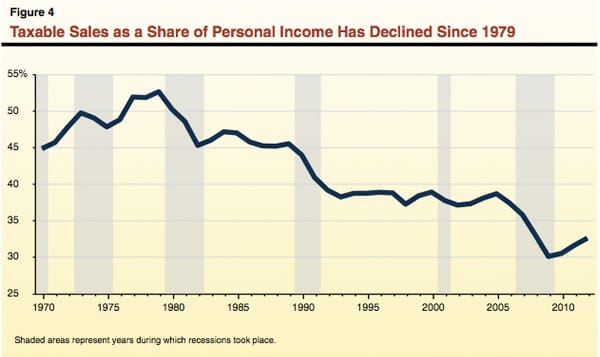
California consumers may have no one to blame but themselves for the state's increasing sales tax rate. According to a Legislative Analyst's Office report, authored by Mac Taylor, the increasing sales tax rate is linked to consumers favoring non-taxable services like healthcare and housing over purchasing taxable goods.

The report, which was released Monday, traced spending habits over nearly 30 years and found that consumers have spent less of their incomes on taxable goods nearly every year since 1979. As goods like cars and electronics take up relatively less of the average consumer's income, healthcare and housing combined (both non-taxable services) now take up more than 40 percent.

The sales tax rate has increased since 1980, but has not kept pace with the growth of California's economy.

"Had consumer spending not shifted toward services, the sales tax would generate the same amount of revenue as it does today at a significantly lower rate—5.2 percent instead of the current rate, 8.4 percent."

Even Proposition 30's sales tax increase, which was approved by a majority of voters last November, has not closed the gap with respect to reaching pre-1980 taxable sales revenues in real terms.

This shift has left the state to pick up the pieces elsewhere, inevitably leading towards the income tax. As Taylor points out, the continued decrease of taxable sales is unlikely to reverse. "Taxable sales are therefore likely to make up a declining portion of the state’s economy over the next decade."

The future economic reality will prompt the state to make revenue adjustments elsewhere, potentially via another sales tax increase or even through an increased income tax.

Overall, the trend has put more weight on personal income tax when it comes to the state's finances. Income tax comprises over 60 percent, or $60.8 billion, of the General Fund's revenue stream. Whereas, sales tax is the second largest component and constitutes nearly a quarter of California's General Fund income.

As the state attempts to balance it's budget in coming years, it's probable that yet another sales tax rate increase is down the road if current trends persist.

Adhere to the IVN etiquette

By posting a comment, you agree to adhere to our etiquette rules: No partisan attacks, no personal attacks, substantiate your sources, no self-promotion.

Contact IVN

Questions about this article or our coverage? Send us a message. A free IVN member account is required.

Message sent

Thanks, we’ll review it and get back to you if needed.

Message not sent

Sorry, something went wrong. Please try again.

Sign in to send a message

Messages are tied to your IVN member account. Signing in is free and takes a few seconds.

Republish this article

Republishing guidelines

Republish IVN articles for free. Independent Voter News articles may be republished online or in print under a Creative Commons BY-NC-ND 4.0 license, on these terms:

  1. Credit the author and IVN. Keep the byline ("By Author Name, Independent Voter News") and the attribution note at the end, which links to the original.
  2. Keep the meaning. You may update time and place references and apply your house style. You may trim for length, as long as the cuts don't change the meaning or misrepresent the author. Keep the headline. Mark any additions as your own (for example "Additional reporting by ...").
  3. Translations are welcome. Translate faithfully, add "Translated from English by [your outlet]", and tell us at editor@ivn.us.
  4. Keep the links, including the link to the original article.
  5. Keep the tracking image. The HTML includes a 1-pixel image that counts readers on your page. It collects no personal information.
  6. Photos and illustrations. Images credited to IVN may be used with this article only. Images credited to others (AP, Getty, Unsplash, Wikimedia and so on) stay under their owners' terms. Secure the rights or switch "Include images" off.
  7. Don't sell it. You can't sell our articles or sell ads specifically against them. Your normal site advertising is fine.
  8. No implied endorsement. Don't suggest that IVN or the author endorses you, your candidates or your causes, or that donations to you support IVN.
  9. Keep labels. Opinion or analysis pieces keep that label.
  10. Point search engines to the original. Where your CMS allows, set the canonical URL to the original IVN article.
  11. No bulk or automated republishing, and don't submit our articles to aggregators (Apple News, Google News, MSN) as your own.
  12. Corrections and removals. Update your copy when we correct it, and remove it promptly if we ask. We'll contact you at the email you give us.
  13. Questions or print republication: editor@ivn.us.

IVN staff: fill in who you're inviting above, then create the invite.

Preparing the article

California Sales Tax Rate May Increase Again Due To Consumer Behavior

Choose a format
  • HTML
  • Email HTML
  • Markdown
  • Formatted (.docx)
  • Plain text
  • WordPress blocks
  • PDF
Choose a platform

Photos credited to others need their owners' permission.

To for

Republishing somewhere else? Questions? editor@ivn.us