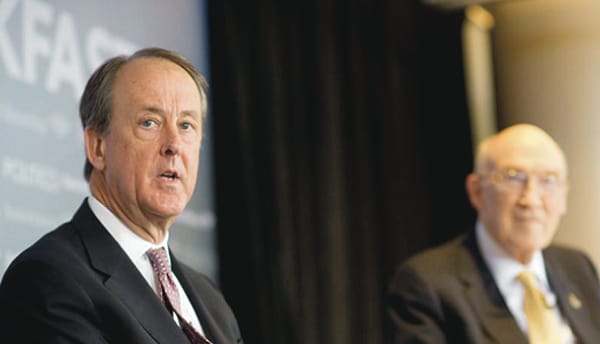
Erskine Bowles (left) and Alan Simpson (right) // credit. momentoftruthproject.org
The Committee for a Responsible Federal Budget (CRFB), a nonprofit organization focused on fiscal policy, completed its analysis of the "Bipartisan Path Forward to Securing America’s Future."
As the latest policy development from the bipartisan National Committee on Fiscal Responsibility and Reform (NCFRR), the proposal touches nearly every sector of government spending from education to tax reform to health care. It advertises nearly $2.5 trillion in savings over 10 years.
The authors of the new proposal include Alan Simpson, formerly a Republican senator from Wyoming, and Erskine Bowles, former chief of staff under Bill Clinton. The two were appointed co-chairs of the NCFRR by President Obama in 2010, tasked with finding a balanced solution to the nation's growing debt crisis.
The first budget recommendation from the bipartisan team -- what was known simply as 'Simpson-Bowles' was shot down in Congress last year. Consequently, the new 'Simpson-Bowles' plan hopes to find an acceptable middle ground, eschewing austerity while reducing the deficit.
Providing for multiple spending scenarios, the authors contend that the proposed package would reduce the debt in various ways while protecting economic growth. From the analysis:
"Under the proposal, debt would fall from 76.4 percent of GDP in 2013 to 69.3 percent of GDP in 2023, compared to 79.0 percent of GDP under our CRFB realistic baseline. Revenues would be 19.7 percent of GDP in 2023 compared to 19.1 percent under the CRFB realistic baseline... It's very encouraging to see a bipartisan approach that exceeds CRFB's recommendation for $2.4 trillion in additional deficit reduction. Along with the already released budget proposals, lawmakers could use the "Bipartisan Path Forward" as a guide for replacing sequestration with smart deficit reduction."
The key revisions in the latest Simpson-Bowles plan include:
- Chained CPI
- Strengthening the Pell Grant program
- Many low-income programs are untouched
- Structural reforms to Medicaid
- A Medicare buy-in
- Increasing the retirement age
- Repealing sequestration
- And indexing the debt ceiling to GDP
It remains to be seen if the new bipartisan effort will pick up any steam when put before Congress in the coming weeks.
Despite last year's momentum going into budget talks, lawmakers were unable to agree to the major budget provisions put forward in the original Simpson-Bowles plan. Similar difficulties await the new proposal this year, yet both Simpson and Bowles remain confident that a compromise is within reach.