(Credit: Gage Skidmore)
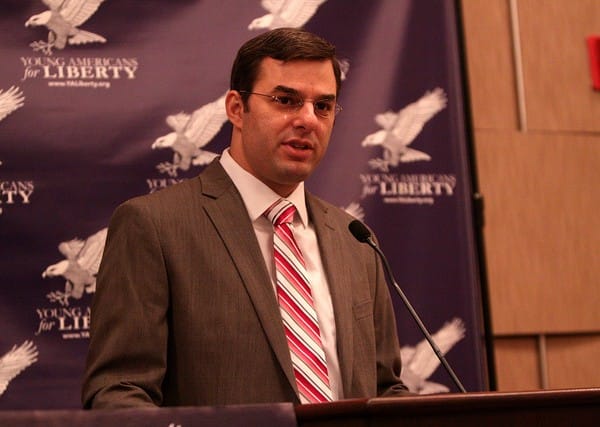
In reaction to the scandal that the U.S. Justice Department seized the phone records of Associated Press journalists, a small bipartisan group of legislators is attempting to rein in some of the excesses of the Executive Branch.
Republican Reps. Justin Amash and Mick Mulvaney as well as Democratic Reps. Zoe Lofgren and Jared Polis are all co-sponsors of the Telephone Records Protection Act. Introduced last Thursday, the main aim of the bill is to require the government to obtain a court order before seizing phone records.
According to the press release:
"HR 2014, the Telephone Records Protection Act, requires court approval when the government demands telephone records from service providers. . . ."The Justice Department's seizure of the AP's phone records - likely without the sign-off of a single judge - raises serious First and Fourth Amendment concerns. . . ."The Telephone Records Protection Act strikes 18 USC § 2703(c)(2)(C), which includes telephone records on the list of basic subscriber information that can be accessed by administrative subpoena. If enacted, the bill would require the government to state 'specific and articulable facts' that can prove to a court that the information sought is 'relevant and material to an ongoing criminal investigation."
This legislation came forth even before the revelation that journalist James Rosen was targeted under the auspices of the Espionage Act of 1917, a World War I era law. The Fox News chief Washington correspondent, Rosen's private e-mails were read after he reported information relayed to him by former State Department official Stephen Kim, who himself is under indictment under the Espionage Act. Rosen is not charged, but he was listed as "an aider and abettor and/or co-conspirator."
When President Obama entered office, he promised an open and transparent administration. However, the Obama administration has compiled a long record of prosecuting whistleblowers.
Columnist Glenn Greenwald, a long-time liberal critic of the president, asserted that the recently-revealed actions of the administration represent an attack on the freedom of the press itself:
"The Obama Justice Department has prosecuted more government leakers under the 1917 Espionage Act than all prior administrations combined - in fact, double the number of all such prior prosecutions. But as last week's controversy of the DOJ's pursuit of the phone records of AP reporters illustrated, this obsessive fixation in defense of secrecy also targets, and severely damages, journalists specifically and the newsgathering process in general."
Last week, Obama adviser David Axelrod inadvertently provided fodder for his conservative critics when he told MSNBC, "Part of being president is there's so much beneath you that you can't know because the government is so vast."
At the Daily Caller, W. James Antle suggests the problem is that a government that is too big is bound to overreach:
"When we give the federal government the power to look at our private financial transactions, listen to our phone calls and regulate political speech, we shouldn't be surprised when those powers are abused. Neither should we be surprised when those powers expand, with the government even inserting itself into Americans' prayers."
It remains to be seen how far the Telephone Records Protection Act will go in Congress. However, it does emerge at a time when partisans on both sides are expressing discomfort with the secrecy of the Obama administration. It also comes at a time when more of the American people are paying attention to what surveillance powers the government claims.