Skip to content
Subscribe

Bangor Daily Op-Ed: Vote YES for Ranked Choice Voting

Published:

In an op-ed for the Bangor Daily News, Ned White rightly points out the future of ranked choice voting (RCV) is once again in the hands of voters. After 52 percent of Maine voters supported the implementation of RCV in 2016, the Maine legislature passed a law to delay the implementation until 2022.

In response, RCV supporters gathered more than 70,000 signatures for a ‘People’s Veto,’ which prevents the delay and places RCV once again on the ballot.

On June 12, voters will be asked if they reject the legislature’s attempt to delay the implementation of RCV on Question 1, the only initiative on the ballot:

“Do you want to reject the parts of a new law that would delay the use of ranked-choice voting in the election of candidates for any state or federal office until 2022, and then retain the method only if the constitution is amended by December 1, 2021, to allow ranked-choice voting for candidates in state elections?”

The question is worded this way because it has to specifically address the law passed by the legislature to delay the reform. Additionally, the measure addresses the potential use of RCV for state elections if the state constitution is amended. Currently, the state constitution says candidates for governor, state senator, and state legislature can win by plurality, not majority.

That has been a touchy subject for Maine voters, considering there has not been a majority winner in nine of the last 11 races for governor, including both times the controversial Paul LePage won the office, with 48.2 percent in a 3-way race in 2014 and only 37.6 percent in a 4-way race in 2010.

White explains what a “yes” vote on Question 1 will mean:

RCV will continue to apply to party primaries (Republican, Democrat, Green) for U.S. Senate, U.S. House, State Senate, State House, and Governor

RCV will not apply to general elections for Governor, State Senator, and State Representative until/unless the constitution is amended to dump the “plurality” language

RCV will apply (for the first time ever) to general elections for U.S. Senate and U.S. House

A sample ballot is included in the piece, which the author says he likes, calling it “clean and simple.”
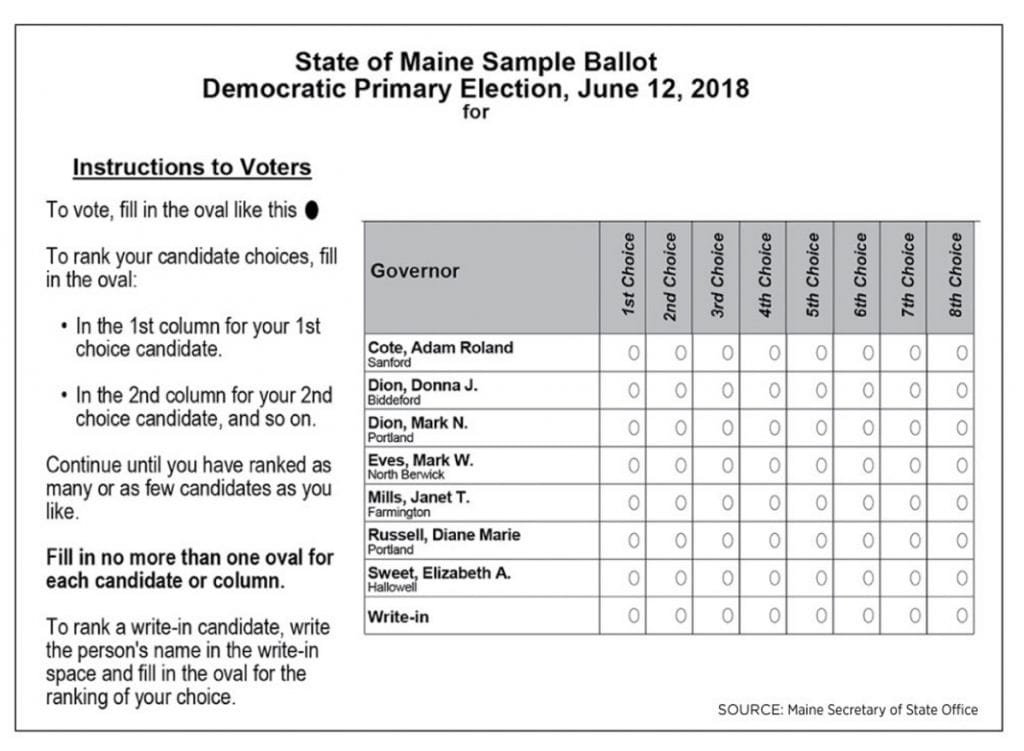
Ultimately, White lists the reasons to vote yes on the measure:

  • Gives you more voice in an election
  • Gets rid of voting for “the lesser of two evils”
  • Eliminates the possibility of “spoiler” candidates
  • Promotes more positive campaigning

This June, Maine voters have a chance to make their elections better for everyone.

Editor's note: This piece originally published on FairVote's blog and has been modified slightly for publication on IVN.

Adhere to the IVN etiquette

By posting a comment, you agree to adhere to our etiquette rules: No partisan attacks, no personal attacks, substantiate your sources, no self-promotion.

Contact IVN

Questions about this article or our coverage? Send us a message. A free IVN member account is required.

Message sent

Thanks, we’ll review it and get back to you if needed.

Message not sent

Sorry, something went wrong. Please try again.

Sign in to send a message

Messages are tied to your IVN member account. Signing in is free and takes a few seconds.

Republish this article

Republishing guidelines

Republish IVN articles for free. Independent Voter News articles may be republished online or in print under a Creative Commons BY-NC-ND 4.0 license, on these terms:

  1. Credit the author and IVN. Keep the byline ("By Author Name, Independent Voter News") and the attribution note at the end, which links to the original.
  2. Keep the meaning. You may update time and place references and apply your house style. You may trim for length, as long as the cuts don't change the meaning or misrepresent the author. Keep the headline. Mark any additions as your own (for example "Additional reporting by ...").
  3. Translations are welcome. Translate faithfully, add "Translated from English by [your outlet]", and tell us at editor@ivn.us.
  4. Keep the links, including the link to the original article.
  5. Keep the tracking image. The HTML includes a 1-pixel image that counts readers on your page. It collects no personal information.
  6. Photos and illustrations. Images credited to IVN may be used with this article only. Images credited to others (AP, Getty, Unsplash, Wikimedia and so on) stay under their owners' terms. Secure the rights or switch "Include images" off.
  7. Don't sell it. You can't sell our articles or sell ads specifically against them. Your normal site advertising is fine.
  8. No implied endorsement. Don't suggest that IVN or the author endorses you, your candidates or your causes, or that donations to you support IVN.
  9. Keep labels. Opinion or analysis pieces keep that label.
  10. Point search engines to the original. Where your CMS allows, set the canonical URL to the original IVN article.
  11. No bulk or automated republishing, and don't submit our articles to aggregators (Apple News, Google News, MSN) as your own.
  12. Corrections and removals. Update your copy when we correct it, and remove it promptly if we ask. We'll contact you at the email you give us.
  13. Questions or print republication: editor@ivn.us.

IVN staff: fill in who you're inviting above, then create the invite.

Preparing the article

Bangor Daily Op-Ed: Vote YES for Ranked Choice Voting

Choose a format
  • HTML
  • Email HTML
  • Markdown
  • Formatted (.docx)
  • Plain text
  • WordPress blocks
  • PDF
Choose a platform

Photos credited to others need their owners' permission.

To for

Republishing somewhere else? Questions? editor@ivn.us