Credit: sodahead.com
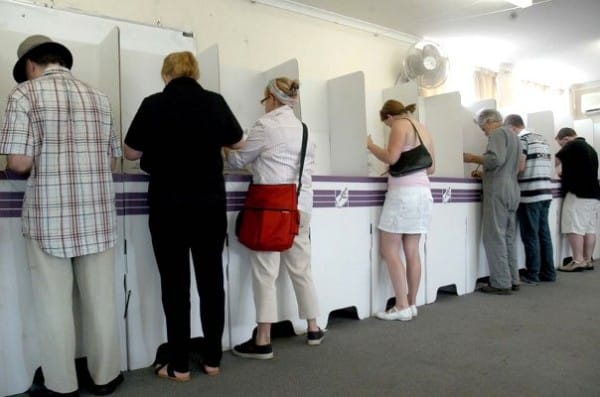
Recent skirmishes between the Republican and Libertarian parties are instructive examples of ballot access fights that too often happen elsewhere too. In Washington, the Libertarian Party claims that the Republican Party should have to run under minority party status, and in turn should be barred from the ballot having failed to make minority party deadlines. In Pennsylvania, the Republican Party is challenging the signatures amassed by the Libertarian Party in an effort to bar Gary Johnson from the Pennsylvania ballot. The political parties are all engaging in this disconcerting pattern of actions to limit possibilities for voters in November.
The parties are able to do this for a number of reasons: First is that our single member district system leads to a two-party system. Single Member District is a voting system that yields a winner take all result; in any election only one party wins the right to representation. If the party has 51% of the vote or 99% they win; parties that win 5% or 49% of the vote both lose just the same. This is opposed to Multi-Member District systems where parties win seats (In a legislature or electoral college) proportionally to the percent of the vote they receive. The reason Single Member Districts (SMD) lead to two-party systems is that in a SMD system to viably have any of their positions represented third-party supporters have to jump ship to one of the “major parties.”
I am not trying to make any normative statement about SMD systems as opposed to Multi-Member Districts. Each has their merits and detractions, but the qualities of SMD allows two major parties (In the United States case the Democrats & Republicans) to amass all the power and in turn use that power to fortify their positions atop the political landscapes. For example in the case of Pennsylvania listed above the two major parties that already garner most of the support only need 2,000 signatures to qualify for the ballot.Yet the minority third parties need 20,000 signatures to qualify. The reason for this disparity does not lie in any political or democratic theory but in the fact that the majority parties control all the seats in the legislatures. Therefore the major parties write all the campaign & electoral laws, requiring 2,000 signatures for “majority parties” defined to be themselves and 20,000 for parties defined as “minority parties”.
This subtle, legal gerrymandering does not even in reality serve the purpose of maintaining the top parties power because they already have such overwhelming support that loss of control is no real threat to them. What it does do is stifle the political discourse. By blocking the third parties the major parties are allowed to frame political discussion in a dichotomy between the Republican side and the Democrat side. Any third, fourth or fifth options that could be explored are not even presented; they are eliminated by default.
However, the third parties are not blameless in this. As the actions of the Libertarian party in Washington show, they too will follow the lead of the major parties. Given they are coming from a retaliatory position, they are just as culpable for trying to limit the most important part of a democracy: the ability for the populace as a whole to decide the best course of action concerning a given issue.
The parties are not acting to represent the people; they are acting to represent their own interests in the frame of a democracy. The result is not parties competing through various policy positions, but parties competing through political and legal manipulation; policy is not the driving force of this campaign, the interests of the politicians are.