 Election Solutions Bulletin

Editor's Note: The following is the Election Solutions Bulletin (ESB) newsletter from October 27, 2026. ESB is a project of the Institute for Political Innovation.
In the midterm elections on Nov. 3, control of the US Senate could be determined by Alaska, whose final returns are notoriously late. Because it is the only state using Final Four Elections (FFE), that system is already being blamed for the delay.
Such accusations against FFE are false, explained two former Alaska election officials in an opinion piece in the Anchorage Daily News on Sept. 27.
Final Four Elections (FFE) is a system with two parts. First, a primary, or preliminary round, open to voters and candidates of all parties plus independents. Second, a general election in which the four top vote getters from the primary contend. The winner is chosen by an instant runoff process. Voters pick a majority victor without going back to the polls.
In Alaska, instant runoff, the most common form of ranked choice voting (RCV), involves voters ranking up to four candidates. Voters whose number-one choices finish fourth in the initial count have their number-two picks distributed to the remaining candidates. The process continues until two candidates remain, and the one with more votes is the majority winner. It is critical under FFE to run all the rounds, even if a candidate has a majority before they are completed. This briefing explains why.
Counting instant runoff ballots may sound complicated, but, with scanners, it takes no more time than a traditional ballot – about one minute per race. A study by FairVote, a national election-reform organization, found that nationwide 79% of the 39 jurisdictions that use RCV released results within 24 hours of polls closing.
The two former officials, with 30 years of experience between them – Gail Fenumiai, the former director of Alaska’s Division of Elections, and Jeremy Johnson, former Region III election supervisor – wrote:
"Claims that ranked choice voting causes delays in reporting election results are being amplified. We can say unequivocally that this is not the case. Ranked choice voting does not extend the timeline for counting votes under Alaska law, nor is it to blame for delays in receiving results on election night."
Alaskans approved FFE in 2020, and the state started using the system with the 2022 elections. Nationally, Final Four and Final Five Elections are opposed by officials of both parties because the change threatens their duopoly, and in 2024, a group tried and failed to repeal FFE in Alaska. There’s another attempt this year, with more than $1 million in funding from Elon Musk.
The organization Repeal Now makes this claim on its website:
"RCV takes too long to declare a winner. Elections should be settled on Election Day. With Ranked Choice Voting and multiple ballots, getting a result is no longer a straight-forward process. Declaring a winner may take weeks. There are no advantages to this cumbersome, complicated process."
Similar criticisms about delays have been voiced by Kim Strassel of the Wall Street Journal and others. Repeal Now is right that “declaring a winner may take weeks.” But the reason is not RCV. Delays were common long before the advent of the Final Four system.
For example, in 2020, the last election under the old system, the Associated Press did not call the Alaska Senate race until Nov. 11, eight days after the election, even though Republican Dan Sullivan ended up winning easily, by 13 points. In 2008, incumbent Republican Sen. Ted Stevens led by about 3,000 votes after election day, Nov. 4, but he didn’t concede to Mark Begich, who won by 3,724 votes, until Nov. 18.
In 2024, the previous attempt to repeal FFE that required a simple yes or no vote (no ranking, of course). But the result was not announced until Nov. 20, some 15 days after the election.
In their article, the two former Alaska election officials explain:
The ballot measure that implemented ranked choice voting, or RCV, did not change the timeline for counting votes under Alaska law (AS 15.20.081(e) and (h)). In a general election, the deadline for an absentee ballot submitted by mail to arrive and remain eligible is 15 days after Election Day.
After all, Alaska is the largest state in the union and has far-flung remote areas.
“By law, absentee and questioned ballots cannot be scanned before 8 p.m. on Election Day [midnight Eastern Standard Time],” write Fenumiai and Johnson. “These ballots typically represent about 25% of all votes cast. In the 2024 general election, the Division of Elections received almost 94,000 absentee and questioned ballots. Verifying and preparing these ballots for counting is a manual, time-consuming process because of geography, logistics and staff capacity.”
But that process is no more arduous under RCV. “Saying that RCV delayed results is false,” write the former officials.
On its website, the Alaska Division of Elections explains the schedule. The deadline for receiving domestic ballots is Nov. 13, that is, 10 days after election date; for overseas ballots, the deadline is Nov. 18. On that day, the official instant-runoff tally will be announced.
Alaska is one of 14 states that accept absentee ballots after election day if they are postmarked by election day. For example, Illinois counts absentee ballots if they arrive 14 days after election day; Mississippi, up to five business days. Washington state has no hard-and-fast deadline as long as the ballot is postmarked by election day. Seventeen states, including Alaska, forbid scanning of absentee ballots before election day.
In 2024, it took both Alaska and California 10 days to count 95% of the vote. Utah and Mississippi took eight days, according to a National Public Radio report.
Frustrated by such delays, the Trump Administration tried to require all ballots in the nation to be received by election day. But in June, the Supreme Court ruled, 5-4, in Watson v. RNC, a case filed by the Mississippi Secretary of State, that such a rule was beyond the authority of the federal government.
“In her majority opinion, Justice Barrett wrote that the federal statutes set the day for casting ballots, not the deadline for receiving them,” according to SCOTUSblog.
The two former election officials wrote that if Alaskans want faster results, they can take steps such as changing the law “to allow the division [of elections]
to process and scan absentee ballots before Election Day.” Those ballots can even be scanned to include the effects of eliminating the third- and fourth-place finisher.
Republican Gov. Mike Dunleavy vetoed a comprehensive bill (SB 64) in April that would have sped up the count.
“Whether you support RCV is entirely up to you. However, ballot processing and election-result timelines in Alaska have operated the same way for decades. RCV did not change that schedule, and that is a critical fact for voters to know,” concluded Fenumiai and Johnson.
A Deeper Dive into the Alaska System
The Institute for Political Innovation (IPI) provides a Talking Points fact sheet with detailed information on the state’s voting process, with the headline, “Alaska’s Results Will Take Time. Here’s Why, and When You’ll Know. It’s the mail, the map and close races, not ranked ballots.” Members of the media, who undoubtedly will be commenting on the late returns from Alaska on election night, would benefit from reading the fact sheet, as well as an extensive briefing.
In the briefing, Katherine Gehl, who devised FFE, explains in detail how vote counting works and the often confusing nomenclature that surrounds it. She points out that instant runoff results can look slow for reasons beyond Alaska’s two-week wait for absentee ballots to come in.
One reason is that the “cast vote record” (CVR) is not released until after all the ballots have been received. The CVR is the electronic, anonymized ballot-by-ballot record of the choices marked on every ballot, produced by the tabulating equipment as ballots are scanned. In an Alaska instant runoff race, each record shows one ballot's first, second, third and fourth rankings. Gehl notes that anyone can run the instant runoff rounds with the CVR:
"RCTab, free open-source software hosted by the Ranked Choice Voting Resource Center, tabulates instant runoff results directly from a cast vote record. It has been federally tested and is certified for official use in New York and Utah. The AP, a newspaper, a campaign or a skeptic can download it, run the rounds and reach the same answer the state will."
The second reason for delay is that FFE “is designed to produce more competitive general elections. That means fewer predictable results and more races close enough that the trailing candidate(s) can still catch up, so they take longer to call. This isn't a defect in the counting. It's the point of the innovation.”
IPI advocates a set of best practices for Final Four and Final Five Elections. First, “Absent extraordinary circumstances (such as Alaska's remote, hard-to-reach regions), every ballot should be in by Election Day, and every ballot should be processed and the data released as fast as possible, with the addition that the cast vote record be released with each ‘vote dump’ so that the AP can call the race as early as is responsible to do.”
At the same time, IPI recommends that states never run preliminary tabulations. “The state should run the instant-runoff rounds once, after every ballot is in, and never before.” The organization adds:
"A tabulation run on a partial count can eliminate candidates in the wrong order. Because each elimination decides whose ballots transfer, a different last-place finisher can produce a different winner the next day. An official "if counting stopped today, this candidate wins" that later reverses invites the charge that the count is rigged, when nothing was wrong except the timing."
The state should only be in the business of announcing official results, says IPI. Media and analysts can use preliminary CVR – but with a caveat such as: “If this candidate is eliminated, most of those ballots are likely to move to that one."
Alaska's SB 64, which, as we noted, was voted by the Governor, would have required a daily "updated tabulation." IPI's view is that this would add risk to public trust and add nothing that decision desks need, since the CVR gives them everything required to call a race responsibly.
The Two Sullivans: A Problem Mitigated by Alaska’s Voting System
Delays aren’t the only controversy in Alaska. On Oct. 23, President Trump said he had directed the Justice Department (DOJ) to file a preemptive lawsuit to try to block the certification of Democrat Mary Peltola if she beats Republican Sen. Dan Sullivan in Alaska. As ABC News explained:
"Republicans have alleged that candidate Dan J. Sullivan is running a sham campaign to purposefully confuse voters and draw votes away from incumbent Sen. Dan S. Sullivan based on their names being similar".
Rick Hasen, a UCLA law professor and director of the school’s Safeguarding Democracy Project, told NPR just two days that Alaska would be the most likely legal battleground if Democrats narrowly take control of the Senate.
“If it comes down to one seat, then I think all bets are off. And then I’m very concerned that the Trump administration will try to do things to manipulate the outcome of the elections,” Hasen said.
We covered the Two Sullivans Issue extensively in our Newsletter No. 23, but the gist is that anyone who understands the state’s Final Four Elections system will recognize that the system could actually save Sen. Sullivan’s seat. As Sen. Bill Cassidy (R-LA) said on Kim Strassel’s Wall Street Journal podcast earlier this month: “Ranked choice voting will actually work for him.”
Greg Orman, a former independent candidate for U.S. Senate in Kansas, wrote in RealClearPolitics on Oct. 26: “The confusion DOJ describes is far more damaging under the voting system the administration seems to prefer than under the one Alaska uses.”
Here is why. Alaska held its primary on Aug. 18. In the race for U.S. Senate, 16 candidates participated, including the two-term incumbent, Republican Dan Sullivan. He faced six other Republicans, three Democrats, and candidates from the Green, Libertarian and Alaskan parties plus a few unaffiliated contenders. Among the Democrats was former Rep. Mary Peltola, who lost her U.S. House seat in the 2024 election.
Sen. Sullivan found himself in a tough re-election fight, and, as the New York Times wrote, “it’s not because of the guy who shares his name.”
Peltola placed first with 49.5% of the vote; Sen. Sullivan (“Daniel S. Sullivan” on the ballot) was second at 41.4%. That is a big margin in any race. If the open primary were a typical general election, where a plurality wins, Peltola would be the easy victor. But to continue….
A retired schoolteacher named Dan J. Sullivan was also in the running as a Republican. Because of the possible confusion, the Republican party objected.
“The election agency agreed and kicked Daniel J. Sullivan off the ballot,” said the New York Times. “But a judge reversed that decision, and the state’s highest court upheld that reversal.”
In the primary, Dan J. received 2.5% and qualified for the general election, as did a Democrat, David Leslie, with 1.1%. The two Sullivans, Peltola and Leslie will compete Nov. 3, where, under FFE, voters will be able to rank their choices, and a majority winner will emerge.
As this briefing from IPI explains, choosing between the Sullivans is not confusing (nor a reason to oppose FFE), and the Division of Elections in this case has taken steps to remove possibilities of voter mistakes.
The Division of Elections has taken steps to prevent confusion. The general election ballot lists Sen. Dan as “Sullivan, Dan S. (Registered Republican/Incumbent.”) The other Sullivan is listed fourth simply as “Sullivan, Daniel J. Jr.” with no party affiliation. Here is a reproduction of the sample ballot where Sen. Dan is listed first (Alaska rotates the names on the ballot throughout its 40 state House districts).
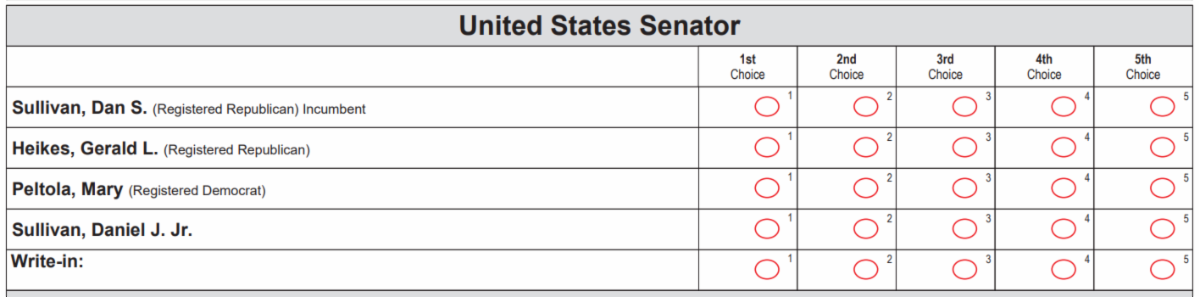
On another Kim Strassel podcast, this one on July 22, Sen. Sullivan stated:
"It's going to say 'Sullivan, Dan. S.' [referring to his line on the ballot]. Importantly, Kim, it's going to say 'Republican slash incumbent.' So that is what's going to be on the ballot. The sham candidate, again, who is put on there to confuse Alaskans, is going to be listed as 'Sullivan, Dan J.,' with no other indication of party or anything else. We think that's going to be enough to educate Alaskans on."
So Sen. Sullivan himself appears to be satisfied.
Similarly named candidates are hardly a new phenomenon. Ballotpedia, the obsessive election website, found that in 2022 alone, there were 22 races in 13 states that pitted candidates with the same last name, ranging from Baker to Tudela.
In Alaska itself, Tom Begich, a progressive Democrat, is running for governor while Nick Begich, a Republican who has voted with Donald Trump 99% of the time, is an incumbent U.S. Representative on the ballot for re-election.
The good news for Republicans is that FFE helps mitigate any confusion among voters. Under the system that prevailed before FFE, a candidate like Dan J. could appear on the general election ballot as an independent, perhaps causing votes from a confused electorate to be siphoned off from Sen. Dan, who could lose even if none of his opponents achieved a majority.
But under FFE, as an Alaska lawyer named Scott Kendall wrote in the Anchorage Daily News “any voter who is truly confused as to which Dan is which can simply rank them both and be sure that their support for Sen. Sullivan will ultimately be registered in the final results.”
Kendall is the godfather of FFE. He ran the campaign to change Alaska’s voting system after reading a 2017 Harvard Business School paper on the subject by Gehl and strategy scholar Michael Porter titled, “Why Competition in the Politics Industry Is Failing.”
Sen. Dan trailed Mary Peltola, a former U.S. Representative who lost her seat after a single term to – yes – Nick Begich by more than eight points, according to the final tally by the Alaska Division of Elections. But the race isn’t over. We haven’t followed the campaign closely, but by appealing to voters who didn’t back him in the primary, including Peltola backers, the incumbent might be able to close the eight-point gap.
Imagine a voter who supports Sen. Sullivan but marks Dan J. by mistake, writes Orman. Dan J. will almost certainly be eliminated early. “When that happens, the ballots that chose him first are moved to the voter’s second choice, the senator, and counts fully in the final round. Under ‘first-past-the-post,’ the system most states use and the one President Trump has defended against ranked-choice reforms, that same voter is simply out of luck. A plurality ballot has no second choice.” Orman continues:
"The only ballots ranked-choice voting can’t save are those that rank Daniel J. Sullivan first and leave the incumbent off entirely. That is a much smaller group than first-past-the-post would lose. It is also hard to call those voters confused. Someone who ranks one Sullivan and deliberately leaves the other off may have meant exactly that."
We can’t tell how the race will turn out, but it is certain that Sen. Cassidy is correct: instant runoff voting helps Sen. Sullivan.