Skip to content
Subscribe

Agreement in Reach on Decades-Long Yakima River Water War

Published:

Credit: usbr.gov

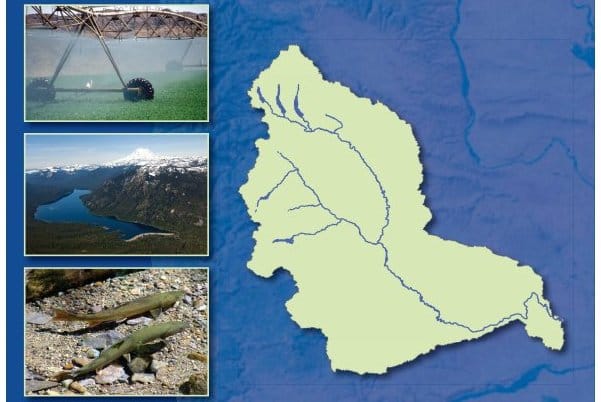
The Yakima River in Washington, like the Colorado River and the Sacramento Delta, has been the focus of nasty, divisive water wars for years. But it now appears that a landmark agreement is within reach for the Yakima. This gives hope to other areas where disputes over water seem to never be resolved. Sometimes warring sides really can come together and make peace. The Yakima Basin Integrated Plan is a model of cooperation that shows others how to resolve their differences for the common good. May others take heed and follow their example.

Supported by conservationists, farmers, and the Yakama Nation, the original stewards of the basin’s lands and waters, it’s a precedent-setting opportunity to restore salmon, protect public lands and rivers, increase the reliability of water supplies for farmers, and create new jobs in the basin. Beyond that, the plan is a template for smart innovation in basins across the country that face the four horsemen of climate change, water scarcity, dwindling wildlife, and divisive politics.

It is really quite astonishing, as well as heartening, that such diverse players and interests could come to the bargaining table and work out a deal.  Negotiations were encouraged by Washington Governor Chris Gregoire, Secretary of the Interior Ken Salazar, and US Rep. Doc Hastings. Gregoire is a Democrat and Hastings is a Republican. But apparently partisan politics wasn’t allowed to intrude on the process. The Bureau of Reclamation was also helpful by “championing ecosystem services and helping to create a model for future water projects around the country.”

The Yakima River plan protects public land and water, creates safe passage for salmon and other fish, and expands water markets and water storage. It will bring back a big sockeye salmon run as well as build two reservoirs so farmers can be assured of a more reliable supply.

Integrated Plan

Somehow, amazingly, the plan has done it all. Sure, it’s a compromise, but that’s what cooperation is about. The plan still needs to be funded by the US Congress, but given the diverse coalition formed here with members of all parties and factions, the process should be much simplified.

Sacramento Delta and Colorado River, are you listening? If water stakeholders in the Yakima River basin can come to an agreement, so can you.

Adhere to the IVN etiquette

By posting a comment, you agree to adhere to our etiquette rules: No partisan attacks, no personal attacks, substantiate your sources, no self-promotion.

Contact IVN

Questions about this article or our coverage? Send us a message. A free IVN member account is required.

Message sent

Thanks, we’ll review it and get back to you if needed.

Message not sent

Sorry, something went wrong. Please try again.

Sign in to send a message

Messages are tied to your IVN member account. Signing in is free and takes a few seconds.

Republish this article

Republishing guidelines

Republish IVN articles for free. Independent Voter News articles may be republished online or in print under a Creative Commons BY-NC-ND 4.0 license, on these terms:

  1. Credit the author and IVN. Keep the byline ("By Author Name, Independent Voter News") and the attribution note at the end, which links to the original.
  2. Keep the meaning. You may update time and place references and apply your house style. You may trim for length, as long as the cuts don't change the meaning or misrepresent the author. Keep the headline. Mark any additions as your own (for example "Additional reporting by ...").
  3. Translations are welcome. Translate faithfully, add "Translated from English by [your outlet]", and tell us at editor@ivn.us.
  4. Keep the links, including the link to the original article.
  5. Keep the tracking image. The HTML includes a 1-pixel image that counts readers on your page. It collects no personal information.
  6. Photos and illustrations. Images credited to IVN may be used with this article only. Images credited to others (AP, Getty, Unsplash, Wikimedia and so on) stay under their owners' terms. Secure the rights or switch "Include images" off.
  7. Don't sell it. You can't sell our articles or sell ads specifically against them. Your normal site advertising is fine.
  8. No implied endorsement. Don't suggest that IVN or the author endorses you, your candidates or your causes, or that donations to you support IVN.
  9. Keep labels. Opinion or analysis pieces keep that label.
  10. Point search engines to the original. Where your CMS allows, set the canonical URL to the original IVN article.
  11. No bulk or automated republishing, and don't submit our articles to aggregators (Apple News, Google News, MSN) as your own.
  12. Corrections and removals. Update your copy when we correct it, and remove it promptly if we ask. We'll contact you at the email you give us.
  13. Questions or print republication: editor@ivn.us.

IVN staff: fill in who you're inviting above, then create the invite.

Preparing the article

Agreement in Reach on Decades-Long Yakima River Water War

Choose a format
  • HTML
  • Email HTML
  • Markdown
  • Formatted (.docx)
  • Plain text
  • WordPress blocks
  • PDF
Choose a platform

Photos credited to others need their owners' permission.

To for

Republishing somewhere else? Questions? editor@ivn.us