
 Dan Schnur
HUNTINGTON BEACH, Calif. - A judge has tentatively ordered Huntington Beach to overhaul how it elects its city council with ranked choice voting after finding that the city’s at-large system violates the California Voting Rights Act by diluting Latino voting power.
The remedy is a complete shakeup in how elections function after the court determined that the city’s current system does not offer under-represented groups a seat at the table.
Orange County Superior Court Judge Craig L. Griffin ordered the city to adopt ranked choice voting for its city council elections and end its staggered-election system in which city council elections took place in different cycles.
In other words, all 7 seats have to be elected at the same time every 4 years.
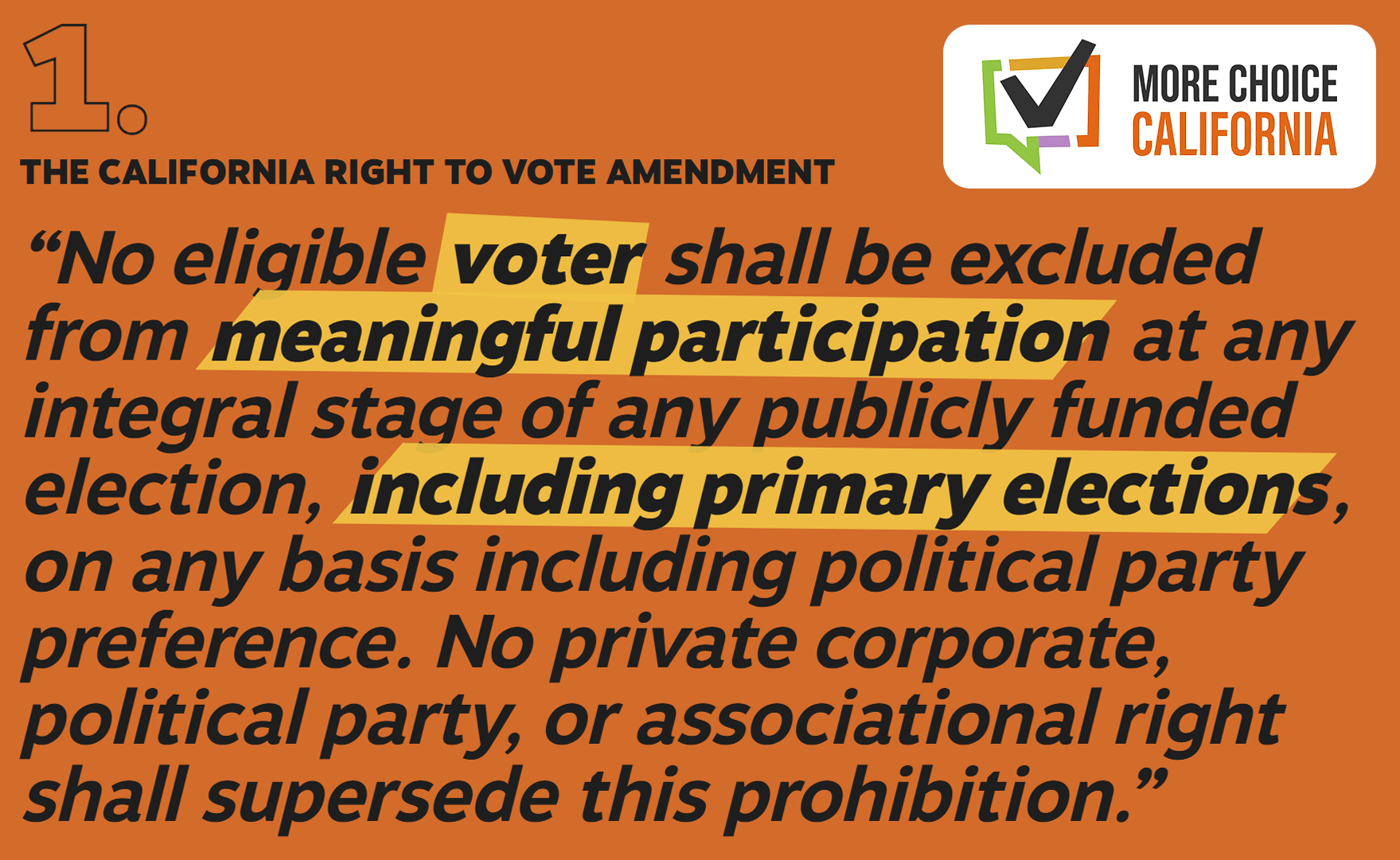
This decision aligns with the principles of the "California Right to Vote Amendment" offered by More Choice California, which states that "no eligible voter shall be excluded from meaningful participation at any integral stage of any publicly-funded election."
This includes nonpartisan city elections and primaries. "No private corporation, political party, or associational right shall supersede this prohibition."
Griffin's order is tentative and could still face further litigation or change. But its significance is already clear: a court is treating more choice voting reform not as a trendy experiment or a partisan weapon, but as a remedy to voter disenfranchisement.
It also comes at a time when party operatives on both sides of the aisle in California are trying to strip voting rights away from independent voters—a political designation shared not only by a quarter of the state’s registered voting population, but by a third of Latinos.
More Choice Reform Is Increasingly Becoming the Answer to Voting Rights Disputes
The ruling stems from a lawsuit brought by Huntington Beach resident Victor Valladares and the Southwest Voter Registration Education Project, which argued that the city’s current system has disadvantaged Latino voters, particularly in the Oak View neighborhood.
The court concluded that Huntington Beach’s at-large election structure does make it harder for Latino voters to elect candidates of their choice, but dividing council elections into districts would conflict with the city charter’s requirement for at-large elections.
Griffin steered away from remedies that focused solely on race—like trying to draw individual districts of influence for Latinos. This was a point of contention between plaintiffs and the city. Instead, he focused on a nonpartisan alternative—ranked choice voting.
“Regardless of remedy imposed, some charter eggs will be broken in the making of this omelet,” Griffin wrote. “Ranked-choice voting continues to allow voters full participation in the elections as contemplated by the city charter.”
Since the elections that use ranked choice voting would decide all 7 city council seats in one election, the model used would have to be a multi-winner, proportional form of ranked choice voting instead of having individual runoffs for each seat.
Put simply, voters would rank candidates in order of preference, and ballots would transfer as candidates are elected or eliminated until all 7 seats are filled. A seat is filled once a candidate reaches a certain vote threshold.
The point is not to produce a winner with 50% support for every seat. It is to make sure that a large, cohesive minority of voters can win representation instead of being shut out by a citywide winner-take-all sweep.
This isn’t the first time a legal dispute has been resolved with this specific reform. However, it is the first time a judge has explicitly ordered it rather than the parties involved reaching a settlement.
In 2019, Eastpointe, Michigan, adopted proportional ranked choice voting through a settlement with the US Department of Justice after the DOJ challenged the city’s council-election system under Section 2 of the federal Voting Rights Act.
The agreement was the first use of ranked choice voting to resolve a federal VRA case. The city used RCV to elect two council members in 2019, and FairVote reported that 82% of voters ranked at least two candidates in that election.
Earlier this year, Newburgh, New York, agreed to adopt proportional ranked choice voting as part of a settlement in a lawsuit alleging that its at-large system also diluted Black and Latino voting power.
Notably, what connects all 3 jurisdictions is not party advantage. It is the growing recognition that election design can either lock underrepresented voters out of power or give them a viable path to meaningful choice.
Above All Else, This Is About Representation
Historically, these types of cases would result in a city being ordered to switch to district voting and carve up the electorate. But Griffin recognized that voting reform is a credible and legitimate solution when a governing body fails to reflect the city it governs.
The judge said it himself. The remedy he went with was to ensure that all voters still got to participate in a meaningful way under the city charter.
Ranked choice voting does not guarantee any particular candidate or demographic group a seat. However, it gives every voter the ability to further express themselves in city elections that are already nonpartisan and open to every eligible citizen, regardless of party.
It also incentivizes candidates to reach beyond their base support—because the one who does will get a seat on the city council.
This distinction matters. Independent voters are often treated as politically invisible because they are not organized under a party label. But a system that rewards coalition-building over partisan gatekeeping gives them more leverage.
And when independent voters know they have more leverage in elections, they participate. Just look at turnout in the 2026 statewide primaries in California.
Research shows approximately a third of Latino voters are registered “No Party Preference" (NPP). This is the largest percentage within any ethnic demographic group and does not count Latinos registered with a party, but identify as independent.
The 2026 primary elections under nonpartisan primaries saw an increase in turnout not just among statewide voters (increasing from 33% in 2022 to roughly 40% in 2026), but among independents (who made up more than a quarter of voters) and Latinos (26% of the turnout).
There were no systemic barriers that got in the way of these voters participating. Every voter received the same ballot and could choose any candidate they wanted. And, when independents saw the power they held in statewide contests, they voted.
Now, operatives from both major parties want to take this away, including from independent Latinos. They want to go back to a system that carves up the electorate amongst themselves, and tells voters: pick a side or don’t vote.
If the concern is that there are not enough candidates on the November ballot, there is a solution that does not mean dividing up voters and splitting up choice.
The Independent Voter Project (which authored California’s nonpartisan Top Two primary) encourages California to expand on Top Two and advance 4 or 5 candidates. It joins other reform leaders in the More Choice California coalition to advance this reform.
Then, voters can use ranked choice voting to determine which candidate in November crosses a majority threshold. It doesn’t strip the constitutional guarantee that all voters get full participation, and it offers a remedy that has already been approved by the courts.
Dan Schnur is the Academic Advisor for the More Choice California coalition. He is a Lecturer at the UC–Berkeley’s Institute of Governmental Studies, Pepperdine University’s Graduate School of Public Policy, and the USC’s Annenberg School of Communications, where he teaches courses in politics, communications and leadership.