As a society, we have evolved into a citizenry reliant on technology in almost all aspects of our lives -- politics is no exception. And if the 2014 midterm elections taught us one thing, it's that the space for online campaigning is exponentially growing.
In just 4 years, the proportion of Americans who use their cell phones to track campaigns has doubled, according to the Pew Research Internet Project, jumping from 13 percent in 2010 to 28 percent during the 2014 election cycle.
Clinging to their "tried and tested" strategies of direct mail and television, political consultants continue to miss out on opportunities to utilize this innovative space online. Here are seven reasons why traditional political consultants miss the mark when it comes to online campaigning.
Social media is about building relationships. It’s about connecting with people online, actual people, who in the case of a political consultant, will go vote.
What is the point of having tens of thousands of Facebook Likes on a campaign's page if none of these people are voting in the election? What do campaigns gain from having a post go viral if it does nothing to advance the candidate in the polls?
If the end goal is to get a candidate elected, or pass a piece of legislation, then success should be measured in terms of people, not numbers.
Independent-minded voters are not swing voters, they do not consistently lean one way or another, and they are not partisans in disguise. They are exactly what it sounds like they are: independent-minded. They think for themselves, they make decisions based on policy issues and analysis, and most importantly, they can see through partisan messaging.
Delivering the same message to these voters as you would to loyal conservatives or liberals would be a mistake.
In a political climate where 42 percent of voters now self-identify as independent, consultants need to tailor their messages to remain relevant to this near-majority of voters. So forget the traditional red v. blue campaign rhetoric and try to craft a nonpartisan message that engages voters based on its substance, not a party label.
While it is hard to control what outside groups or campaigns say about a candidate, the one place where campaigns have control of the narrative is their Facebook Page.
to enlarge.
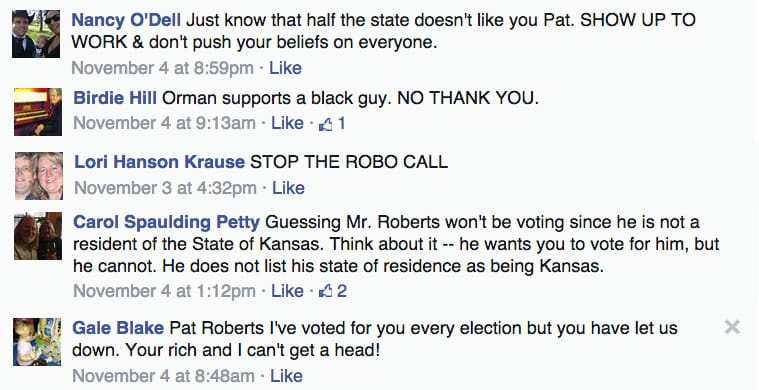
Comments pulled from Pat Roberts for Senate 2014 Facebook Page. Click here

Campaigns have the power to respond to comments and reframe the debate. They have the power to remove offensive comments from their wall (because there will nearly always be offensive comments on a Facebook wall). Campaigns have the opportunity to influence not only their fans, but the friends and family of their fans by actively engaging in and monitoring the conversation.
A great example of a campaign that failed to follow this simple rule is U.S. Senator Pat Roberts, who was running for re-election against Independent Greg Orman. On Election Day, comments on his GOTV messages on Facebook ranged from people complaining about his robo calls, to offensive comments bashing his opponent, to criticisms of his job in office.
While these didn't cost him the election, the campaign could have easily responded to these comments -- especially on Election Day.
Despite the unavoidable negative commentary that the anonymity of the Internet breeds, most people using Facebook and Twitter do not want their newsfeeds bombarded with attack ads. Americans have consistently reported that negative campaigning is a turn-off, so why do consultants continue to use it?
Because changing how they operate to adapt to the creativity and innovation that the Internet invites would just be too much work. Political consultants who have spent their careers perfecting their craft would have to change how they talk to people. Entrenched party bosses would have to employ new methods to spread their message to a growing range of voters.
Instead, consultants continue to regurgitate traditional strategies in the not-so-traditional online landscape, often times failing to engage voters.
Fact: Sending three fundraising emails in one day will result in voter frustration, annoyance, and an unnecessarily high number of unsubscribes.
Just because a consultant's life now revolves around this campaign, their supporters still have their jobs, families, and probably an inbox full of work-related emails. Don’t annoy them early in the campaign by over-saturating them with fundraising emails and GOTV-type messages on Facebook and Twitter.
One of the keys to successfully managing a political campaign online is to continuously test strategies until one that fits is found.
This does not mean posting a status on Facebook and forgetting to measure its reach, how many users engaged with the post, and the sentiment of the feedback. And this does not mean sending out one version of an email and hoping people will open it.
This does mean analyzing successes along the way. What if a Facebook post doesn't reach as many people as a previous post? Consultants should take a look at what time it was posted in comparison to more successful posts. They should be comparing the language and imagery used in successful and unsuccessful posts and using this data to shift their strategy if necessary.
Running a political campaign gives you the unique opportunity to respond to negative feedback with the click of a button -- something that is impossible with traditional print and TV advertising.
Instead of dismissing user comments that are negative, political consultants should use them constructively to address the individual's concerns by responding on Facebook. If it's an issue that relates to all constituents, the campaign should write a blog post and share it with all online audiences.
It is not campaigning that starts too late. It seems candidates are already gearing up for 2016. However, what most traditional political consultants don't understand is that online it takes time to develop a base of supporters who will act as online advocates.
A candidate needs to earn the trust of their online base, and this means posting relevant and meaningful content on their social media channels year-round. If an initial connection has not been made with a person online, how can they be expected to share campaign messages when it matters?
Start building meaningful relationships early, so that when mobilizing a base is needed to share a particular image, or change his or her profile picture, the campaign can count on its audiences online.