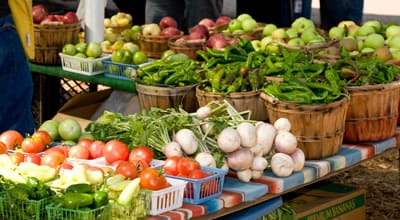
USDA rule changes proposed by Secretary of Agriculture Tom Vilsack would not only benefit the local food movement but would make for more effective use of Farm Service Agency (FSA) resources, says the Department of Agriculture.
Earlier this month USDA officials began a tour of the Western United States, seeking public comment on their proposal to offer microloans to beginning and specialty farmers. With a loan cap of $35,000, microloans would cater to very small start-ups. So far the feedback has been positive.
"As we expand options in agriculture, we're seeing a new vibrancy across the countryside as younger people - many of whom are now involved in local and regional production - pursue livelihoods in farming, raising food for local consumption," Vilsack said.
Since 2008, 40 percent of FSA loans have gone to beginning farmers, but microloans promise to increase the number of farm start-ups by filling a financing void. In recent years “micro-farms” have exploded onto the agricultural scene due in part to growing demand for locally produced food. Other factors that have led to a resurgence of small-scale farming operations (after a decades-long trend of farm consolidation) are record high commodity prices and a still shaky job market, making agriculture a very attractive choice for entrepreneurs.
Until now, financing options from the federal government did not cater to so small of operations.
“What inspired our new microloan program is that our traditional loan program that we offer did not fit all farmers well,” said Washington state FSA representative Chris Bieker during a recent tour stop. “The average age of farmers throughout the country has increased into the late 50s. There are new generations of farmers trying to get into farming. One of the largest obstacles of getting into farming is access to financing.”
The USDA hopes that its microloan program, with reduced paperwork, lower collateral requirements and more flexibility with loan terms, might be the key to enticing young people back to the land.
In addition to shrinking its standard 17-page loan form to 8 pages, the USDA has simplified reporting of past yields for microloan borrowers. This is because, as Bieker points out: “Many specialty farmers may change what they’re growing from year to year; they don’t necessarily have the production history records that we require for traditional loans." The program will also slacken elegibility requirements, allowing farm apprenticeships and in some instances past membership in associations such as FFA or 4-H to count towards farm management experience. Microloans will also come at a low interest rate, around 5%.
Though the announced microloan program is not exclusive to young or beginning farmers, USDA Undersecretary Michael Scuse has emphasized the agency's goal to make young farmers successful by giving them “another tool in the toolbox." He is here referring to several other financing options available to young and beginning farmers to buy land and equipment to get a start in the industry. But as Scuse noted, "You don't have to farm a thousand acres to make a living today."
The USDA wants to roll out the microloan program by the end of the year. It is receiving public comment on the proposal until July 24. Comments can be submitted online here or mailed to:
Director; Loan Making Division, FSA, USDA; 1400 Independence Ave. SW, Stop 0522; Washington, DC 20250-0522.
If you do decide to submit a comment to the agency, be sure to offer a copy to IVN readers in the comments section below.