
 Chad Peace
Every election cycle, we get the same headline dressed up in new numbers. In 2024, Latino voters shifted toward Donald Trump, and the national media treated it like a historic partisan realignment. A tectonic shift. The Latino vote was "coming home" to the GOP.
Then, almost immediately, came the speculation about a 2026 backlash and a swing right back toward Democrats.
Here's the problem with that framing: it assumes Latino voters are a bloc that gets handed from one party to the other, like a football at midfield. Axios got closer to the truth when it described the Latino vote as "fragmenting" rather than realigning.
And Mike Madrid, a longtime Republican strategist, co-founder of the Lincoln Project, and author of "The Latino Century: How America's Largest Minority is Transforming Democracy," put it about as plainly as it can be put.
"It's a dealignment," Madrid said on Newsweek's "The 1600" podcast and in comments to Axios. "It's not a realignment."
What "De-Alignment" Actually Means
So what's the difference? A realignment is when a group of voters trades one party jersey for another. A de-alignment is when they take the jersey off entirely.
Madrid, who has spent more than three decades studying Latino voters, argues that Latinos aren't uniformly swapping D for R. Plenty of them land in one party or the other for their own individual reasons. But the polling shows something more fundamental going on underneath: Latino voters carry less overriding party loyalty than the historical American norm, and a growing share want no party label at all.
That's not a story about which party is winning. It's a story about both parties losing their grip.
California Is the Proof
If you want to see de-alignment in the raw numbers, look at California. An analysis of L2's voter file, compiled in August 2026, lays it out.
Latinos make up 35% of California adults, the largest group in the state. But they're under 20% of the state's most likely voters. Madrid calls that "the participation gap," and he's careful to distinguish it from a motivation gap. It's not that Latino voters don't care. It's that the system hasn't historically made their vote count.
Now look at how they register. Latino voters in California break out to roughly 55% Democratic, 30% no party or independent, and 16% Republican. That 30% no-party share is well above the statewide independent rate of about 22%.
In other words, Latino voters are less partisan than California as a whole, not more.
And they're showing up. Latino independent turnout jumped from 11.8% in the 2022 primary to 16.5% in the 2026 primary. That's a roughly 40% jump, about three times the growth of the electorate overall.
The June 2026 California primary drew 9,446,461 ballots, a 40.8% turnout. That's the highest gubernatorial primary turnout since the state started keeping records back in 1914. And here's the part worth sitting with: ballot growth over 2022 ran +56 to 63% among independents (No Party Preference and the American Independent Party), compared to +38% for Democrats and +34% for Republicans.
Independents grew fastest. And Latino independents drove a large share of that surge.
The Rules Are Doing the Work
None of this happens in a vacuum. California uses a top-two primary, which lets every voter, regardless of party registration, vote for any candidate on one ballot. The top two vote-getters advance to November, no matter their party.
That's not a small detail. That's the whole game.
Madrid made this argument in a Sacramento Bee op-ed, republished by IVN as "California Latinos Showed Up—Now Party Insiders Want to Shut Them Out." His point: the top-two system is precisely why Latino independents could show up and matter in the 2026 governor's race.
And he warned that a campaign to repeal Top Two and restore partisan primaries would disproportionately silence the fastest-growing, least-partisan share of the electorate. He called it "voter suppression aimed at the fastest-growing share of the electorate, dressed up as a return to party order."
Voters seem to agree. A May Independent Voter Project survey found 53% of respondents wanted to keep or expand Top Two, versus only 22% who wanted to eliminate it and return to partisan primaries.
The Becerra Effect
Here's where it gets concrete. Out of a field of more than 60 candidates, Xavier Becerra emerged as a surprise frontrunner in the 2026 governor's race. Becerra, a Democrat and former US Health and Human Services Secretary and California attorney general, is now positioned to become California's first Latino governor in modern history.
Reporting attributed his rise partly to growing enthusiasm among Latino voters. Per Madrid's analysis and that reporting, this isn't a coincidence. It's the visible result of the participation trend above.
The same de-aligned, independent-minded Latino electorate that top-two primaries let participate fully is the electorate that helped push a Latino candidate to the front of a crowded pack.
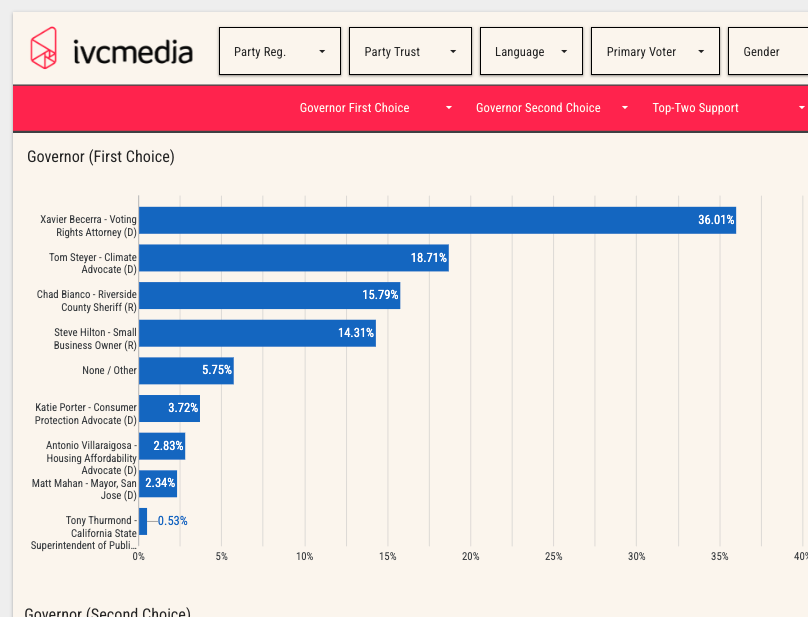
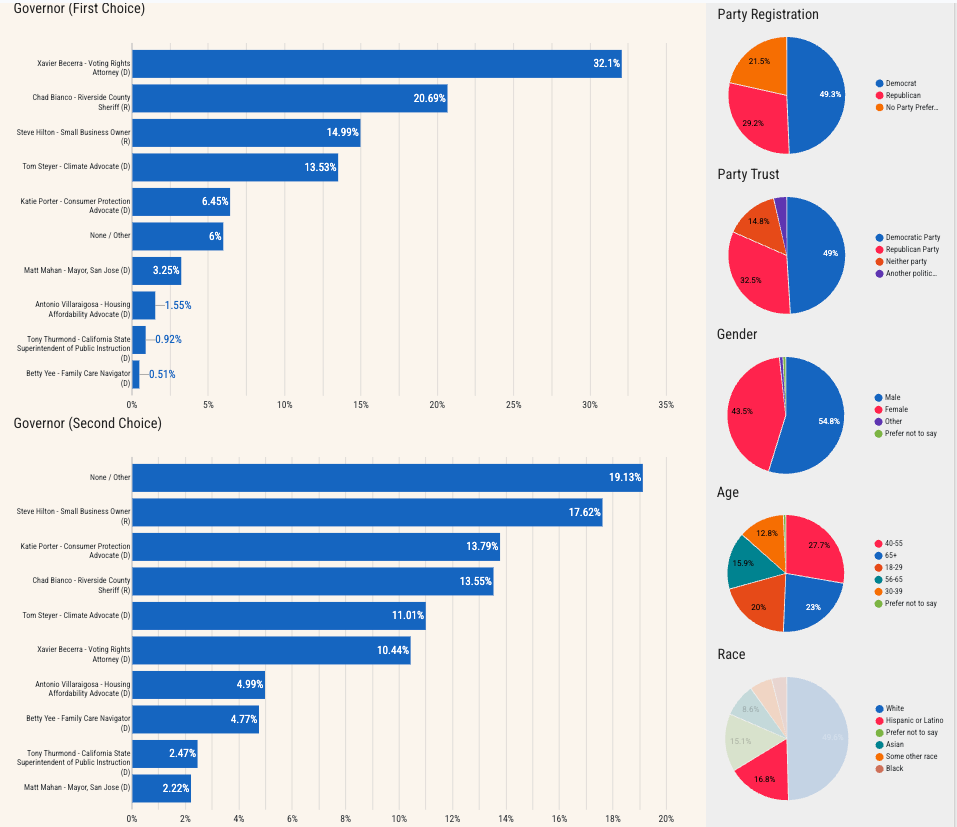
The numbers back it up. In polling among Latino voters, Becerra led runner-up Tom Steyer for first-choice governor by roughly two to one, 32.1% to 13.5%. A separate Independent Voter Project survey, highlighted by the New York Times, found the same pattern once results were isolated for Latino respondents.
Now the Young Voters
Here's the part that should reframe the whole conversation. The behavior we keep filing under "Latino trend" is now showing up across the youngest slice of the electorate, regardless of ethnicity.
A CIRCLE survey found that 43% of Gen Z voters, ages 18 to 29, report no party affiliation, even though most still nominally lean Democrat or Republican. An Arizona State University survey titled "Frustrated but Engaged" found that Gen Z voters are more likely than voters over 30 to register independent or "no party declared." Four in five young respondents said the two major parties don't represent people their age.
Those are large numbers.
Weak party loyalty. Issue-driven rather than party-driven voting. Participation that depends heavily on whether the rules let their vote actually matter. Those are the exact traits we've spent a decade treating as distinctly Latino. They're becoming the norm for the rising generation of American voters.
Latino voters didn't turn out to be the anomaly. They were the preview. They just got there first.
Where This Goes
As more states debate open primaries, ranked choice voting, and how independents get to participate at all, the California experience offers a useful lens. The fight over election rules isn't really a fight about procedure. It's a fight over how much of the fastest-growing, most de-aligned parts of the electorate get heard.
The Latino vote showed us what that looks like. The next generation is about to show us how big it gets.