Skip to content
Subscribe

Correlation Between Taxes on Wealthy and Economic Growth Questionable

Published:

Credit: Congressional Research Service
To qualify as one of the top 1% of income earners in the United States, one must earn around $350,000 and above, annually. For the purposes of this article, ‘rich’ will refer to this top 1% of income earners.

The prevailing arguments surrounding tax policy reform this election fall into two primary camps. One argues that the wealthiest Americans are already paying their fair share in taxes and any increase would stifle already weak economic growth and lead to higher unemployment. The other camp argues that wealthy Americans have perverted the tax system to benefit themselves and this has resulted in weak economic growth.

Driving this debate is the mounting US deficit. In order to address America’s overwhelming debt, tax policy must change in one form or another in order to slow and eventually reverse the growing disparity between revenue and borrowing. There is consensus on one facet of this debate: the only way to address the mounting debt is to either increase revenues (by raising taxes or closing loopholes and exemptions) or cut spending (government services like Medicare and Social Security), or a combination of both.

A Congressional Research Service report released in September sought to answer a key question: Will raising taxes on the wealthy create economic growth?

Historical anecdotes are used by all camps to justifier higher or lower taxes on the rich. Opponents of raising taxes on the wealthy reference the past periods of economic prosperity like the 1920s and the Reagan era. During the Reagan era, real median household income rose by $4,000, as tax rates were lowered. Similarly, during the roaring 20s marginal tax rates on high-income earners were lowered from 73 percent to 25 percent.

debating

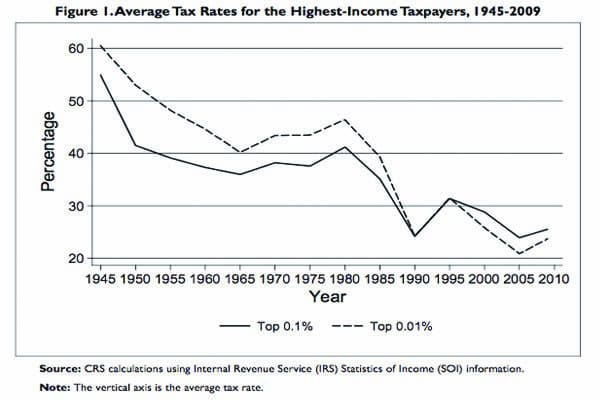
Those in favor of raising taxes on high-income earners point to post-war growth from 1945-1981.

debating These results suggest that as the top tax rates are reduced, the share of income accruing to the top of the income distribution increases - that is, income disparities increase.
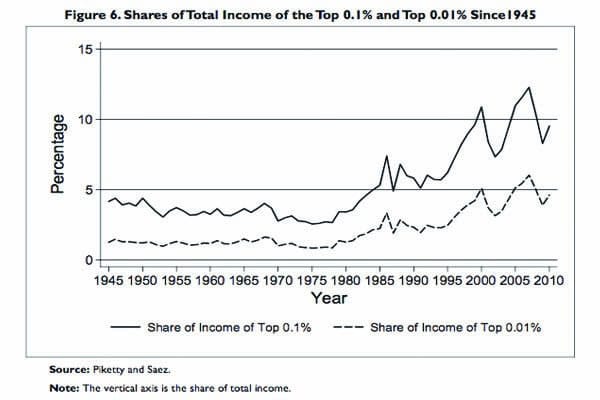
The Congressional Research Service’s report made several conclusions regarding economic growth and its relationship to tax rates on the wealthy.

“The results of the analysis suggest that changes over the past 65 years in the top marginal tax rate and the top capital gains tax rate do not appear correlated with economic growth. The reduction in the top tax rates appears to be uncorrelated with saving, investment, and productivity growth. The top tax rates appear to have little or no relation to the size of the economic pie. However, the top tax rate reductions appear to be associated with the increasing concentration of income at the top of the income distribution.”

Whether or not lowering or raising tax rates on the wealthiest Americans leads to more or less economic growth remains murky. Yet, there is one Congressional Research Center finding that is absolutely clear: the correlation between tax cuts on the wealthy and income inequality is a positive one. As tax cuts for the wealthy increase, so does income inequality.

Adhere to the IVN etiquette

By posting a comment, you agree to adhere to our etiquette rules: No partisan attacks, no personal attacks, substantiate your sources, no self-promotion.

Contact IVN

Questions about this article or our coverage? Send us a message. A free IVN member account is required.

Message sent

Thanks, we’ll review it and get back to you if needed.

Message not sent

Sorry, something went wrong. Please try again.

Sign in to send a message

Messages are tied to your IVN member account. Signing in is free and takes a few seconds.

Republish this article

Republishing guidelines

Republish IVN articles for free. Independent Voter News articles may be republished online or in print under a Creative Commons BY-NC-ND 4.0 license, on these terms:

  1. Credit the author and IVN. Keep the byline ("By Author Name, Independent Voter News") and the attribution note at the end, which links to the original.
  2. Keep the meaning. You may update time and place references and apply your house style. You may trim for length, as long as the cuts don't change the meaning or misrepresent the author. Keep the headline. Mark any additions as your own (for example "Additional reporting by ...").
  3. Translations are welcome. Translate faithfully, add "Translated from English by [your outlet]", and tell us at editor@ivn.us.
  4. Keep the links, including the link to the original article.
  5. Keep the tracking image. The HTML includes a 1-pixel image that counts readers on your page. It collects no personal information.
  6. Photos and illustrations. Images credited to IVN may be used with this article only. Images credited to others (AP, Getty, Unsplash, Wikimedia and so on) stay under their owners' terms. Secure the rights or switch "Include images" off.
  7. Don't sell it. You can't sell our articles or sell ads specifically against them. Your normal site advertising is fine.
  8. No implied endorsement. Don't suggest that IVN or the author endorses you, your candidates or your causes, or that donations to you support IVN.
  9. Keep labels. Opinion or analysis pieces keep that label.
  10. Point search engines to the original. Where your CMS allows, set the canonical URL to the original IVN article.
  11. No bulk or automated republishing, and don't submit our articles to aggregators (Apple News, Google News, MSN) as your own.
  12. Corrections and removals. Update your copy when we correct it, and remove it promptly if we ask. We'll contact you at the email you give us.
  13. Questions or print republication: editor@ivn.us.

IVN staff: fill in who you're inviting above, then create the invite.

Preparing the article

Correlation Between Taxes on Wealthy and Economic Growth Questionable

Choose a format
  • HTML
  • Email HTML
  • Markdown
  • Formatted (.docx)
  • Plain text
  • WordPress blocks
  • PDF
Choose a platform

Photos credited to others need their owners' permission.

To for

Republishing somewhere else? Questions? editor@ivn.us