 Shawn Griffiths
Four independent veterans are running for offices in Tuesday’s primary in Eastern Washington—each representing a different military branch, level of government, and a different path through the state’s nonpartisan Top Two primary.
Nate Powell, for example, is running for Congress. Danny Tarkenton wants to become Spokane County’s prosecuting attorney. Aaron Croft is seeking a state House seat. And Ronald McCoy is running for the state Senate.
One thing they all have in common is that they have been endorsed by Independent Veterans of America (IVA), founded by Paul Rieckhoff to “identify, inform, and unite independent veterans and give them a voice at all levels,” according to the group’s website.
These candidates will not appear together on every voter’s ballot, though their races cover overlapping constituencies inside Washington’s 5th Congressional District.
However, all four of them are competing under the same nonpartisan primary rules: Every voter and candidate participates on a single primary ballot, regardless of party, and the top two candidates advance to November.
This system gives independent voters AND candidates something they rarely receive elsewhere. Specifically, an equal place in the primary.
Washington became the first state in the US to adopt this type of nonpartisan, voter-nominated system when voters approved it with nearly 60% of the vote in 2004, and it has been used in elections since 2008.
The Eastern Washington Electorate
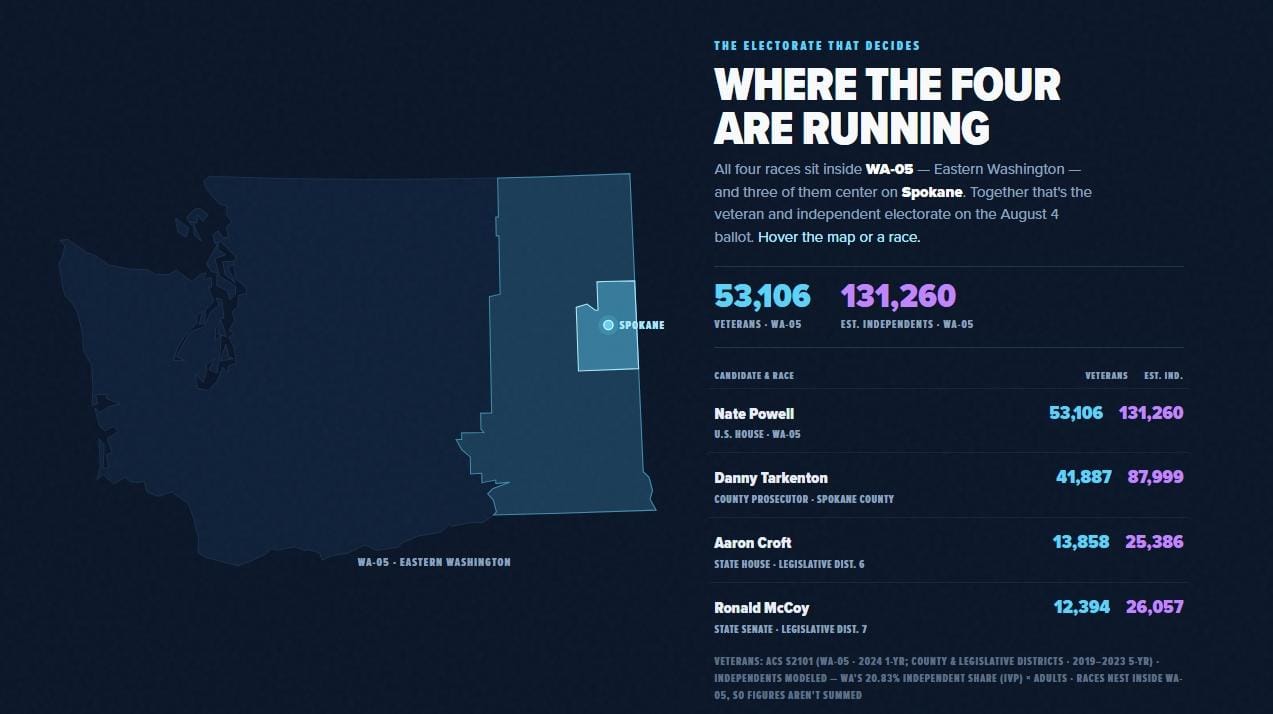
- Washington’s 5th Congressional District contains 53,106 veterans and approximately 131,260 independents.
- Spokane County has 41,887 veterans and 87,999 independents.
- Washington’s 6th Legislative District has an estimated 13,858 veterans and 25,386 independents
- The 7th District has 12,394 veterans and 26,057 independents.
Notably, these figures are estimates—not official registration totals.
Washington does not register voters by political party. IVA calculated the numbers by applying a statewide estimated independent share of roughly 21% to the adult population in each constituency.
The statewide figure for independent voters comes from data compiled by the Independent Voter Project. The veterans figures come from the American Community Survey.
Nate Powell: The Crowded Congressional Fight
A Marine Corps veteran and Spokane firefighter, Nate Powell has arguably the most difficult path of the four—just looking at the numbers.
There are 12 candidates running in Washington’s 5th Congressional District, including Republican incumbent Michael Baumgartner, 5 Democrats, and 5 candidates identified as independent.
Powell must finish ahead of at least 10 of them to reach November.
He has framed his campaign around working-class representation, arguing that Congress has become dominated by wealthy donors, corporate interests, and career politicians. His priorities include the cost of living, health care and the national debt.
He describes himself as a union firefighter, father, and veteran running because neither major party has adequately represented working families.
 Matt Shinners
The district-wide numbers give Powell the largest independent-veteran electorate of the four candidates: 53,106 veterans and an estimated 131,260 independents. But he is also in the largest and most fragmented candidate field.
Danny Tarkenton: An Independent Prosecutor in a Two-Candidate Race
Danny Tarkenton, an Army National Guard veteran, is running for Spokane County prosecuting attorney against Republican incumbent Preston McCollam. Her candidacy stands out because unlike the other 3 veterans featured in this piece, she is guaranteed a spot in November.
Tarkenton is a Gonzaga Law graduate and former Spokane County deputy prosecutor. After returning from Iraq, she studied philosophy, psychology and forensic psychology. She says this academic path shaped her belief that public safety requires addressing the behavior and conditions that repeatedly send people through the justice system.
Her campaign emphasizes evidence-based prosecution, breaking cycles of harmful behavior and keeping the office independent of party pressure.
Because there are only two active candidates in this race, all Tarkenton has to do is meet Washington’s minimum requirement of receiving at least 1% of the vote to advance to the general election.
Tuesday’s primary is therefore less about surviving for her than establishing a baseline for November. It will be a test to see if an independent challenger can begin the general election within striking distance of an incumbent Republican.
Aaron Croft: One Independent, One Democrat, One Republican
Air Force veteran Aaron Croft is running in Washington’s 6th Legislative District, which includes communities around northwest Spokane County, Fairchild Air Force Base, Airway Heights and Medical Lake.
Croft served nearly 22 years in the Air Force, including as a combat search-and-rescue helicopter pilot. He faces former Spokane City Council member Jonathan Bingle, a Republican, and Democrat Julia Payne.
Three candidates. Two spots in November.
Croft’s campaign has focused on lowering living costs, expanding health care coverage, challenging monopolistic business practices, and removing election barriers for independent candidates.
IVA also lists ranked choice voting among his reform priorities.
The math is more straightforward than Powell’s situation: He does not have to deal with a large candidate field. He does not have to defeat both major parties. He only needs to defeat one of their candidates.
Ronald McCoy: One Independent Against Three Republicans
Ronald McCoy, a retired Navy petty officer and former mayor of Chewelah, is running for the state Senate in Washington’s heavily rural 7th Legislative District.
His campaign focuses on many of the same issues as the other independent veterans featured: rural health care access, affordable housing, small-business development, and job creation—particularly for younger residents to remain in northeastern Washington.
This is a race that pits McCoy against 3 Republicans, including incumbent Sen. Shelly Short, Brandon Ray Medina, and David Swoap, which creates a unique opportunity for him to take one of the top two spots in November.
Three Republicans are competing for overlapping voters, which means they will split the Republican base. McCoy, on the other hand, can consolidate independents, crossover voters, and residents looking for an alternative to an all-Republican November contest.
There is no guarantee that the Republican candidates will split the vote enough for McCoy to advance. However, there are enough veterans and independents in the district to prevent the GOP from treating the primary as an exclusively internal party competition.
The Parties Don’t Get the Final Say
Washington’s system does something only two other states (Alaska and California) do: It allows independent candidates and voters to compete and participate under the same rules as everyone else.
It also ensures every voter can vote for any candidate they want, regardless of party. Voters are not forced to pick a party. They are not limited to the options of one side or the other.
Their options are the entire field.
This does not, on its own, guarantee independent candidates an advantage. Powell has to survive a 12-candidate congressional field. Croft must beat either a Democrat or a Republican. McCoy must leapfrog at least two Republicans.
The system does not guarantee anyone or any party a place in November. It guarantees voters have the most control over who advances—and does not condition the right to vote on joining a political party.
This gives the four campaigns featured here access to opportunities they would not have under party-nominated processes. The parties do not get to decide whether these independent veterans deserve to be considered.
Washington voters do.