Skip to content
Sign up free
News

U.S. Emissions Drop Due to Switch to Shale Gas from Coal

By Breakthrough Institute

2-minute read

Credit: eia.gov

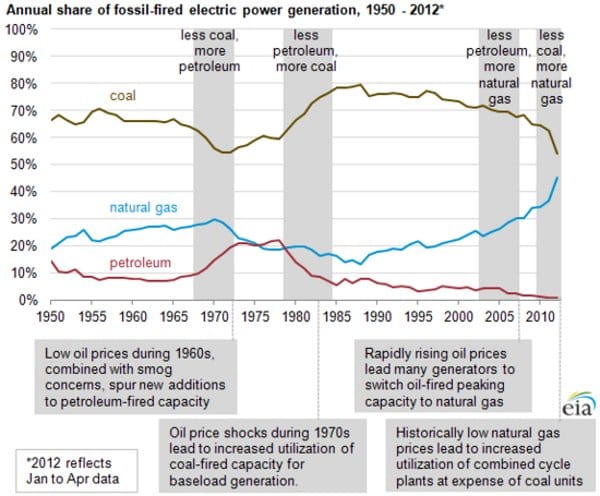
U.S. emissions have dropped 7.7% since 2006 due to the rapid switch from coal to shale gas.  All this cheap gas came from a concerted, public-private effort dating back to the mid-1970s to cheaply extract gas from shale. There is a clear lesson for those concerned about global warming: seek public-private investments in technological innovation to make clean energy cheap.

Breakthrough Institute has since 2007 made the case that a public-private technological push on clean energy sources was the key to reducing emissions, and that carbon pricing is less important. The shale gas revolution shows that a rapid and significant decline in emissions can occur without cap and trade or a carbon price. Europe has had both, but neither have resulted in any measurable emissions reductions.

To deal with global warming, we will need an entirely new energy infrastructure. Creating a new energy infrastructure is more comparable to the creation of the railroads, the interstate highway system, personal computers, the Internet, and the space program than it is to installing catalytic converters and scrubbers, or phasing out ozone-depleting chemicals. The latter involved mere technical fixes, not wholesale technological revolutions.

Environmentalists have been so focused on making clean energy relatively cheaper (by imposing regulations that make dirty energy expensive) that they overlook the possibility of making clean energy absolutely cheaper through major investments in technology innovation and infrastructure.

Causes of the shale gas revolution.

The history behind the shale gas boom remained virtually unknown until late 2011, when researchers at the Breakthrough Institute conducted an extensive investigation revealing the role that federal agencies like the Department of Energy and the National Laboratories played in supporting gas industry experimentation with shale fracking.Featured in the Washington Post and the President's 2012 State of the Union, this Breakthrough investigation enunciates - again - the crucial role that the federal government has always played in technological innovation...

Government-led efforts to make shale gas and renewables cheap challenge the orthodoxies of neo-classical economists

The Economist's Ryan Avent says "economics is clearly moving beyond the carbon-tax-alone position on climate change, which is a good thing." In fact, Acemoglu and his colleagues went further than Avent suggested. "Optimal policy," they found, "relies less on a carbon tax, and even more so on a direct encouragement of clean energy technologies."

Which nations have reduced their emissions most rapidly? Sweden and France. They did so not through a carbon price or cap and trade but rather technological innovation.

(This was excerpted from The Breakthrough Institute, where it first appeared.)

Tags: News

Adhere to the IVN etiquette

By posting a comment, you agree to adhere to our etiquette rules: No partisan attacks, no personal attacks, substantiate your sources, no self-promotion.

Get IVN’s Free Weekly Newsletter:Get IVN’s Free Newsletter

Get IVN’s Free Weekly Newsletter:Get IVN’s Free Newsletter

Nonpartisan Issues. Diverse Perspectives.

Check your inbox and click the link to confirm.

Republish this article

Republishing guidelines

Republish IVN articles for free. Independent Voter News articles may be republished online or in print under a Creative Commons BY-NC-ND 4.0 license, on these terms:

  1. Credit the author and IVN. Keep the byline ("By Author Name, Independent Voter News") and the attribution note at the end, which links to the original.
  2. Keep the meaning. You may update time and place references and apply your house style. You may trim for length, as long as the cuts don't change the meaning or misrepresent the author. Keep the headline. Mark any additions as your own (for example "Additional reporting by ...").
  3. Translations are welcome. Translate faithfully, add "Translated from English by [your outlet]", and tell us at editor@ivn.us.
  4. Keep the links, including the link to the original article.
  5. Keep the tracking image. The HTML includes a 1-pixel image that counts readers on your page. It collects no personal information.
  6. Photos and illustrations. Images credited to IVN may be used with this article only. Images credited to others (AP, Getty, Unsplash, Wikimedia and so on) stay under their owners' terms. Secure the rights or switch "Include images" off.
  7. Don't sell it. You can't sell our articles or sell ads specifically against them. Your normal site advertising is fine.
  8. No implied endorsement. Don't suggest that IVN or the author endorses you, your candidates or your causes, or that donations to you support IVN.
  9. Keep labels. Opinion or analysis pieces keep that label.
  10. Point search engines to the original. Where your CMS allows, set the canonical URL to the original IVN article.
  11. No bulk or automated republishing, and don't submit our articles to aggregators (Apple News, Google News, MSN) as your own.
  12. Corrections and removals. Update your copy when we correct it, and remove it promptly if we ask. We'll contact you at the email you give us.
  13. Questions or print republication: editor@ivn.us.

IVN staff: fill in who you're inviting above, then create the invite.

Preparing the article

U.S. Emissions Drop Due to Switch to Shale Gas from Coal

Choose a format
  • HTML
  • Email HTML
  • Markdown
  • Formatted (.docx)
  • Plain text
  • WordPress blocks
  • PDF
Choose a platform

Photos credited to others need their owners' permission.

To for

Republishing somewhere else? Questions? editor@ivn.us