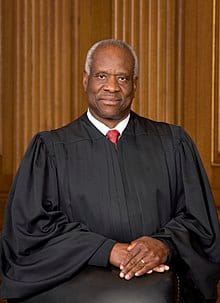
I was dismayed and disappointed, to say the lest that someone who themselves benefited from Affirmative Action, Justice Clarence Thomas, voted against it. This was all the more disturbing, as the case seems to have been groomed for the decision, and to have been won through misrepresentation of fact.
It appears that the plaintiff, Ms. Abigail Fisher, did NOT lose a well-earned position in the college of her choice that should have been hers through hard work and achievement; quite the opposite. And of those who scored lower than she did on some metric, for the few remaining positions, they do appear to have scored higher on others, and overwhelmingly those other students were white with only a few who were black. The notion that she lost out because of race was disingenuous at best, and outright dishonest at worst. The Atlantic did an excellent review of why her claim was false.
Fisher did an excellent job of playing the conservative victim card. She promoted the age old right wing myth that white people are disadvantaged through affirmative action, while conveniently ignoring relative actual advantage and disadvantage. Nothing in the actual statistics of Ms. Fisher's rejection from the University of Texas show that to be true. More generally, white students have higher rates of graduation, from better performing schools, and have a greater percentage of college attendance. When minorities DO attend college, they incur greater rates of student loan debt. The comparative struggles to enter and complete college are quite dissimilar.
According to multiple sources, but just quoting here from the government report Status and Trends in the Education of Racial and Ethnic Minorities:
In 2008, about 72 percent of recent White high school completers were enrolled in college in that same year, up from 50 percent in 1980. In addition, the immediate transition to college rate was higher in 2007 than the rate in 1980 for Blacks (56 vs. 44 percent) and for Hispanics (62 vs. 50 percent) (indicator 23.1).
For context, whites make up 72% of the population, with Hispanics at 15% and Blacks at 12%.
Ultra-conservatives claim, as a foundational belief of their ideology, that whites are victims of reverse discrimination. This appears to be at the core of extreme conservatism generally, and to an even more pronounced degree among hard core white supremacists.
For a long time I've thought that Clarence Thomas substantially conducted his time on the Supreme Court bench perfecting his impersonation of a lump on a log, saying little, originating few if any original opinions. Looking back at Thomas's career, he has never been particularly distinguished as a legal mind. Taking a survey of his academic and legal career, it has been pretty clear that Thomas has never been a top legal mind, and that his career has consisted largely of political appointments that relied on his towing the party line reliably.
Legal scholar and author Jeffery Toobin described Thomas, picked to replace retiring Thurgood Marshal, as the only plausible black candidate who would provide a reliably conservative vote. That certainly sounds like both tokenism and political patronage rather than merit, in the larger context of failure to be hired for any job that was not a political appointment combined with the ABA low rating.
When Thomas was proposed for the Supreme Court, it had been customary for the American Bar Association to rate proposed Justices. The White House and Republican Senators pressured the ABA to give Thomas a competent rating, expecting an incompetent rating; but the rating he did receive was one of the lowest, ever, for a Supreme Court nominee.
But the origins of how Thomas voted goes back much further. After graduating from Yale, Thomas couldn't get a job. He blamed affirmative action, even though other minority students did not have the same problem. Clarence Thomas was very vocal in blaming affirmative action for devaluing his degree; the reality is that it appears to be a lack of ability, and only moderate accomplishment while at Yale, graduating in the middle of his class. Thomas claimed that interviewers believed that potential employers thought that if he didn't earn his admission, but was accepted only through affirmative action, that he must not be very good.
wrote in his memoirMy Grandfather's Son
What Thomas fails to acknowledge, is that he is a political hack who doesn't appear to be a significant contributor to the SCOTUS, or any of his previous political patronage positions, through no fault of affirmative action, and entirely through the failure of Justice Clarence Thomas.
In the case of Abigail Fisher, Thomas, in one of the few opinions he has ever bestirred himself to provide, compared affirmative action to slavery and segregation.
Except that Abigail Fisher did NOT in fact qualify for a position at the college to which she applied, and did not, so far as can be factually determined, lose a deserved placement on merit to a minority student.
In this regard, as only the second African American to hold that distinguished position, he differs significantly from his predecessor, Thurgood Marshall, as well as lacking the accomplishments and distinguished record on the bench of the first two women to hold the position, Sandra Day O'Connor and Ruth Bader-Ginsburg.
In a previous piece I defined a person who was a token as someone from a minority (either demographic or by representation in power) who defers consistently to the dominant group or majority against the interests of his or her own experience. Thomas, in my opinion, meets that definition.
Thomas's decision is a tremendous disappointment, that appears to derive more from his own long standing wounded vanity and ego. That decision is likely to be harmful to more talented minority future scholars who could become the next Thurgood Marshall or Sandra Day O'Connor or Sonia Sotomayor or Louis Brandeis.
THAT harms us all. We can only hope that the factual errors in the decision, the lack of validity to the claims made by Abigail Fisher, might lead to the decision being undone, fully or in part, by a future SCOTUS that operates less on extreme partisan ideology and ego.