Skip to content
Subscribe

Student Loans in California Worth the Burden and Make Economic Sense

Published:

The latest study from the Public Policy Institute of California (PPIC) provides a cost-benefit analysis and discussion of student loans in California. Student debt is currently a hot discussion on the national level, but the Golden State seems to have relatively better situations for college students.

Hans Johnson, co-director of PPIC, spoke on a panel discussion hosted by the organization on June 4. When asked if student loans make economic sense, he answered with a "resounding yes." Johnson does not speak for the PPIC, but refers to the data provided by its study.

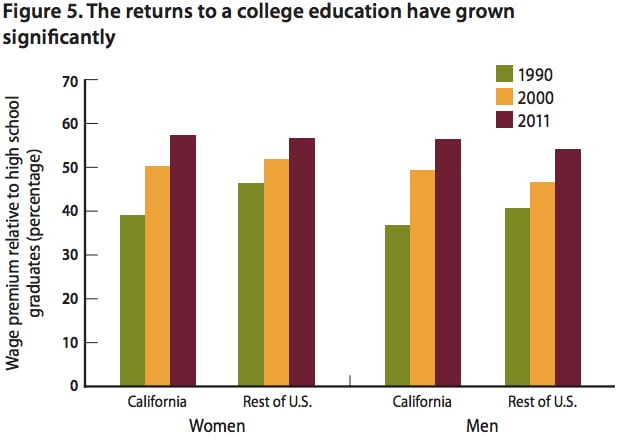
On average, college graduates are shown to earn much more than high school graduates, and the gap has grown over time. From 1990 to 2011, the percentage of wage earning increases have gone up almost 20 percent. This holds true in both California and the United States for both men and women.
Student Loans in California Worth the Burden, PPIC Study 1

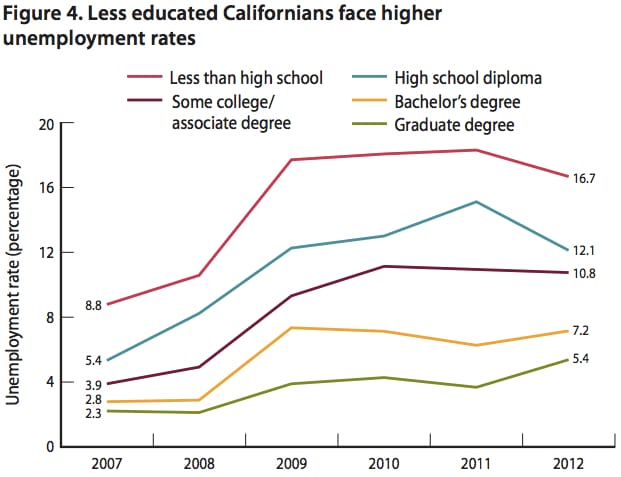
Although unemployment remains high in the state, college graduates have a much lower unemployment rate. Of course, the point of a degree is to secure better employment. But, through the recession, Bachelor's degree holders experienced unemployment rates 5 percent lower than those with high school diplomas.
Student Loans in California Worth the Burden, PPIC Study 2

The figure may not answer the concern of underemployment, but the study does. It states that 11.8 percent of degree holders are underemployed, while high school graduates are at 23 percent.

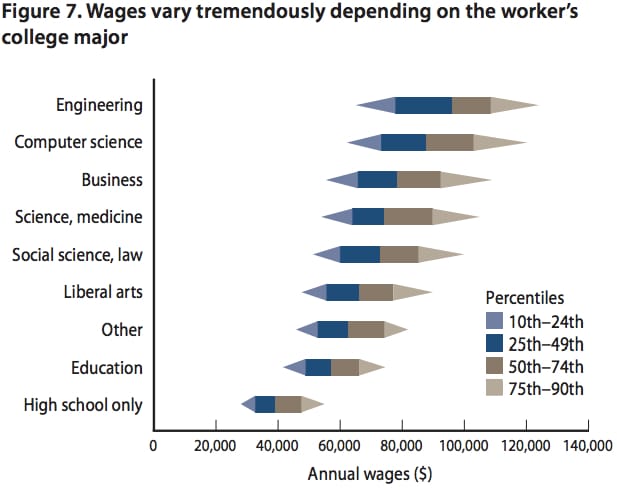
Degree majors are still a significant factor in wage earnings. This is one of the most important data set to look at when determining the worthiness of an education and if student loans are a smart option. However, the median annual income for all degrees are higher than that of a high school graduate.
Student Loans in California Worth the Burden, PPIC Study 3

It is still possible for the highest income percentile of high school graduates to earn more than the bottom percentile with the least lucrative degrees. In fact, 15.6 percent of high school graduates earn more than those who graduated with a four-year degree in education. However, the income gap will grow over time.

Tuition has spiked in recent years, and trends in student loan debt are reminiscent of the 2008 housing bubble. Still, the data supports the notion of incurring reasonable amounts of debt to earn a degree.

Debbie Cochrane of the Institute for College Access and Success participated in the PPIC panel discussion. She explained that a very loose rule of thumb is a student should not take on loan debt higher than expected first-year income.

Smart borrowing is paramount and taking out large loans to earn a degree that does not net enough earnings to pay back is dangerous, and it still happens. However, student loans remain a viable tool for degree attainment, leading to generally better economic situations.

The PPIC provides a wealth of information on the student loan debt dilemma. The entire PPIC study can be downloaded here.

Adhere to the IVN etiquette

By posting a comment, you agree to adhere to our etiquette rules: No partisan attacks, no personal attacks, substantiate your sources, no self-promotion.

Contact IVN

Questions about this article or our coverage? Send us a message. A free IVN member account is required.

Message sent

Thanks, we’ll review it and get back to you if needed.

Message not sent

Sorry, something went wrong. Please try again.

Sign in to send a message

Messages are tied to your IVN member account. Signing in is free and takes a few seconds.

Republish this article

Republishing guidelines

Republish IVN articles for free. Independent Voter News articles may be republished online or in print under a Creative Commons BY-NC-ND 4.0 license, on these terms:

  1. Credit the author and IVN. Keep the byline ("By Author Name, Independent Voter News") and the attribution note at the end, which links to the original.
  2. Keep the meaning. You may update time and place references and apply your house style. You may trim for length, as long as the cuts don't change the meaning or misrepresent the author. Keep the headline. Mark any additions as your own (for example "Additional reporting by ...").
  3. Translations are welcome. Translate faithfully, add "Translated from English by [your outlet]", and tell us at editor@ivn.us.
  4. Keep the links, including the link to the original article.
  5. Keep the tracking image. The HTML includes a 1-pixel image that counts readers on your page. It collects no personal information.
  6. Photos and illustrations. Images credited to IVN may be used with this article only. Images credited to others (AP, Getty, Unsplash, Wikimedia and so on) stay under their owners' terms. Secure the rights or switch "Include images" off.
  7. Don't sell it. You can't sell our articles or sell ads specifically against them. Your normal site advertising is fine.
  8. No implied endorsement. Don't suggest that IVN or the author endorses you, your candidates or your causes, or that donations to you support IVN.
  9. Keep labels. Opinion or analysis pieces keep that label.
  10. Point search engines to the original. Where your CMS allows, set the canonical URL to the original IVN article.
  11. No bulk or automated republishing, and don't submit our articles to aggregators (Apple News, Google News, MSN) as your own.
  12. Corrections and removals. Update your copy when we correct it, and remove it promptly if we ask. We'll contact you at the email you give us.
  13. Questions or print republication: editor@ivn.us.

IVN staff: fill in who you're inviting above, then create the invite.

Preparing the article

Student Loans in California Worth the Burden and Make Economic Sense

Choose a format
  • HTML
  • Email HTML
  • Markdown
  • Formatted (.docx)
  • Plain text
  • WordPress blocks
  • PDF
Choose a platform

Photos credited to others need their owners' permission.

To for

Republishing somewhere else? Questions? editor@ivn.us