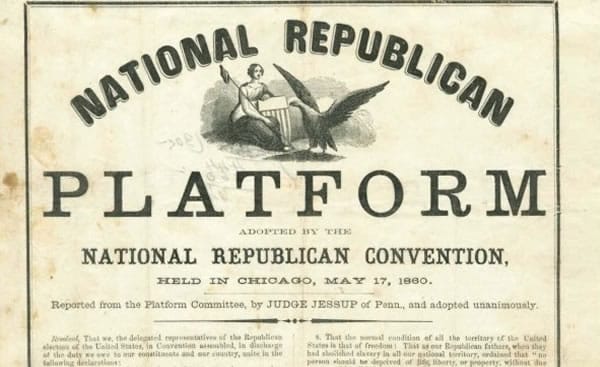
The Republican platform contains a remarkable “sleeper” provision calling for repeal of nearly all of the federal criminal code. So far as I can tell, this radical proposal has not caught the attention of the press or even of legal scholars. Maybe the reason is that it’s buried in a long section on law enforcement.
Here’s what the platform says: “Federal criminal law should focus on acts by federal employees or acts committed on federal property – and leave the rest to the States.” This isn’t just a call to prioritize certain crimes rather than others – instead, it says that the federal government should limit itself to a very narrow set of crimes and the states should do everything else.
That may not leap off the page at you as a big deal. But if you take it seriously, the scope of the proposal is considerably broad. Hundreds, if not thousands, of federal laws would have to go by the wayside. Federal criminal law covers many actions by private citizens that don’t take place on government property – since many crimes take place across state lines or have national significance.
To begin with, we would have to decriminalize drugs, ending bans on interstate drug sales, drug smuggling, and penalties for drug kingpins. Organized crime would be more difficult to regulate, with the repeal of federal anti-racketeering laws. Child pornographers would be similarly less regulated; free from any federal penalties for selling child porn on the Internet. Bank robbers would no longer have to worry about the FBI.
Further, terrorists would no longer be subject to federal law enforcement. So long as they did not commit their crimes on federal land, there would be no federal penalty for even things like blowing up airplanes or buildings like the Twin Towers, or for obtaining or using weapons of mass destruction. The platform would allow criminal penalties for crimes by federal officers but not crimes against them. Theoretically, killing the president or members of Congress or FBI agents would no longer be federal offenses, assuming the crime wasn’t committed on federal property.
White-collar criminals would also find comfort if the GOP platform were fully embraced. No federal penalties for bribing members of Congress or local officials. No criminal penalties for price-fixing conspiracies, securities fraud, bank embezzlement, or bid rigging. No penalties for dumping toxic chemicals or breaking safety laws. No penalties for tax fraud either, as long as it’s not committed in a government building. And the platform also contains another proposal that would benefit white-collar criminals. It calls for repealing laws that make it a crime to intentionally violate federal regulations.
What’s behind this bizarre platform plank? There’s no way to be sure, but it seems to reflect three motivations. The first is pure Tea Party. The federal criminal code extends the power of the national government; a non-starter for many hard-liners. The second is pure Bain. Business people hate the idea that something they might do, as opposed to something done by inner-city gangbangers, could be considered criminal. That may be the source of the platform’s complaint about the “over-criminalization of behavior.” Finally, some convention delegates were probably aware of specific instances where the federal government has criminalized conduct that should be left to the states. They didn’t focus on the fact that the platform’s remedy went far beyond dealing with a few instances of federal overreach.
Of course, there’s no chance that a Republican President or Congress would go that far. Drug dealers, terrorists, and child pornographers are not popular figures with Republicans. White-collar criminals might have better luck, however. Putting inner-city criminals in prison is one thing, but putting away people who go to the office wearing suits somehow seems less palatable. So we might actually see a move to reduce sharply the federal government’s prosecution of white-collar crime.
But more important than its direct impact is what this platform provision says about the Republican Party, and the political dialogue for that matter, today. It shows the lengths to which we are willing to go to accommodate the views of ideological extremists and business interests. It is not a good sign that, in order to placate those groups, the GOP is willing to go on record with a proposal as radical as this one.