
Uncertainty Remains Over Leadership in Egypt After Election

 Ashley Modrzynski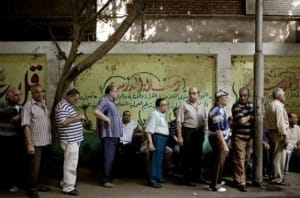
Over the weekend, Egyptians took to the polls to determine their new leader in their first free presidential election since the overthrow of Hosni Mubarak. Ahmad Shafiq, former prime minister of the Mubarak regime, and Mohammed Morsi, conservative Islamist of the Muslim Brotherhood, were running against each other in the first presidential election since Mubarak's overthrow in early 2011. Morsi is believed to be the victor, but uncertainty remains regarding how much power he will have as president. The true result of the election may not be declared until Thursday, according to an electoral supervisor.
The Supreme Council of the Armed Forces (SCAF) has been the ruling power of Egypt ever since Mubarak stepped down. The SCAF has issued an interim constitution that defines the authority of the new president. The power of the president has been stripped considerably and the most authority is given to the SCAF. The military council has also dissolved the Islamist-led parliament. It appears at this point that no matter who is elected in Egypt, the military will be the true ruling authority.
Egypt is not stable. An economic crisis, not unlike what is occurring in the US and Europe, has led to high unemployment and few prospects for young Egyptians. It is also one of the main reasons why Egyptians decided to protest Mubarak's regime. The political fragility of Egypt has sent many investors scurrying because of fears regarding the military-led government. The conflict between the Muslim Brotherhood and the military-led regime has delayed negotiations regarding a $3.2 billion loan from the International Monetary Fund (IMF). The Wall Street Journal reports that the loan could be a solution to restore investor confidence and help shore up the country's diminishing foreign-currency reserves.
Many Egyptians may not be thrilled with the outcome of the election, regardless of which candidate is finally announced as the new president. The people who took to the streets to protest Mubarak's regime are probably not happy that their only choices for a president were Mubarak's former prime minister or a member of the Muslim Brotherhood. Many Egyptians most likely do not want a new Mubarak-like administration with Shafiq or a Morsi-led Islamic state. It appears that the people who devoted their time to ousting Mubarak are not getting what they want or need. What is worse is that the military seems to have grabbed control of the country and they are not willing to let go of that power, regardless of who is elected. This is clearly not the democratic Egypt that the founders of the April 6th Youth Movement fought for.
You Might Also Like


