 Shawn Griffiths
Polls consistently show that nearly all Americans across the political spectrum agree that there is too much money in politics – whether from foreign sources, corporations, or so-called “dark money” groups.
However, regulating the flow of cash has been difficult due to Supreme Court rulings that link money spent in elections to protected speech. This includes cases like Buckley v. Valeo (1976), Citizens United (2010), and a host of others.
Legal precedent has presented a challenge for states and voters to push any kind of reform.
For example, a Maine citizen initiative from 2024 that essentially bans super PACs in the state was approved by three-quarters of the electorate. Yet it has already been ruled unconstitutional by a federal court and is in the appeals process.
In Oregon, state lawmakers may water down a 2024 legislative package that would enact a slew of campaign finance reforms and restrictions, including:
- Limits on campaign contributions to state campaigns,
- Stops entities from forming to evade these limits,
- Implements new disclosure requirements and stricter civil penalties, and
- Prohibits candidates from rolling campaign funds into another election cycle
These are just the main headlines from the bill.
It is a hefty package of reforms that are popular with voters, but while lawmakers also worked with labor and business interests to find compromise, these monied interest groups have pressured legislators to undo the original deal.
The law passed was already delayed until 2027, presumably to give the secretary of state time to update the state’s computer systems to track campaign contributions and to enact rules that specify how the new reforms will be enforced.
Now, it is uncertain if voters will get the campaign finance reforms they want – reforms that came in lieu of a citizen initiative slated for the general election ballot.
The point is, it is difficult under the country’s current legal and political frameworks to pass and implement new regulations. Citizens United alone wiped out several federal, state, and local campaign finance laws in a single day.
Yet, on the 50th Anniversary of Buckley, American Promise released a survey that found 81% of Americans are concerned about the influence of money in politics, including 82% of independents.
The results also found that 76% of survey takers agreed large donors make it harder for ordinary Americans to have their voices heard.
For Our Freedom Amendment Gives Congress, States Authority to Control the Cash Spigot
American Promise describes itself as a cross–partisan organization focused on a single goal: Pass the For Our Freedom Amendment. The group does not endorse candidates, does not try to influence elections, but it does lobby legislatures to support its plan.
The proposed amendment to the U.S. Constitution does not put in place any specific campaign finance rules or regulations. Instead, it gives Congress and state legislatures the authority to enact reasonable limits on campaign and election spending.
It doesn’t turn off the spigot completely, but it does put in place the mechanisms to control the cash flow. The current system says people and entities with more money are entitled to greater political speech. American Promise aims to level the playing field.
“I think it is great that this is the 250th anniversary of the Declaration of Independence, because that original founding moment was all about self-government and the sovereignty of the people,” said Brian Boyle, Chief Program Officer and General Counsel for American Promise.
“It’s a quaint historical idea, but I think it matters now more than ever. What does self-government and the sovereignty of the people mean in the 21st Century? I think the American people would agree that it means the ability for the peoples’ voices to matter more than the monied interests and constituents mattering more than the donor class.”
He added that the For Our Freedom Amendment raises essential questions about what it means to be a self-governing people and this is one reason why so many voters support it and believe it is necessary.
In a heated and polarized political environment, the prospect of a constitutional amendment may seem like a pipe dream. Under Article V of the U.S. Constitution, an amendment needs two-thirds approval from Congress and ratification from three-fourths of the states (38).
The 27th Amendment was the last to be ratified in 1992 – over 200 years after the first Congress sent it to the states (it was initially intended to be a part of the Bill of Rights). But the last amendment to actually be approved by Congress was the 26th Amendment in 1971.
The 26th Amendment lowered the voting age from 21 to 18.
Still, American Promise is optimistic about the For Our Freedom Amendment and is taking a different approach for success. Instead of bringing the matter directly to Congress, Boyle says American Promise is first laying the groundwork in the states.
“We have added a step to the amendment process that isn’t part of the constitution,” he explained. “We’re getting states on the front end ready to ratify by seeing if they will pass legislative resolutions that call on Congress to propose an amendment.”
Put simply, this gets the states on the record when the matter is brought before Congress and when ratification begins.
The success and momentum American Promise has seen so far shows the nonpartisan nature of their effort. Nearly half of all U.S. states (23) have passed some form of resolution asking Congress to act, from Democratic-controlled Massachusetts to Republican-controlled Montana.
Utah became the twenty-third state in March 2025, calling on Congress to pass the same kind of amendment proposed by American Promise with S.J.R. 7. Similar to the rest of the country, polling showed 8-in-10 Utah voters supported the resolution.
Its passage also came at a time when Pew Research found that the role of money in politics was the top concern for American voters.
“This whole movement for an amendment started organically just from the American people reacting to court decisions,” he explained, noting that one of the first states to adopt a resolution was Montana in 2012.
He said it was a reaction to the Supreme Court striking down a state law that had been in place for roughly a century.
Then several Democratic-leaning states took action in response to Citizens United, but what started out as a partisan reaction to that decision developed into cross-partisan agreement and it didn’t take long for more Republican-leaning states to get involved.
“American Promise was built specifically to give people a home so that they could join across party lines to do this work rather than it be a one-partisan vehicle or one-partisan push,” Boyle said. He added that there is a focus on red and purple states right now because they offer more opportunity.
In the first quarter of 2026, American Promise is working on and tracking legislation and resolutions in 14 states, many of which are often regarded as partisan strongholds like Texas, Missouri, and Idaho.
But these efforts also include hotly contested states like Arizona, Pennsylvania, and Minnesota.
“We had a resolution introduced in Arizona. It was heard in the Arizona Senate’s Federalism Committee,” Boyle said. “It received unanimous support.” This means despite being incentivized to remain divided on issues, the 4 Republicans and 3 Democrats on the committee agreed on common ground.
But that is only the beginning of 2026 successes so far. Boyle said a resolution passed the full Indiana Senate in the beginning of February. It is also being heard in Ohio, where a resolution has already had a couple of committee hearings.
The next step after a state passes this resolution is to connect state legislators who supported it with members of their state’s congressional delegation. Boyle said Utah is a prime example of how effective this approach can be.
In January, American Promise hosted a congressional briefing with the Sutherland Institute, a Utah-based think tank. The institute published a report endorsing the For Our Freedom Amendment and explaining how judicial decisions have constrained state lawmaking power.
“We had a lawmaker from Wyoming and a lawmaker from Utah come to D.C. and talk about their experiences. They then went to meetings with their delegation and explained why this matters back home,” Boyle said.
“It is a gradual shifting of the political will in Washington, D.C., based on the developments back in the states.”
American Promise does not endorse candidates in elections. However, it makes available to any candidate running for state legislature or Congress a pledge that says they are supportive of an amendment.
It is a pledge anyone can sign on the group’s website.
“When you have a conversation on the ground, whether it is with a citizen or state lawmaker, people are feeling that the system is under considerable stress and some type of solution needs to happen,” Boyle said.
He concluded by saying more people are starting to look at the amendment process as an avenue for needed reform.
In Other Reform News…
Virginia Judge May Have Just Killed a Democratic Gerrymander Plan
A Virginia court on Thursday blocked a Democratic-backed and legislative approved redistricting plan that is set to appear on an April 21 ballot. It's possible this means the death of the effort to give Democrats more seats in Congress as early voting is set to begin on March 6.
Tazewell County Circuit Judge Jack Hurley Jr granted an emergency injunction filed by the Republican National Committee, which challenged the timing and language of the referendum. The injunction is in effect until March 18.
This means that unless Hurley’s decision is overturned by a higher court (in this case the state Supreme Court), the referendum will not be allowed to be added to the ballot in time for early voting and thus would not appear at all.
Just like Proposition 50 in California, the Democratic majority in the Virginia Legislature approved a new congressional map to go before voters which will bypass the state’s redistricting commission.
The map is designed to give Democrats as many as 4 additional House seats.
It’s another example of how down-to-the-wire the bipartisan gerrymander fight has become, with a legislative fight in Maryland still ongoing and Missouri still fighting a veto referendum against a mid-decade gerrymander.
The U.S. Supreme Court has refused to hear the case against California Prop 50, while the Utah Supreme Court has rejected an appeal from Republicans to block a judge-approved map that will give Democrats a chance at one congressional seat.
 Shawn Griffiths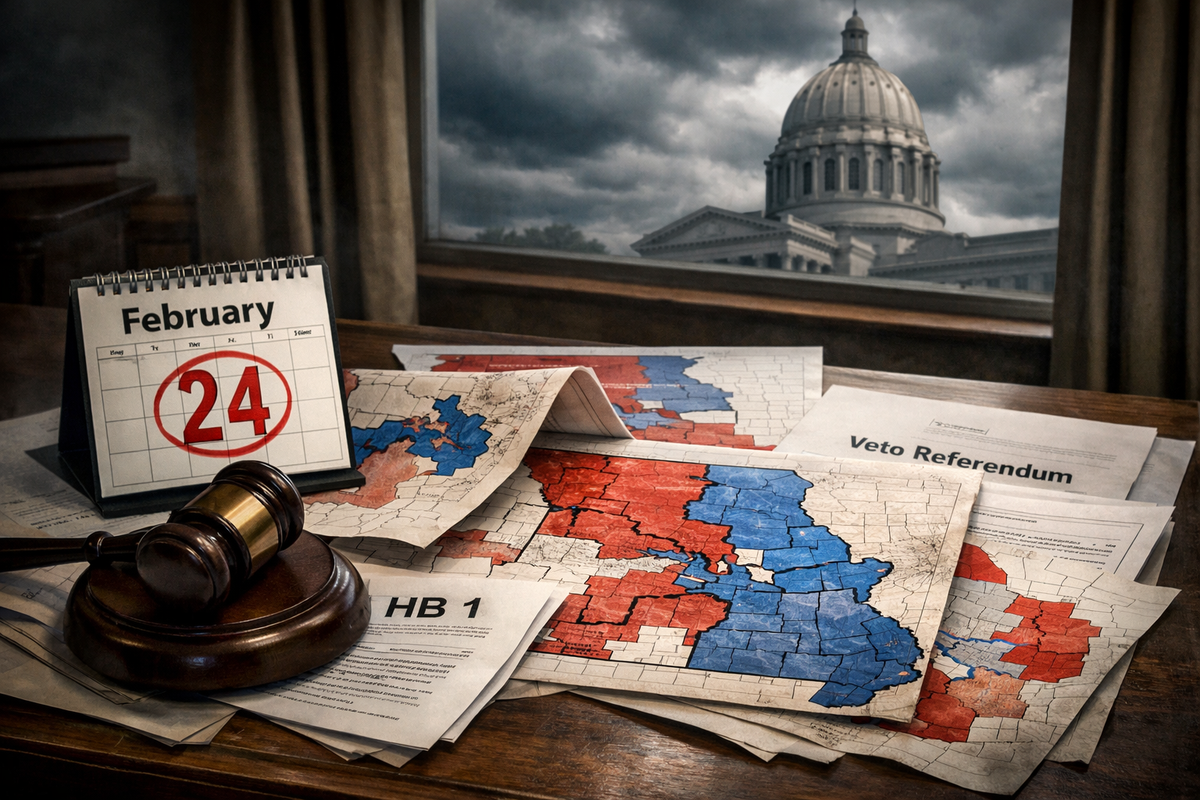
Virginia Attorney General Jay Jones vowed immediate appeal to the Virginia Supreme Court, which has already ruled against Hurley in a previous case involving this redistricting matter.
However, March 6 is approaching quickly, and ballots will need to be printed out before then.
Meanwhile in Missouri, candidate filing is set to begin, and the courts have still not resolved critical issues like what map will be used for the 2026 midterm elections and if a third of the signatures collected for a veto referendum will count.
Poll: 60% Say New York’s Political System Is Broken — But 78% Believe Reform Is Possible
Unite NY released its latest Voter Empowerment Index (VEI) last week, which tracks voter sentiment on popular and upcoming reforms. What the latest poll shows is a majority of New Yorkers believe the state’s political system is unhealthy – but most also believe it can be fixed.
According to the February 2026 VEI, 60% of respondents say New York’s political system is not healthy, compared to 36% who say it is. At the same time, 78% believe the system’s problems are at least somewhat fixable, while 22% say they are not.
The poll, conducted January 5-8 among 1,411 registered voters statewide, has a margin of error of 2.8%. It found strong bipartisan support for several structural reforms, including:
- Term limits for statewide elected officials (82% support) for members of the legislature (81% support)
- Giving citizens the power to place issues directly on the ballot through citizen-led initiatives (74% support)
- Open or nonpartisan primaries (59% support)
- Ranked choice voting (44% support)
“These findings show that New Yorkers are frustrated, but optimistic about the possibility of reform,” said Unite NY Executive Director Anthony Thomas.
“When more than four in five voters support term limits and nearly eight in ten believe reform is possible, that is a clear signal that voters want a political system that is more representative and responsive to the people it serves.”
The VEI reflects Unite NY’s five pillars of reform: term limits, open primaries, ranked choice voting, citizen ballot initiatives, and expanded ballot access. The findings come as lawmakers in Albany debate election administration and voter participation during the 2026 legislative session.
Since its launch in 2022, the VEI has served as a nonpartisan gauge of how voters across the Empire State view democracy and political reform.
Other Highlights
- The campaign to get a voter ID initiative on the 2026 California ballot announced it collected 1.3 million signatures before submitting them to the state a full month ahead of the petition deadline. California requires statewide ballot initiatives to gather 874,641valid signatures from registered voters. “Getting these signatures was only possible because of the amazing team effort that involved multiple organizations, elected leaders, contributors, and volunteers,” said state Assemblymember Carl DeMaio, one of the initiative’s lead proponents.
- California Clean Money Action Fund, California Common Cause, and the League of Women Voters of California have launched a campaign to get what they call the California Fair Elections Act on the November 2026 ballot. The initiative aims to remove a statewide ban on the public financing of elections. “The California Fair Elections Act is a pro-voter reform that opens the door for teachers, nurses, small business owners, and community leaders to run competitive campaigns and win," said Common Cause California Executive Director Darius Kemp.
- A bill (SB2480) in the Hawaii Legislature would implement a nonpartisan all-candidate and all-voter primary that advances the top two candidates, regardless of party. Similar systems exist in California and Washington. The bill has already cleared one committee vote. Just over a decade ago, the Hawaii Democratic Party sued to close the state’s primaries. The party was unsuccessful in the attempt.
- In Illinois, Evanston, Oak Park, and Skokie have all approved the use of ranked choice voting. However, implementation in these cities has been stalled over confusion regarding state election law. The Cook County Clerk has specifically prevented Evanston from implementing the reform, saying current law only allows voters to select one candidate. The City of Evanston and Reform for Illinois sued and now all 3 cities are waiting for the court to rule and for the state legislature to respond. There is a bill, SB2004, that would make it explicitly clear that cities can adopt ranked choice voting.
- Speaking of ranked choice voting and the local option to adopt it, HB630 in Virginia would give cities and counties the permanent option to adopt ranked choice voting. This means it could be adopted for any and/or all local elections – not just for city councils and county boards. The bill passed the House of Delegates and is now in the state Senate.