
Political Polarization Hits 25 Year High

 Jane Susskind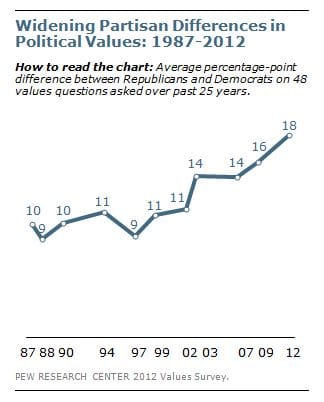
Political polarization is the highest it's been in the last 25 years, Pew Research Center pointed out yesterday, with Americans increasingly divided on key election issues going into the November election. In 1987, the partisan gap was at 10 percentage points, and has now nearly doubled, hovering at 18 percentage points, according to a new study on American values.
Pew reports:
Both parties have become smaller and more ideologically homogeneous. Republicans are dominated by self-described conservatives, while a smaller but growing number of Democrats call themselves liberals. Among Republicans, conservatives continue to outnumber moderates by about two-to-one. And there are now as many liberal Democrats as moderate Democrats.
What's more, partisanship increased most during the presidencies of both Republican George W. Bush and Democrat Barack Obama.
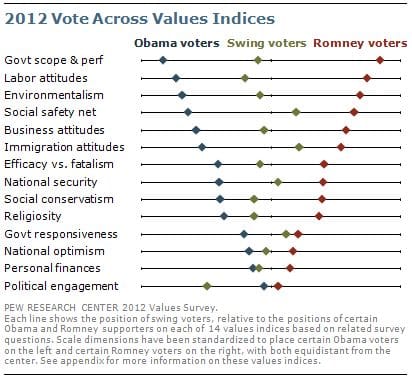
Swing voters, who according to Pew make up 23% of all registered voters, fall in the middle of Obama and Romney voters on key issues, maintaining a relatively moderate stance going into the 2012 election:
On views about the scope and performance of government, for example, there is a wide divide between certain Obama and Romney supporters. But the attitudes of swing voters are about equidistant from backers of either candidate. The same is true on several other key indices, including views of business, the environment and national security.
As IVN editor Kym pointed out last week, swing voters are not the same as independent voter, so this number is referring to those voters who are either undecided, are only leaning towards a candidate, or who favor a candidate but can still be swayed.
What's behind the growing polarization?
You Might Also Like


