
 Cara Brown McCormick
If you want to tax billionaires, California already knows how.
The state taxes capital gains as ordinary income. That means when a billionaire sells her stock, the gain gets taxed at the same rate as a paycheck. It is straightforward, it is constitutional, and it works. The federal government should do the same thing.
That is not what the California Billionaire Tax Act proposes. This initiative, backed by SEIU-UHW and currently in the signature-gathering phase, would impose a one-time 5% tax on the net worth of anyone with more than $1 billion as of January 1, 2026. It taxes wealth that has not been sold, income that has not been received, and gains that may not even hold their value by the time the bill comes due.
IVN covered this in depth in March. My earlier explainer, “How It Really Works: The California Billionaire Wealth Tax,” lays out the mechanics, the history, and the risks. The short version: France tried a version of this. Norway tried it. Most European countries that adopted wealth taxes eventually repealed them. The revenue projections looked good, but then not so much. The capital flight was real.
But now two experts who understand California's budget from the inside (and happen to be Democrats) have made the case even more directly.
 Cara Brown McCormick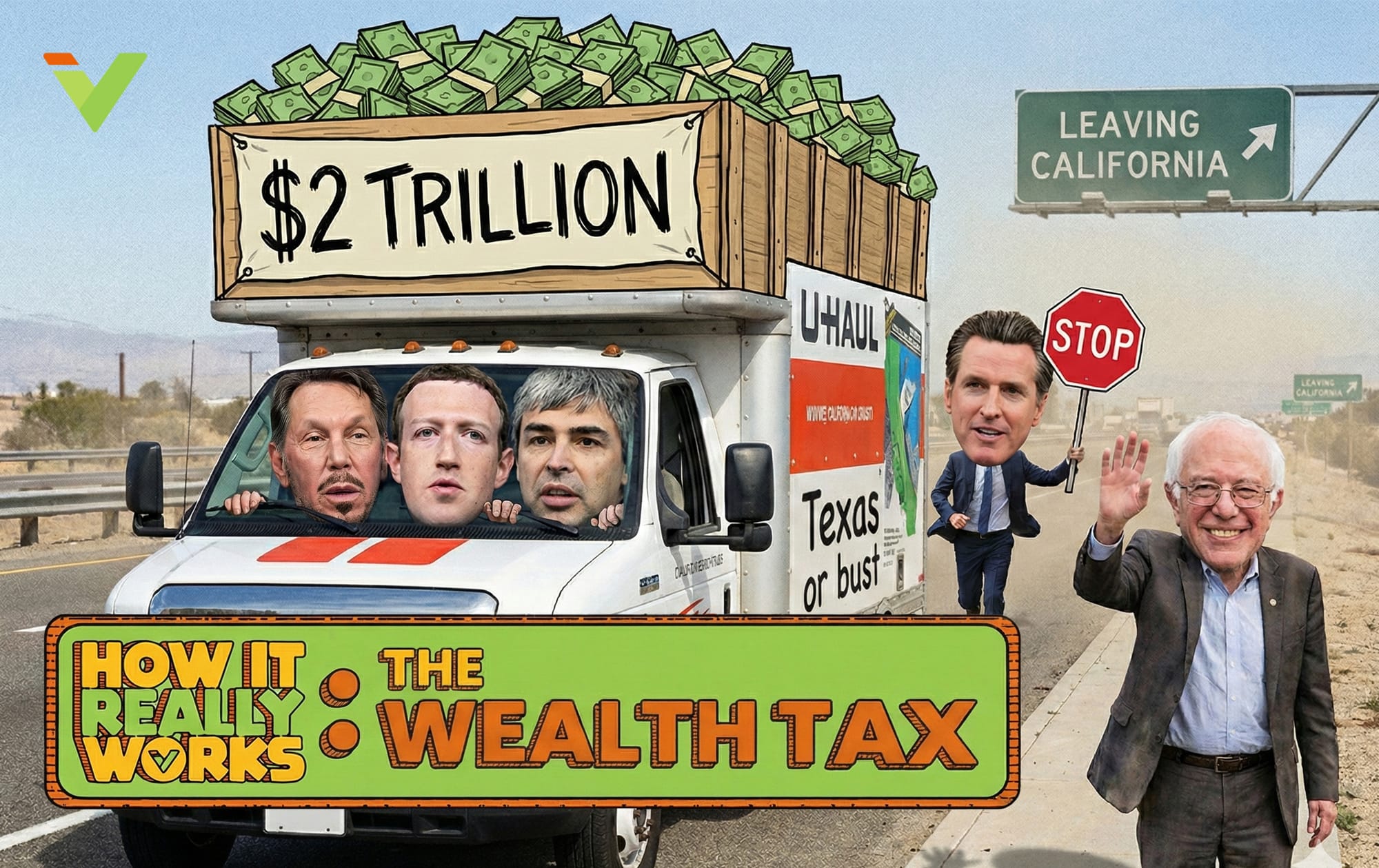
Writing in Bloomberg Tax, Keely Martin Bosler and Lenny Mendonca argue that California simply cannot afford this gamble. Bosler was the director of California’s Department of Finance under Governor Newsom. Mendonca was Newsom’s chief economic and business adviser from 2019 to 2020. These are not anti-tax ideologues. They are the people who managed California’s budget and economic strategy under the current governor, and they are saying this proposal will not work.
Their piece is worth reading in full: “California Can’t Afford the Reckless Gamble of a Billionaire Tax.”
The core of their argument is this: The federal preferential rate on long-term capital gains, 20%, compared to a top ordinary income rate of 37%, is a massive subsidy for the wealthy. It is why Warren Buffett pays a lower effective tax rate than his secretary. And as Bosler and Mendonca point out, the federal government has an advantage California does not: You can’t just move to Nevada to escape it.
The wealth tax debate has been framed as a question of political will. Do you have the courage to tax the rich or not? But that framing misses the actual problem. It is not that billionaires go untaxed. It is that their income, when it comes in the form of capital gains, gets taxed at a much lower rate than wages.
The fix is not to tax what they own before they sell it. The fix is to treat what they earn when they do sell it the same way we treat everyone else’s income.
California already does this at the state level. There is a reason California’s top earners pay more in state taxes relative to their federal liability. The state does not offer a preferential capital gains rate. Congress does.
There is also something that rarely gets mentioned in this debate. We consistently underestimate how much revenue a wave of IPOs and stock buybacks generates for the state. When those transactions happen, California collects. Major market events that are already in motion, and more that are coming, may produce more revenue than a one-time wealth seizure would ever reliably deliver.
That revenue is recurring, constitutionally stable, and does not require California to value a private art collection.
The wealth tax is being sold as a solution to a budget problem. But it is a one-time measure chasing assets that are already moving. The capital gains tax is a structural fix that collects every time wealth is converted to income, year after year, at the time of the transaction, rather than based on speculation about what something might be worth today.
Democrats who genuinely want to reduce inequality and fund public services should be arguing for treating capital gains as ordinary income at the federal level. Republicans who believe in broad-based growth and fiscal sustainability should also be interested in a system that does not reward holding over working.
It’s not partisan. It’s structural.
A federal capital gains tax may not make for a great motivator to get out the vote. But it does produce stable, durable, constitutionally sound revenue that cannot be avoided by changing your zip code.
We will soon find out whether the billionaire wealth tax in California even makes it to the ballot. Even if it does, it faces serious legal exposure, massive enforcement challenges, and a well-funded opposition.
Even if it passes, it will raise money only once, while the underlying structural advantage that allows capital gains to grow at a preferential rate for the wealthiest among us will remain intact everywhere else in the country.
If the goal is to actually tax billionaires, the answer is not a one-time state levy on their paper wealth. The answer is a federal capital gains rate that treats income as income, regardless of where it came from.
California has been showing the country how to do this for years. The rest of the country should catch up.