
 Shawn Griffiths
A broad cross-partisan coalition of California reformers launched More Choice California on Monday to lead the opposition against a proposed repeal of the state's nonpartisan Top Two primary system. The repeal effort, filed last week by a Democratic political operative, has already attracted support from some of the state's most prominent Republican operatives.
The More Choice California coalition is a rare thing in California politics: a unified alliance willing to take on both major parties on behalf of all voters. Its honorary co-chairs and California advisors include former Republican legislators, former Democratic administration officials, nonpartisan good-government reformers, Latino political analysts, open-primary supporters, ranked-choice voting organizers, grassroots leaders, veterans' advocates, and third-party voices. These are not people who typically find themselves in the same coalition. In California… they have.
That breadth is the point.
“This is about a fundamental question: do voters have the right to choose their representatives, or do political parties have the right to control who voters can choose?” said Amy Tobia, More Choice California’s grassroots advisor and Chapter Leader of RepresentUs San Diego, in the coalition’s launch announcement.
“At a moment when democratic institutions and voting rights are under pressure nationwide, eliminating the Top Two primary in favor of closed partisan primaries would be a major step backward for California.”
The coalition’s launch was timed to a specific threat. On May 8, Democratic consultant Steve Maviglio, founder of Forza Communications and a former senior adviser to past Assembly Speakers and Governor Gray Davis, filed paperwork with the California Secretary of State to repeal Proposition 14 and return California to closed party primaries. Maviglio has said his initiative is driven by the possibility that two Republicans could advance in the 2026 governor’s race, a scenario he called “horrifying.”
Within four days, the effort picked up exactly the kind of allies that complicate the partisan narrative.
Ron Nehring, the former chair of the California Republican Party, publicly endorsed the Maviglio measure. On Tuesday, Reform California chairman Carl DeMaio, a Republican Assemblymember and candidate, announced that his organization would commit funding and, he claimed, 18,000 signature-gathering volunteers to the repeal effort.
“I’m pleased to see prominent Democrats join me in supporting the repeal of the failed Top Two system,” DeMaio said, “and I look forward to bipartisan collaboration to get this done.”
 Shawn Griffiths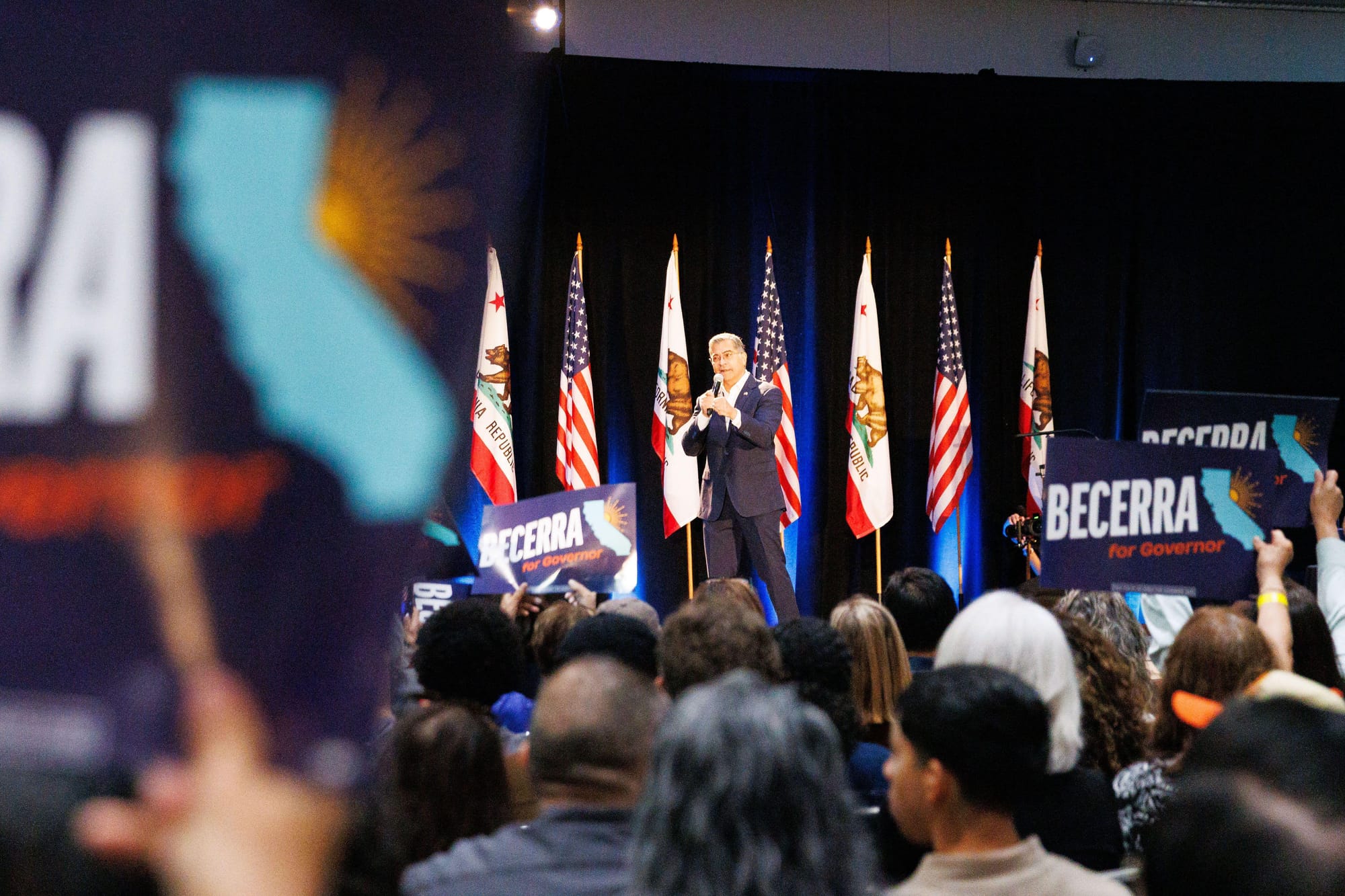
DeMaio, the Trump-aligned Republican running the signature operation, and Lorena Gonzalez, president of the California Federation of Labor Unions and one of the state's most influential Democratic labor leaders, are now publicly aligned on the goal of repealing the nonpartisan system and shutting independent voters out. Gonzalez told the New York Times that labor unions in California will "likely support" the Maviglio measure because "voters understood that a Democrat could get eliminated from even being in the top two."
The repeal effort is being framed publicly as a Democratic-led initiative. It’s actually led by the most partisan factions of both major parties. The funding, the consultants, and the volunteer infrastructure are coming from a familiar collection of party insiders on both sides who share something in common: each of them does better when fewer voters get to participate in the primaries that decide most California elections.
 Shawn Griffiths
A California-Built Coalition with National Reach
More Choice California is led by the Independent Voter Project, which is also the committee’s largest donor according to its public disclosures. That is not a coincidence of timing. IVP co-founded the original nonpartisan Top Two primary in 2010. The legal team, the drafting, and the strategy behind passing Proposition 14 ran through IVP for years before then-Senator Abel Maldonado leveraged his budget vote in Sacramento to put the measure on the ballot.
 Independent Voter Project
The coalition’s honorary co-chairs make the cross-partisan range explicit:
Lenny Mendonca is the former chief economic and business advisor to Governor Gavin Newsom, a founding board member of the National Association of Nonpartisan Reformers, a former vice-chair of Common Cause, and co-chair emeritus of California Forward.
Kristin Olsen-Cate is the former California Assembly Minority Leader and vice-chair of the California Republican Party, who built a reputation in Sacramento as a bipartisan consensus builder.
John Palmer is a longtime California reform leader who sits on the board of the National Association of Nonpartisan Reformers, CalRCV, and Rank the Vote.
Anne Marie Schubert is the former Sacramento County District Attorney, best known for cracking the Golden State Killer cold case; she left the Republican Party in 2018 to register No Party Preference and ran for California Attorney General in 2022 as a nonpartisan candidate.
The California advisor team brings the operational expertise. Cara McCormick, the campaign advisor, is the architect of the Maine ballot measure campaigns that produced and protected the country’s first statewide ranked choice voting law. She is also the leader of the winning citizens' initiative to end superPACs.
Shaudi Fulp, the state advisor, has built a powerful career in government affairs advising companies around the globe while mentoring the next generation of leaders. She serves on the Berkeley Social Sciences Dean's Advisory Council and is Chair of the External Advisory Committee for the Jack Citrin Center for Public Opinion Research at UC Berkeley.
Mike Madrid, the senior advisor, is a veteran political strategist, a co-founder of The Lincoln Project, the former political director of the California Republican Party, a nationally recognized expert on Latino voting trends, and the author of The Latino Century.
Dan Schnur, the academic advisor, is the former chairman of the California Fair Political Practices Commission, a former Republican strategist who registered No Party Preference, and a political science professor at USC, Berkeley, and Pepperdine.
Marcela Miranda-Caballero, the ranked choice advisor, is the executive director of the California Ranked Choice Voting Coalition, which has organized successful local RCV efforts in Berkeley, Oakland, San Francisco, Redondo Beach, and Santa Clara County.
Rey Lopez-Calderon, the development advisor, is the former executive director of California Common Cause, where he led the state’s redistricting reform advocacy.
Chad Peace, the legal advisor, is IVP’s senior strategist on election law and has authored amicus briefs and litigation defending nonpartisan elections in federal and state courts.
Amy Tobia, the grassroots advisor, leads the San Diego chapter of RepresentUs.
Joe Fitzgerald, the veterans advisor, represents the California chapter of Veterans for All Voters, a national group of veterans supporting reforms to reduce the partisanship in government.
Connor Owens, the third-party advisor, represents the Forward Party of California and brings a minor-party and unaffiliated-voter perspective that closed primaries are designed to marginalize.
Republican Party leaders, Democratic administration alumni, Latino political analysts, former prosecutors, Common Cause veterans, Maine RCV campaign architects, ranked-choice coalition leaders, military veterans, and minor-party reformers do not typically sign on to the same coalition. That is the point of this one.
What More Choice California is Actually Proposing
More Choice California is not just defending the existing system. The coalition is also suggesting a next step for those concerned about “only two” candidates advancing to November.
The case for that next step is not new, and it did not come from outside California. In June 2018, Dan Howle, then executive director of the Independent Voter Project and a chief architect of Proposition 14, and Rob Richie, the founder and longtime CEO of FairVote, co-authored an op-ed in the San Diego Union-Tribune laying out a joint position.
The two organizations, often treated as competing camps in the reform space, agreed that the logical next step for California would be to increase the number of candidates that advance from the nonpartisan primary from 2 to 4 or 5, allow write-in candidates in November, and use ranked choice voting in the general election to avoid vote-splitting and guarantee majority rule.
Howle and Richie did something else in that op-ed. They predicted, almost word for word, what is happening this week. “Don’t be surprised if some party insiders use this year’s elections as a pretext to seek a return California to its old incumbent-friendly system,” they wrote. “That isn’t going to fly.”
Eight years later, that prediction is being tested.
The structural argument has held up. Former California state senator and IVP co-founder Steve Peace, one of the original authors of the nonpartisan primary, has continued to make the case, even as the political class has found new ways to game a two-candidate runoff.
 Steve Peace
Peace pointed in 2024 to Adam Schiff’s U.S. Senate campaign, which used paid media in the primary to elevate a weaker Republican opponent, and to Carl DeMaio’s Assembly race, which ran the same play in reverse to elevate a weaker Democrat. Top Four with ranked choice voting would stop that kind of maneuvering by giving voters more finalists to choose from and a way to express the full order of their preferences in November.
That is the system More Choice California is now organizing California’s reform community to advance.
The National Picture, and An Honest Assessment of How Hard This Is
More Choice California is the lead California opposition to the Maviglio repeal, but it is not operating in isolation. The Independent Voter Project is a founding member of the National Association of Nonpartisan Reformers (NANR), the Denver-based umbrella organization launched in January 2018 to connect state-level reform groups nationwide.
Other NANR members include Unite America, FairVote, Open Primaries, Rank the Vote, American Promise, Better Choices for Democracy, and Veterans for All Voters.
Unite America is a national reform group that has focused on primary election reform across several states. It issued its own statement opposing the California repeal effort on May 11, calling the Maviglio initiative part of “a familiar pattern” in which dominant-party operatives push to restore closed primaries whenever an open system threatens their lock on the general election ballot.
📣 NEW: @NickTroiano on a new effort to repeal open primaries in California 📣
— Unite America (@uniteamerica) May 11, 2026
Citing the small possibility that two Republicans could advance to the general election in the California governor’s race, a Democratic consultant filed a repeal initiative Friday with state elections…
That national context matters. It also requires some honesty.
True nonpartisan reform is hard. In 2024, Unite America spent roughly $18.9 million on Top Four or Top Five primary and ranked choice voting initiatives in Alaska, Colorado, Idaho, and Nevada. The Alaska defense succeeded by about 743 votes after a recount. All three new state measures failed. Oregon’s RCV measure also failed.
Brookings Institution Senior Fellow Darrell West, reviewing the cycle, concluded that nonpartisan reform efforts were hurt by complicated ballot language, by the perception that the funding came from out-of-state donors, and by party organizations on both sides treating the reform as a threat.
Those losses are not a reason to retreat. They are a reason to take California’s situation seriously.
California already has the underlying structure that reform groups in other states have struggled to build from scratch. The nonpartisan primary, passed by millions of voters, has now been in place for sixteen years. Roughly 6.2 million California voters are unaffiliated with either major party. That total includes more than 4 million voters registered as No Party Preference, plus nearly a million voters registered with the American Independent Party who, according to a 2016 Los Angeles Times investigation, believed they were registering as independents when they checked the AIP box.
The reform community in California, anchored by IVP and the original drafters of Proposition 14, knows the legal terrain, knows the political traps, and knows the difference between a “partisan” Top Two and a “nonpartisan” Top Two as a matter of constitutional law. Other states are still trying to learn that distinction.
 Chad Peace
What the repeal effort would do is hand that hard-earned structural ground back to the political parties.
Beyond the Signature Path
The Maviglio initiative will not appear on a ballot unless its proponents gather hundreds of thousands of valid signatures. That is a real operational lift, even with Reform California’s volunteer and funding commitments. It is also not the only path.
California’s constitution can also be amended by legislative referral. A two-thirds vote in each chamber of the legislature places a constitutional amendment directly on the ballot, with no signature requirement and no qualification window. That mechanism has been used many times in California’s modern political history, and it can move quickly when the leadership of both major-party caucuses sees a shared incentive to act.
It would not be a total surprise to see a legislative push this session to refer some version of the Maviglio repeal directly to the 2026 or 2028 ballot, bypassing the signature process altogether. The two major parties will then control the framing. Each side has the infrastructure to brand the repeal with messages that cater to its own base as a reform that restores fairness, expands choice, or fixes an “experiment” that did not work.
That framing would be inaccurate.
What is actually on the table is the elimination of California’s nonpartisan primary, one of only three statewide primary systems in the country that treat every voter and every candidate the same, regardless of whether they joined a political party. Repealing it is not a reform. It is the rollback of one of the most significant voter-rights expansions in modern history.
What Is At Stake
Under California’s current system, every voter participates in the same primary, and the two highest vote-getters advance to the general election.
Under the Maviglio repeal, each qualified party would nominate its own candidate, and parties would decide whether to allow independent voters to participate in their primaries at all. That is a step backward to the system the California Supreme Court considered partisan in California Democratic Party v. Jones, and it is the system Proposition 14 was specifically designed to replace.
“Millions of Californians voted overwhelmingly in a free and fair election for a nonpartisan system. Party bosses are now trying to take back control,” said Cara McCormick in the coalition’s launch announcement. “These elections belong to all voters, and we will fight to protect the right of every voter to participate equally and meaningfully.”
More Choice California’s task is to make sure California voters understand who is actually behind the repeal, what it would do to their right to participate, and what a real next step toward expanded voter choice would look like.