
 Shawn Griffiths
When California voters cast their votes in 2026, they will be doing so under congressional lines that did not exist in the last election cycle. This raises a few questions, including:
Do voters know what changed? And, do they know how their voting power was affected?
The state adopted a new map under Prop 50 in 2025. It was the Democratic majority’s response to a Texas gerrymander at the behest of President Donald Trump to take 5 seats away from Democrats going into the midterms.
Gov. Gavin Newsom’s warning to Texas was: If you take seats away from Democrats, we will take seats away from Republicans. The consequence of all of this is the mid-cycle gerrymandering war that continues to this day.
Prop 50 was approved by nearly two-thirds of voters who participated in the November special election. It suspended a congressional map drawn by the state’s independent redistricting commission and replaced it with a map drawn by the California Legislature.
To do this required amending the constitution to allow a temporary map that will be in place until after the 2030 census. The amendment also suspended a provision in the constitution that prohibits partisan gerrymandering.
And so, it had to be put before voters.
Unlike the commission map, Prop. 50 was not required to follow the same state-level rules that prohibit consideration of political parties, incumbents, or candidates. Under the new congressional lines, Democrats could end up with 92% of the state’s House delegation.
Voters were sold on a message of “fighting fire with fire” and “balancing the scales.” Democrats argued that if Republicans were going to cheat in order to hold on to their majority in the US House then California had to respond.
The national story is about which party gains seats. However, this obscures the local impact. Even if temporary, many voters in California will not have the same voting power they had in previous election cycles. The incumbent listed on their ballot may not even be the same.
Some districts saw massive shifts, like Congressional District 1. The district used to cover the northeast corner of the state and had a partisan score of R+25%. Based on the results of the 2024 presidential election, it is now D+12%.
It went from solid Republican to solid Democrat, according to the Cook Political Report. After the death of Doug LaMalfa (R) earlier this year, CA-1 is an open seat – open, but safe for the Democrat who wins it.
Californians living near the Oregon border are now in Congressional District 2, which was redrawn to be the most egregious example of what a partisan gerrymander looks like in the state.
 Cara Brown McCormick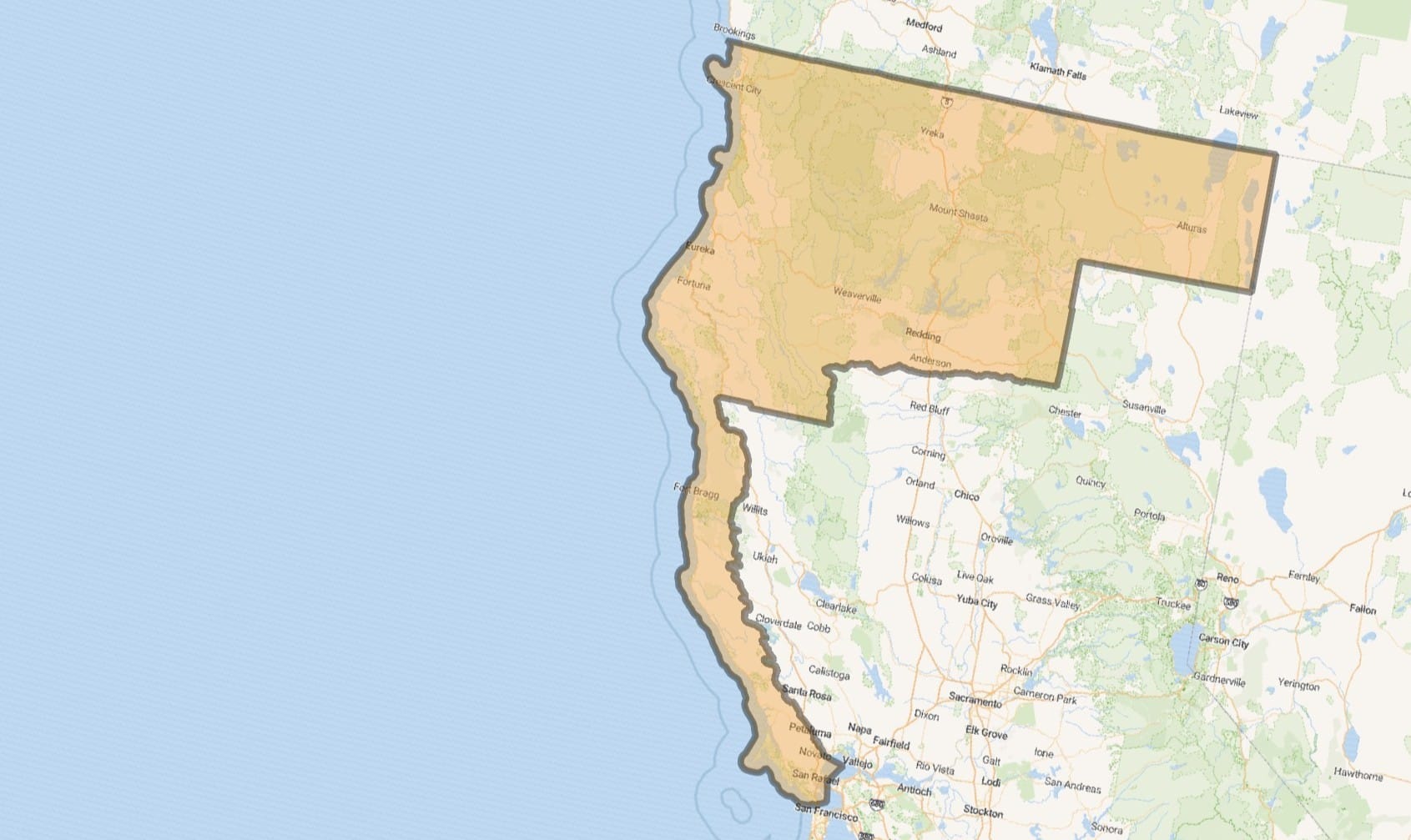
US Rep. Kevin Kiley still represents California’s 3rd Congressional District. However, after Prop 50, he will run for re-election in CA-6. He was moved out of a competitive district that leaned Republican to a safe Democratic district.
Kiley switched his party affiliation to No Party Preference, but he will likely lose his seat.
Kiley and US Rep. Ami Bera essentially switched districts because Bera represented CA-6 until the passage of Prop 50. Now, he is running for re-election in the 3rd district, which was redrawn to have a partisan score of D+10%.
Four incumbents in total are running in a different district in 2026: Kiley, Bera, Republican US Rep. Ken Calvert (from CA-41 to CA-40), and Democratic US Rep. Linda Sánchez (from CA-38 to CA-41).
There are two other districts of note that show how much changed under Prop 50: California’s 22nd in the Central Valley and the 48th in San Diego and Riverside counties.
However, these districts reflect the unintended consequence of the partisan redistricting effort: By making them lean more Democrat, lawmakers actually gave independent voters more power in the primary.
CA-22: A More Democratic District, But Not a Simple Race
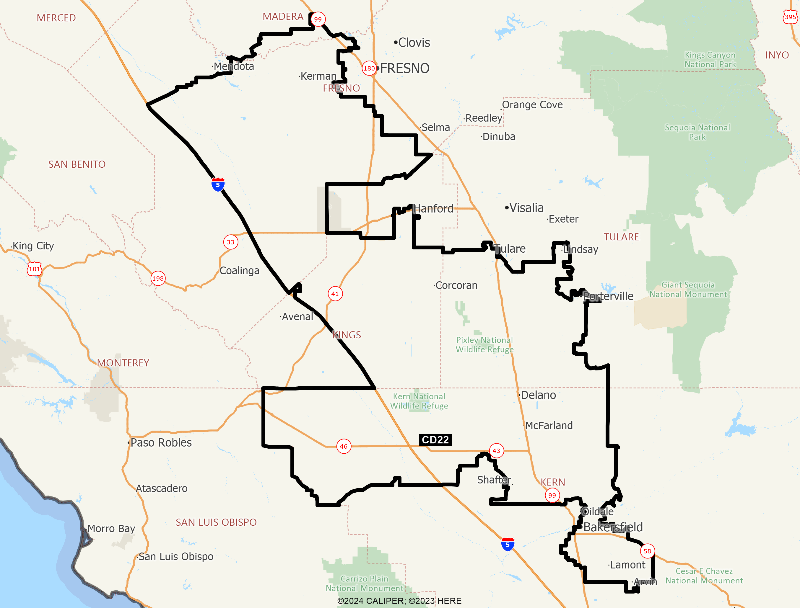
California’s 22nd Congressional District is represented by Republican Rep. David Valadao, who has long been one of the GOP’s most difficult incumbents for Democrats to defeat due to his popularity in the district.
Under Prop. 50, CA-22 still includes parts of Kings, Tulare, Fresno, and Kern counties, but it now includes a small portion of Fresno and the eastern side of Bakersfield. The district’s voter registration is 42% Democrat, 26% Republican, and 24% No Party Preference.
In the central valley, a Democratic advantage in voter registration doesn’t always mean a win. In fact, Cook still rates this seat a toss-up. So, while Democrats shaped the district to be more friendly to them, it will still be a nationally watched test to see if they can actually flip it.
It also changed the candidate field. Democrats are not merely lining up behind one challenger.
Assemblymember Jasmeet Bains, a physician and moderate Democrat, is running with support from major labor groups and was added to the Democratic Congressional Campaign Committee’s “Red to Blue” program.
Randy Villegas, a Visalia school board member and college professor, is running as a progressive alternative backed by groups like the Working Families Party and National Nurses United.
Valadao, meanwhile, is the only Republican running and has the California Republican Party’s endorsement.
These are the only 3 candidates in the race. So, at least in 2026, this gives independent voters more leverage over the outcome. Specifically, the question for voters is: What kind of Democrat do they want to see face Valadao in November?
The primary is not just about partisan control of Congress; it is also about whether the district’s November choice becomes Valadao versus a moderate Democrat or Valadao versus a progressive Democrat.
CA-48: A Republican Stronghold Becomes a Democratic Target
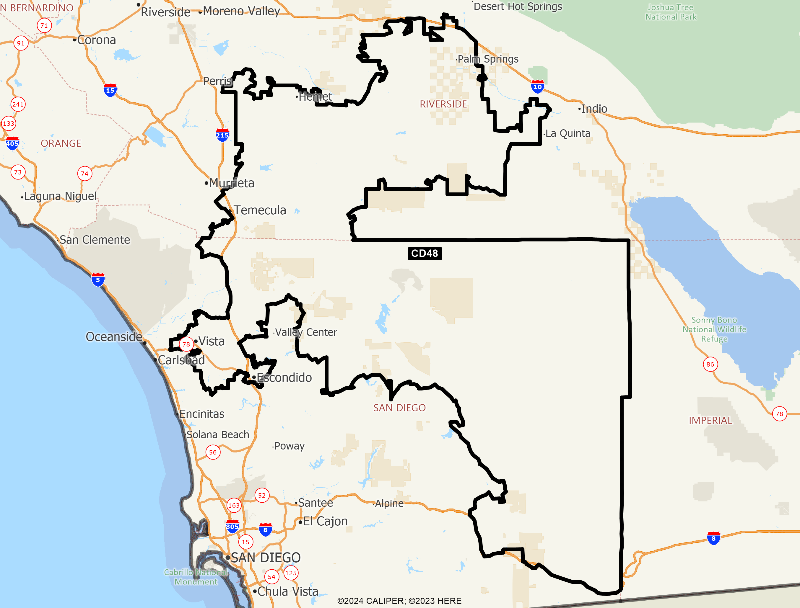
California’s 48th Congressional District may be the clearest example of redistricting changing the political reality before voters even cast a ballot.
The seat is currently held by Republican Rep. Darrell Issa, but Issa announced he would not seek re-election after the district was redrawn under Prop. 50. The district went from being a safe Republican R+13% to a Democrat-leaning D+3%.
Issa decided not to run again in this new electoral landscape.
CA-48 now covers most of East and North County San Diego and parts of Riverside County, including Palm Springs. Voter registration is at 37% Democratic, 33% Republican, and 22% No Party Preference.
It is another race where independent voters will have a meaningful impact.
The candidate field changed almost overnight. Jim Desmond, a Republican San Diego County supervisor, moved into the race and became the leading Republican contender.
On the other side, the democratic field is crowded, with San Diego Councilmember Marni von Wilpert and former Obama official Ammar Campa-Najjar among the main candidates seeking to advance.
National party organizations quickly treated CA-48 as a battleground. The NRCC added Desmond to its “MAGA Majority” program in late April. The DCCC responded by attacking Desmond’s inclusion in that program.
Redistricting Changed More Than the Map
Prop. 50 has been covered largely as a national chess move: California Democrats countering Republican redistricting efforts in states like Texas. That framing is not wrong, but voters do not experience redistricting as a national strategy memo.
They experience it as a new ballot, a new set of candidates, new campaign ads, new outside attention, and sometimes a new sense that their vote suddenly matters less, more, or – not at all.
This raises a broader accountability question for California: Are voters being told enough about what changed in their own district?
Not just that the lines changed. Not just that one party may benefit. But whether their district became more competitive, more partisan, more nationally targeted, and how their personal vote is actually impacted.
California voters approved Prop. 50. Now they are voting under it.