
 Shawn Griffiths
On March 28, the ranked choice voting advocacy group, Rank MI Vote was kicked out of the Michigan Republican Party Convention. Reports say one Republican state lawmaker called volunteers “communists” and even threatened physical violence.
"We were having a productive day meeting like-minded, politically engaged convention attendees until Rep. [Matt] Maddock chose to bully our volunteers and anyone who stopped to speak with us," said Jennifer Umphress of Rank Mi Vote.
Umphress is the group’s conservative working group director. She has twice been a delegate at the state GOP convention.
Rank MI Vote said there weren’t any problems until Maddock showed up, who then proceeded to heckle the group and block attendees from talking with volunteers. He called them communists and leftists, which the volunteers disputed.
The group’s account is that Maddock told one volunteer if they were in the parking lot he would “kick your ass.” Maddock did not deny he made the threat. He said he threatened to expose Rank MI Vote and he did.
Not only was Rank MI Vote kicked out of the convention but State Sen. Jim Runestad, the party’s chair, said it was “a regrettable decision to permit them to have a table.” He claimed to have no knowledge of Maddock’s heckling and threats.
The assertion by Maddock and other Republican leaders in Michigan is ranked choice voting is a system designed to benefit Democrats or “the left.” However, it is worth noting that the method has been used recently by other Republican Parties.
For example, a few days after the Michigan GOP convention the Lynchburg Republican City Committee (LRCC) in Virginia elected to move forward with a firehouse primary and use ranked choice voting to determine party nominees.
A “firehouse primary” is a type of closed party caucus run by the party instead of the government. These types of primaries were banned in Virginia under a 2021 law, but the LRCC can conduct one if it can ensure remote voting for out-of-state voters.
While there is a question of if the party will be allowed to use a firehouse primary, the LRCC still chose to use ranked choice voting.
And it isn’t the first time in Virginia. The state’s Republican Party has used ranked choice voting in its conventions to select party nominees. It is how former Gov. Glenn Youngkin advanced to the general election in 2021.
The center-right think tank, R Street Institute (headquartered in DC), supported the passage of HB 630 in the Virginia Legislature this year, which expands the local option on ranked choice voting.
The bill was approved by state lawmakers and is on the governor’s desk.
“While some people worry that implementing a new system will confuse voters, the R Street Institute’s research suggests that voters can navigate ranked-choice voting without difficulty,” wrote R Street Institute’s Robert Melvin in a letter to Gov. Spanberger.
“Our findings suggest that, rather than avoiding it, voters will actively use the ability to rank candidates–particularly during primary contests.”
Melvin is the organization’s Northeast Region State Government Affairs Director.
In 2024, the Republican Party in the U.S. Virgin Islands used ranked choice voting in its presidential caucus that President Donald Trump won. In doing so, it became the first Republican Party to use RCV in a presidential caucus or primary.
These are just a few examples.
The incident in Michigan illustrates how voting reforms are often shoved into the same “red versus blue” narrative that envelops every political issue in the US. But ranked choice voting advocates assert that it is not a Democrat reform or a Republican reform.
Republican Parties have used it. Democratic Parties have used it. Republicans have been elected under it, as have Democrats.
Leaders of both parties have also opposed its usage. For example, Democratic officials in Maine, Washington DC, and New York City were resistant to or actively tried to block implementation of ranked choice voting systems approved by voters.
A bill to allow ranked choice voting in gubernatorial and state legislative general elections in Maine was brought before the state Supreme Court on April 1 and the state’s Democratic attorney general wants the court to declare it unconstitutional.
Democratic leaders in Colorado and Nevada opposed measures on the 2024 ballot to adopt more choice elections that included both nonpartisan all-candidate and all-voter primary elections and ranked choice voting in general elections.
In both cases, they focused their objections on ranked choice voting, relying on some of the same arguments Republican leaders in Michigan use against the reform. The most common argument they used is that it is too confusing for voters.
For example, in 2024, Democrat-aligned groups in Nevada who opposed Question 3 (a top 5 nonpartisan primary and ranked choice voting) pointed to a University of Pennsylvania study that they say shows 1-in-20 ballots under ranked choice systems in the US are rejected.
But this isn’t true. The study stated that about 5% of ranked choice ballots in elections researchers looked at had some kind of error on them. But most of these errors could either be corrected or were so innocuous that they did not affect the counting of the ballot.
The study found that rejection rates under ranked choice voting rose to about half of 1% at most – which is not uncommon even under choose-one voting and is a smaller rejection rate than mail-in ballots in Nevada.
Multiple research groups, including the R Street Institute, have found that most voters understand ranked choice voting where it is used. A 2025 exit survey of New York City primary voters showed 96% of respondents found ranked choice voting to be simple and 97% found it at least somewhat easy to understand.
But there is a reason why ranked choice voting is only used in closed primary elections in New York City, and that is because the Democratic Party and aligned interest groups won't allow its implementation for the general election.
As long as the most critical elections in the city remain closed, the party with the most power is okay with systemic reforms that are reserved only for their members. Note how the GOP examples were closed party contests or conventions.
Is it any wonder why most implementations of ranked choice voting in the US come from voter-approved ballot measures?
Rank MI Vote pushed for a 2026 statewide ranked choice voting initiative. However, in December the group sent an email out to volunteers announcing that it was “pausing signature gathering efforts, but we aren’t pausing the campaign to bring ranked choice voting to Michigan.”
The group says it is now aiming to re-launch a campaign in April 2027 for a 2028 initiative.
In Other Reform News…
American Promise Says Record AI Spending In Elections Exposes Failure of ‘Money = Speech’ Theory
American Promise reports that nearly $200 million has already been spent by tech, AI, and other outside interests in the 2026 midterms, which the group says raises new questions about the Supreme Court precedent that “money = speech.”
“At least $185 million in AI-related spending is entering the 2026 midterm elections, including the industry’s recent spending in primary elections in Illinois and Texas, in which they spent tens of millions of dollars,” said American Promise CEO Jeff Clements.
“This is not just a test of corporate political power. It is also a test of a 50-year-old constitutional theory.”
In Illinois, Think Big (an affiliate group tied to Silicon Valley figures like Marc Andreessen and OpenAI President Greg Brockman) spent $2.5 million in an effort to get two candidates, Jesse Jackson Jr in IL-2 and Melissa Bean in IL-8, a victory in their Democratic primaries.
Jackson lost, but Bean won.
Jobs and Democracy PAC, funded by Anthropic, also spent about $1 million on negative ads in the same races while Making Our Tomorrow, backed by Meta, spent $750,000 on a handful of state legislative races.
AI spending paled in comparison to the money spent by crypto groups and AIPAC (along with aligned donors). Still, one thing all of these groups had in common was none of them focused their messaging on their core interests.
“Super PACs formed to influence how AI is regulated have already run millions of dollars in midterm primary ads – including attack ads on hot-button issues like immigration, health care, the economy, and crime – without a single mention of AI,” Clements said.
“The strategy is clear: flood the airwaves with ads that make elections about everything except AI, and cut off an urgently needed policy debate about this technology by ensuring the defeat of foes and the election of friends.”
Clements believes this shows how the prediction the Supreme Court made in Buckley v. Valeo (1976) that “more spending would mean more – and better – political discourse” failed. Instead, money is being used to suppress discourse and inflame division.
“To be clear, the tech and AI industry behind this spending isn’t doing anything new,” he said.
“This is what political spending looks like under the system the Supreme Court has built; not an expansion of the marketplace of ideas, but a strategic deployment of money to shape electoral outcomes and the public policy that follows, with the real agenda often hidden from the voters being targeted.”
American Promise is a group committed to a single goal: Pass the For Our Freedom Amendment, which does not push a specific campaign finance agenda, but ensures Congress and the states have the authority to regulate money in politics as they deem necessary.
Dr. Richard Barton, a senior research fellow at Unite America, also noted that Illinois’ primaries exemplified how monied interest groups exploit low turnout primaries because they know it is “the most efficient lever of political influence in American democracy.”
“Unite America Institute’s analysis of three decades of congressional primary data shows why primaries are the target,” he writes.
- "There are far fewer voters to persuade in primaries."
- "Primary voters are actually persuadable. In the absence of partisanship as the main signal, name recognition makes all the difference – and money is an effective way to do that."
Most elections in Illinois and the rest of the country are so safe for one party or the other that the best way to manipulate outcomes is to influence who wins (or loses) partisan primary elections.
Take Illinois’ 7th Congressional District as an example.
The influence of outgoing US. Rep. Danny Davis ultimately beat the money that poured into the district to defeat Democratic primary winner La Shawn Ford. However, Ford was able to win with only 24% of the vote in a seat that is guaranteed to go to the Democratic nominee.
And the monied interest groups against him didn’t lose by much.
 Shawn Griffiths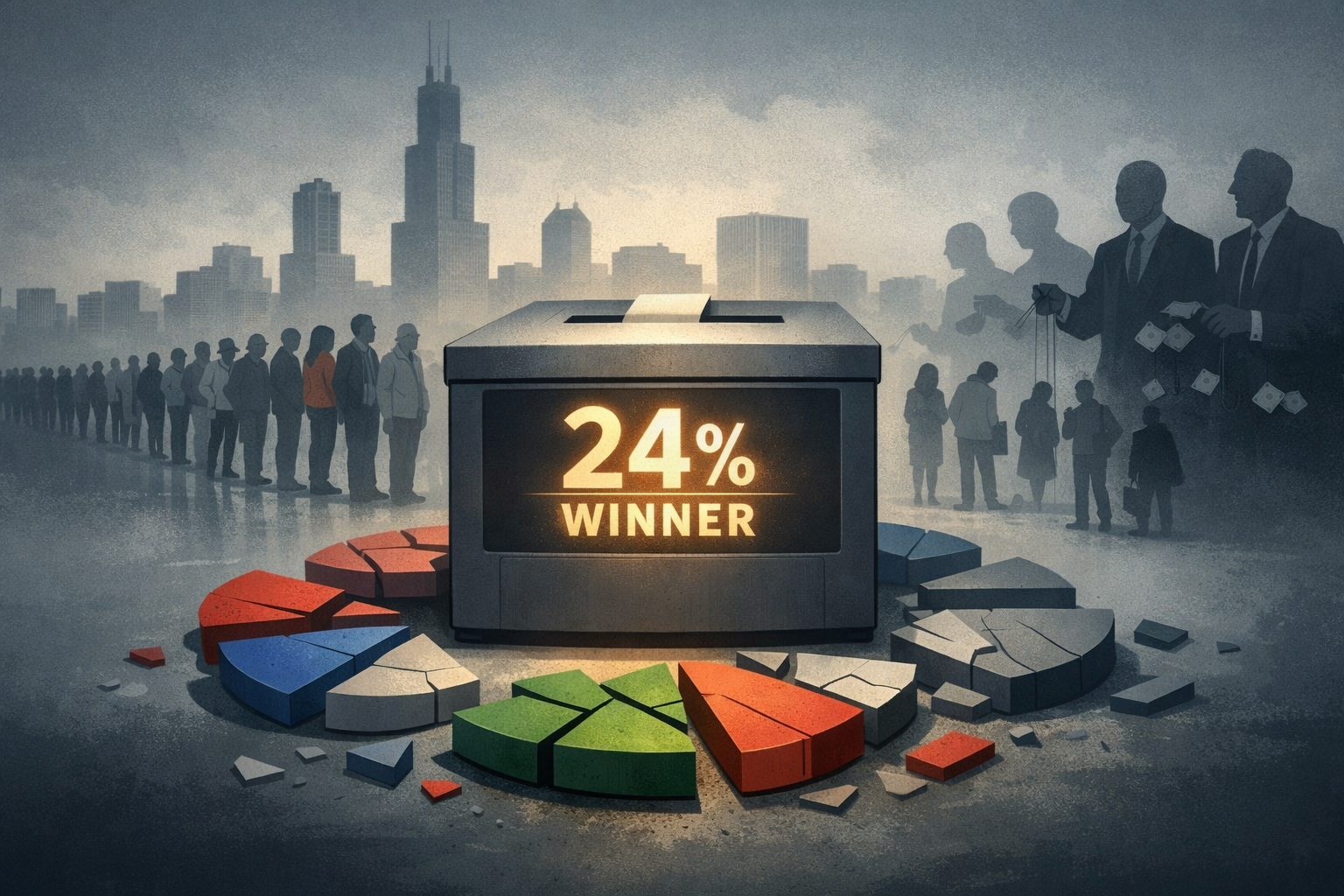
Ultimately, due to how low primary turnout is in Illinois, Ford effectively won his seat with around 4% of his district’s total electorate. With this mind, it is easy to see why super PACs and big money donors have found a vehicle for success in primary elections.
“Over the last few decades, ideological PACs and Super PACs have learned just how much they can ‘wag the dog’ through primary elections,” writes Dr. Barton.
According to his research, ideological super PACS have increased their involvement in primary elections considerably over the last 3 decades. Further, the candidates backed by these groups beat out establishment-backed candidates “roughly four times more often than in the past.”
“The result is a primary system increasingly controlled by a small number of ultra-wealthy donors pursuing narrow national agendas, producing nominees less representative of the broader public and less accountable to the constituents they are elected to serve,” he states.
Quick Takeaways
California Voter ID Initiative Exceeds Projected Qualification Threshold, Campaign Says
Reform California, the organization spearheading the 2026 California voter ID initiative, reported last week that early results from county signature verification efforts show a clear path to the November ballot.
The group says it confirmed that 18 counties have completed verification for the initiative with an 82.4% validity rate. Nearly 1.4 million signatures were submitted for the campaign, which puts the projected number of valid signatures at over 1.1 million.
This is more than enough for the initiative to appear on the ballot.
“These numbers confirm what we’ve said all along – Californians are ready for common-sense reforms to restore trust in elections and protect taxpayers,” said Assemblymember Carl DeMaio, chair of Reform California.
“Even with limited resources, a grassroots army of volunteers has delivered results that Sacramento politicians said were impossible.”
Voter ID has broad public support, even among a majority of California Democrats. The initiative’s success hinges on the campaign messaging both supporters and opponents use in what is likely to turn into an expensive race.
CO Judge’s Ruling Makes It Easier for Political Parties to Shut Out Independent Voters
A federal judge in Colorado struck down a provision in the state's open primaries law that established a threshold for political parties to hit if they want to close their primaries.
Prop 108 (approved by voters in 2016) states that if parties want to close their primaries, they need a three-fourths vote from their state’s central committee. U.S. District Court Judge Philip A. Brimmer wrote that this is unconstitutionally high.
He did not dictate what the threshold should be or direct parties on how to proceed. However, as a result of the ruling, it will be easier for parties to shut independent voters out of this critical stage of the elections process.
This includes the Republican Party of Colorado, which brought the lawsuit in the first place. The Colorado GOP has attempted to close its primaries 3 times. Brimmer denied the party's 2024 request to close the state's primaries altogether.
Approximately 231,000 independent voters participated in Republican primaries back in 2022. Statewide, this accounted for more than a third of the vote in these contests.
In some counties, independent voters matched the number of Republicans voting in 2022 and 2024.
In the last 10 years, unaffiliated registration has climbed exponentially in Colorado. Not only do independent voters outnumber Republicans and Democrats, but they also make up a majority of the registered electorate.
Making it easier for the parties to close primary elections would give the partisan minority an outsized influence over election outcomes while treating the state’s majority like they are second-class voters.
Comedian and national political commentator Bill Maher recently discussed the growth of independents, noting that “there’s a lot of people who don’t like the extremes.”
Colorado Has a Choice: Ban Mid-Cycle Gerrymandering, Allow It, Or Stay Out of It
Also in Colorado, the state’s title board gave final approval to a ballot initiative that would ban mid-cycle redistricting unless 3 criteria are met:
- 3 public hearings are held on the new map.
- The map preserves whole communities of interest.
- The map cannot intentionally favor one party.
A new map would also need to be approved by the state's independent redistricting commission and adopted by the state Supreme Court. The initiative is being pushed by Advance Colorado.
Since it amends the Colorado Constitution, it will need 55% approval from voters.
This initiative was challenged by the state’s Democratic Party, which stands to benefit from a proposal spearheaded by Coloradans for a Level Playing Field that redraws some of Colorado’s congressional districts to benefit Democrats.
But Coloradans for a Level Playing Field will have to select 1 of 3 proposals to put before voters:
- Initiative 240, which suspends an independent congressional map and replaces it with a map drawn by the initiative's proponents for 2028 and 2030. This is similar to Prop 50 in California. The measure will require 55% voter approval.
- Initiative 241, which would move Colorado's independent redistricting commission from the state constitution to state statute. This would make it easier for the Democratic majority in the legislature to alter, suspend, or outright eliminate the commission.
- Initiative 242, which is paired with 241. It asks voters to approve a new congressional map for 2028 and 2030. It will need 55% approval, and if it passes then the independent redistricting commission will be moved from the state constitution to state statute.
So, while the Colorado Republican Party is trying to close state primaries, the Democratic Party is fighting independent redistricting.
But Wait, There’s More…
- A new campaign has emerged to implement ranked choice voting in Sacramento, California, while Eureka announced it is delaying implementation of voter-approved ranked choice voting because it needs voting system updates and state certification.
- 23 states have sued the Trump administration over the president’s executive order that establishes a national voter eligibility list and instructs the USPS to only send election material to voters on this list.
- A judge in Wisconsin dismissed a lawsuit filed by Democratic voters to redraw the state’s Republican-friendly congressional map. The case can be appealed to the state Supreme Court, but it likely wouldn't be resolved before the state's 2026 elections.