
Limited Bandwidth Is Holding Back Digital Learning in Calif. Schools

 Michael Higham
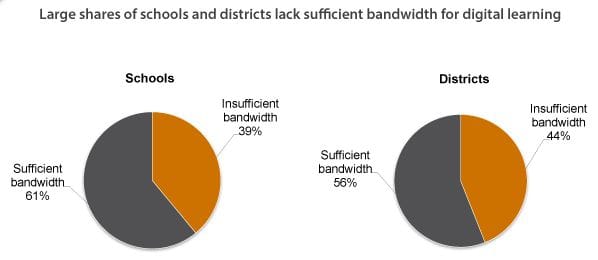
Digital learning is becoming more prominent in classrooms as schools prepare students for the digital world. However, only 61 percent of California schools and 56 percent of the state's school districts have Internet connections faster than 100 megabits per second (mbps), according to the
Public Policy Institute of California (PPIC).
California implemented new tests known as 'Smarter Balanced Assessments' in concert with Common Core Standards. These tests are taken online and do not require much bandwidth, but an increased emphasis on digital learning has focused attention on the technological infrastructure of California schools.
The federal government is pushing states to include more digital tools for instruction. This includes video conferencing, virtual field trips, and personalized audio-visual learning. However, almost half of California's schools don't have enough bandwidth to utilize these tools.
The largest and smallest schools (without a sufficient network) have the biggest hill to climb. According the PPIC:
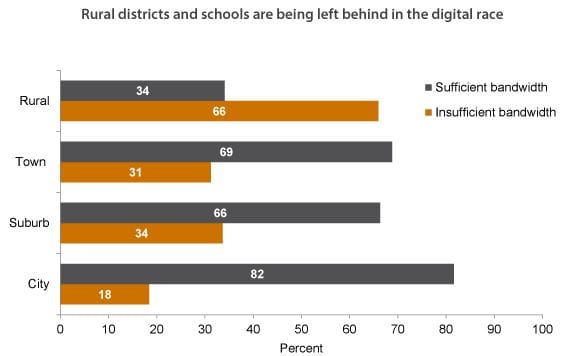
"Up to a point, a network upgrade becomes more cost-effective for a larger number of students. Beyond that point, however, the trend reverses, so that an increase in enrollment slows down network traffic. In other words, the cost to upgrade technology infrastructure is significantly more expensive in very small and very large schools." According the PPIC, about 80 percent of California's 181 urban districts have a 100+ Mbps network.
Rural schools and districts are also facing an uphill battle.
Ten rural districts still operate on T1 connections, a technology developed in the 1960s using telephone lines. T1 connections are fast enough to administer the Smarter Balanced Assessments, but will not be able to take advantage of other technological tools due to slow data transfer.

In Spring 2014, online field tests were given in California for English language arts and mathematics. Students in grades 3 through 8, as well as high school juniors, took these tests.
In addition, the California Educational Technology Professionals Association (CETPA) administered a survey on whether or not school districts had sufficient bandwidth for the tests. About two-thirds (67 percent) of the districts who participated in the survey were either "fairly confident” or "certain” that their district had enough bandwidth on a reliable network.
However, the PPIC notes that the CEPTA survey is not a representative one:
[O]nly 35% of districts responded and large and urban districts were overrepresented in the survey. The Smarter Balanced consortium surveyed test coordinators in 13 participating states. More than 70% of survey responders said their testing was successful—but, again, only a sample of test administrators responded. It is likely that the testing experience varied across districts and schools.
There are policies in place to help schools upgrade their technology. In the 2013-14 legislative session, the California Legislature appropriated $1.25 billion to implement Common Core for training teachers, instructional materials, and upgrades to technology. Not much went into the latter.
In the following year, Governor Jerry Brown dedicated $26.7 million to upgrading broadband connections for schools.
There are also federal policies that California can take advantage of, like the E-rate Program (1996). Schools that qualify for the program receive between a 20 percent to 90 percent discount on technological infrastructure projects. The Federal Communications Commission (FCC) and the Obama administration used $1.5 billion to boost the program, increasing its cap to $3.9 billion.
Significant work on California's part is required, including an extensive evaluation of the current state of public schools' hardware, network, software, and staffing.
Photo Credit: Monkey Business / shutterstock.com

You Might Also Like


