
Independents in California Have Grown Significantly in Past 10 Years

 Michael Abrams
The Public Policy Institute of California's latest compilation of voter facts reveals the growth of non-affiliated voters in the state. Within the past ten years, registering as a non-affiliated voter increased by 5.6 percent:
As of February 2013, the share of California voters who say they are registered as independent (also known as "decline to state” or "no party preference”) is 20.9 percent — up from 15.3 percent in 2003.
Voter registration with the Democratic party slightly increased with an extra half-percent (43.9 percent to 44.4 percent), but Republican registration experienced a large dip. PPIC states there are 100,000 less Republican voters in California, a decrease of 6.3 percent (35.2 to 28.9).
The Republican Party is trying to regain its influence and become more significant in California politics under new leadership. New GOP Chairman Jim Brulte has already called for the party to "leave its comfort zones," but may face a steeper uphill battle with independent-minded voters.
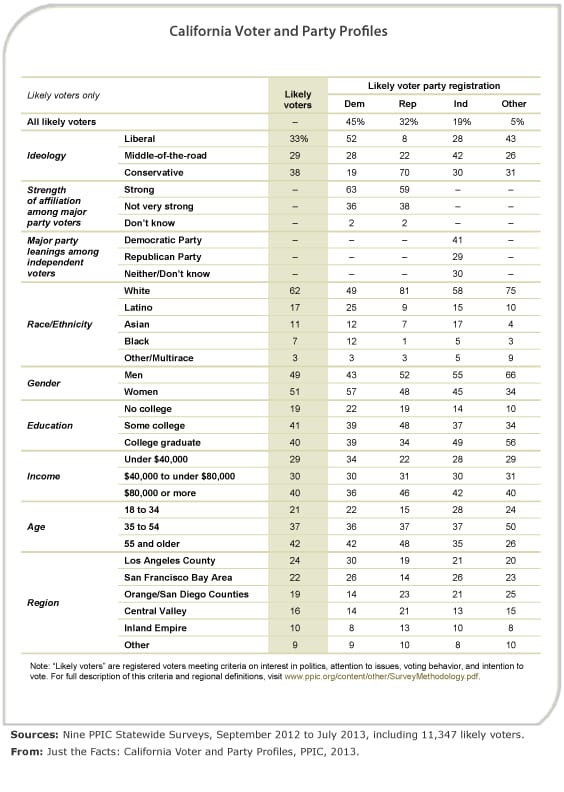
Despite non-affiliated voter status, 41 percent of them say that they lean Democrat in elections while 29 percent lean Republican and 30 percent can go either way.
The two major parties may also have a difficulty convincing younger voters, who tend to remain politically independent:
About half of independent likely voters (49%) are college graduates, compared to fewer Democrats (39%) and Republicans (34%). Independents have the highest share of likely voters age 18 to 34 (28%), compared to Democrats (22%) and Republicans (15%).
Independent voters reached their highest point just before the June 2012 primary election when a record-high registration hit 21.3 percent. Third-parties are also growing in the state, but PPIC revealed in 2012 that third parties may find it difficult to attract independent voters:
Seven in 10 independent likely voters (71%) say they would prefer to remain unaffiliated even if there was a political party that was a good reflection of their political views.
It's important to keep in mind that non-affiliated, independent voters are not politically homogeneous. An increase of independents in California means an increase diversity of opinion and less predictable voter behavior.
For a full breakdown of the PPIC's data and analysis, read the report here, or refer to its chart on likely voters in California:
You Might Also Like


