
George H. W. Bush: 5 Things That Set Him Apart in the "Presidents Club"

 Lindsay France
Washington, D.C. - On Friday, former President George Herbert Walker Bush died at the age of 94, passing away just months after his wife Barbara.
Serving as the 41st President of the United States, Bush’s administration oversaw the end of the Cold War and Operation Desert Storm.
As Bush's casket proceeded up the west-facing steps outside the Capitol building cannon fire roared across Washington. Bush called these steps “Democracy’s front porch."
As the nation honors its 41st president, it is important to remember some of the unique aspects of George H.W. Bush, both as a man and as a leader of our country.
1. A Nonpartisan Respect for the Office
A running theme throughout his life and certainly his presidency was a simple one: respect. He showed respect both in public and in private for his supporters, detractors, political opponents, and the foreign powers he did battle with diplomatically. And he had an unbending and nonpartisan respect for the office of the presidency.
A recent example unfolded at his funeral where, despite tensions between himself and the administration of President Donald Trump, Bush made a point of inviting him to attend.
And in 2014, when President Barack Obama traveled to Texas, he was there at the tarmac in a wheelchair to greet him. When a reporter asked him why he was there Bush said, "I just wanted to say hello to the president and the first lady. When the president comes to your hometown, you show up and welcome him."
Further back, when President Ronald Reagan was shot, aides wanted Bush, who was vice president at the time, to fly back to the White House via helicopter. However, the vice president insisted on landing at the vice president's official residence, preserving the tradition of the president, and only the president, landing on the South Lawn of the White House in Marine One.
2. A Bipartisan Approach
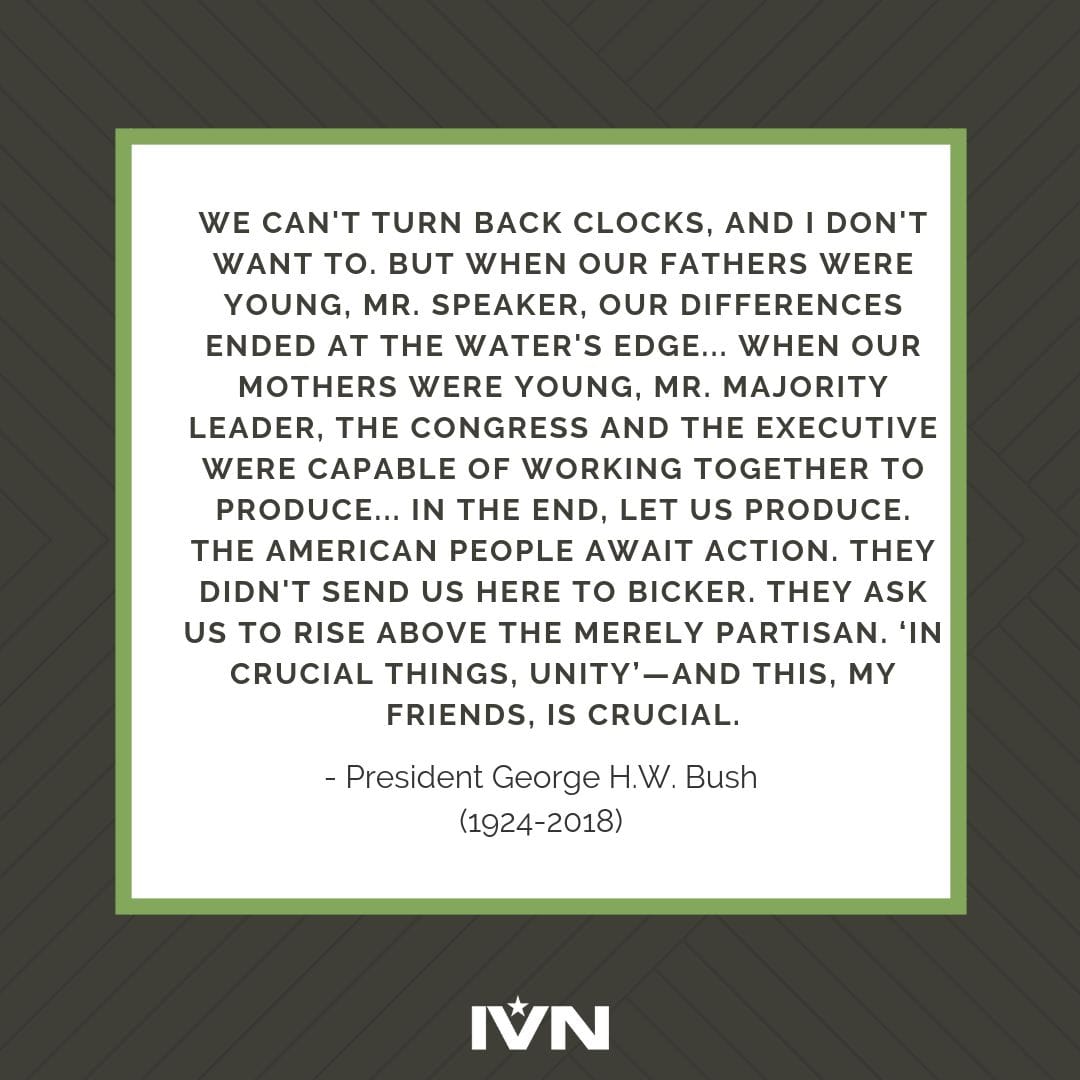
When Bush took office, he faced a Congress fully under Democratic control and he acknowledged that his administration would have to work hard for its support. In his 20-minute inaugural address in January 1989, he got to the point quickly: “The American public did not send us here to bicker.” He declared it the "Age of the Offered Hand."

3. VP to President
Bush was the first sitting vice president to be elected president since Martin van Buren in 1836 and the only head of the Central Intelligence Agency to gain the office.
Both Bush and Van Buren were one-term presidents, each impacted by an economy that was in the throes of recessions.
Martin Van Buren was bounced from office partly because of the Panic of 1837
George H. W. Bush lost re-election in part because the economy sank into a recession in 1990. It was historically mild as recessions go, but the recovery was very slow, which paved the win for William Jefferson Clinton.
"Trickle-down-economics" had become an easy target of Democratic ire.
4. A Parent Who Knew Grief
George and Barbara Bush lost their three-year-old daughter Robin to leukemia. She passed away six months after her diagnosis in 1953. Both parents acknowledged that it was a loss that changed their lives forever.
In 1990, he delivered a speech announcing new initiatives by the National Institutes of Health and the Centers for Disease Control to combat the HIV/AIDS epidemic “on a wartime footing."
“When our own daughter was dying of leukemia, we asked the doctor the same question every HIV family must ask – why, why this was happening to our beautiful little girl?” Bush said in the speech. He referenced his friends who had died of AIDS. “There is only one way to deal with an individual who is sick: with dignity, compassion, care, confidentiality, and without discrimination.”

5.) The Nixon Connection
During his campaign, it was suggested to President Richard Nixon that he take on George H.W. Bush as his running mate. Bush refused the offer and after Bob Dole resigned as chairman of the Republican National Committee in 1972, Nixon named Bush to the position. Shortly after, the Watergate scandal broke out. At first, Bush was loyal and defended Nixon, but as the complicity of the Oval Office became apparent, Bush recommended that Nixon resign. Three days later on August 9, 1974, he did just that.
The Nixon-Bush connection actually goes much deeper. Bush's father, Prescott, helped launch Nixon's political career. Perhaps it is no coincidence that Bush ascended the political ranks of Washington so smoothly. If Nixon had not shined a national spotlight on Bush, it is possible that neither he nor his son would ever have been president.
You Might Also Like


