Skip to content
Subscribe

Top-Two Open Primary Gives Underdog Candidates Fighting Chance

Published:

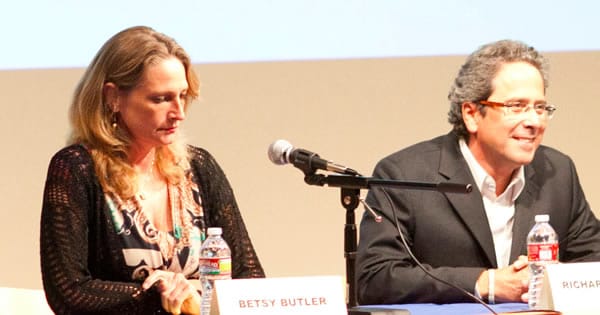
The race for California's 50th Assembly District is still too close to call, but the underdog candidate is holding on to an 800 vote lead. A study conducted by Andrew Sinclair, a CalTech political science graduate student, concluded that California's new non-partisan open primary is to blame, or credit. In the general election, Santa Monica Mayor Richard Bloom, the underdog, faced incumbent Assemblywoman Betsy Butler, a liberal Democrat backed by the Democratic party.

The main thing that Sinclair learned is that the top-two primary system in California worked very well for underdog Richard Bloom.

Under the new system, all candidates, regardless of party affiliation, run on a single primary ballot. The top-two vote getters in the primary go on to the general election. This means that in certain cases, like California's heavily Democratic AD 50, two Democrats (or Republicans) could face off in the general election.

Under the old system, the party-backed incumbent Betsy Butler would have handily defeated Mayor Bloom in the partisan primary. She would have then faced a non-competitive general election against the Republican primary victor because of the heavily liberal make-up of the district.

Sinclair conducted a phone survey of 1,134 voters prior to the election. He concluded that Bloom may have benefitted from not being the Democrat's party-backed candidate:

"[V]oters saw him as the candidate who was closest to the political middle. While Butler got major support from Democrats in Sinclair's survey, Bloom got strong backing from Independents, Republicans, and other voters, while also winning over a respectable chunk of Democrats...This is a good example of where the top two makes a difference by giving Bloom an opportunity to make a competitive election..."

Opponents of the top-two open primary argue that the system reduces voter choice be restricting the general election ballot to two candidates. Proponents of the measure have argued that open primary finally gives voters who are not part of a given district's majority party the first opportunity to have a meaningful vote. In the race for California's 50th Assembly District, the proponents' argument, like the underdog, appears to be the winner.

Adhere to the IVN etiquette

By posting a comment, you agree to adhere to our etiquette rules: No partisan attacks, no personal attacks, substantiate your sources, no self-promotion.

Contact IVN

Questions about this article or our coverage? Send us a message. A free IVN member account is required.

Message sent

Thanks, we’ll review it and get back to you if needed.

Message not sent

Sorry, something went wrong. Please try again.

Sign in to send a message

Messages are tied to your IVN member account. Signing in is free and takes a few seconds.

Republish this article

Republishing guidelines

Republish IVN articles for free. Independent Voter News articles may be republished online or in print under a Creative Commons BY-NC-ND 4.0 license, on these terms:

  1. Credit the author and IVN. Keep the byline ("By Author Name, Independent Voter News") and the attribution note at the end, which links to the original.
  2. Keep the meaning. You may update time and place references and apply your house style. You may trim for length, as long as the cuts don't change the meaning or misrepresent the author. Keep the headline. Mark any additions as your own (for example "Additional reporting by ...").
  3. Translations are welcome. Translate faithfully, add "Translated from English by [your outlet]", and tell us at editor@ivn.us.
  4. Keep the links, including the link to the original article.
  5. Keep the tracking image. The HTML includes a 1-pixel image that counts readers on your page. It collects no personal information.
  6. Photos and illustrations. Images credited to IVN may be used with this article only. Images credited to others (AP, Getty, Unsplash, Wikimedia and so on) stay under their owners' terms. Secure the rights or switch "Include images" off.
  7. Don't sell it. You can't sell our articles or sell ads specifically against them. Your normal site advertising is fine.
  8. No implied endorsement. Don't suggest that IVN or the author endorses you, your candidates or your causes, or that donations to you support IVN.
  9. Keep labels. Opinion or analysis pieces keep that label.
  10. Point search engines to the original. Where your CMS allows, set the canonical URL to the original IVN article.
  11. No bulk or automated republishing, and don't submit our articles to aggregators (Apple News, Google News, MSN) as your own.
  12. Corrections and removals. Update your copy when we correct it, and remove it promptly if we ask. We'll contact you at the email you give us.
  13. Questions or print republication: editor@ivn.us.

IVN staff: fill in who you're inviting above, then create the invite.

Preparing the article

Top-Two Open Primary Gives Underdog Candidates Fighting Chance

Choose a format
  • HTML
  • Email HTML
  • Markdown
  • Formatted (.docx)
  • Plain text
  • WordPress blocks
  • PDF
Choose a platform

Photos credited to others need their owners' permission.

To for

Republishing somewhere else? Questions? editor@ivn.us