Photo: Wikimedia Commons / Author: Coolcaesar
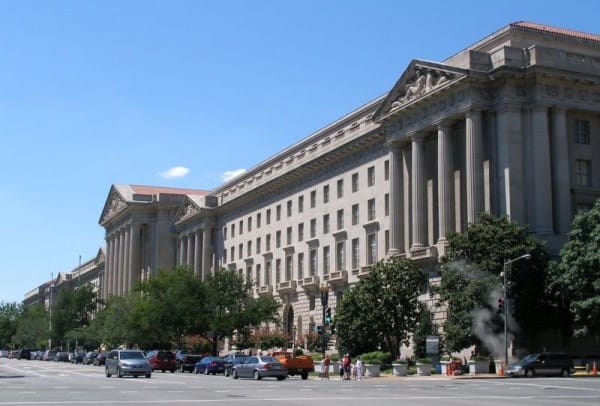
The Environmental Protection Agency’s regulation of greenhouse gases is often used as an example of bureaucracy run amok. For instance, in a speech a year ago, Paul Ryan said:
"In 2007, a wrongheaded Supreme Court decision cleared the way for the Environmental Protection Agency, the EPA, to unilaterally regulate greenhouse gases if the agency found that such gases 'may reasonably be anticipated to endanger public health or welfare.' As soon as Obama’s EPA chief took office, 'reasonably' was unreasonably defined, and the agency issued finding after finding that would produce real economic harm in exchange for distant — and dubious — environmental ends."
Ryan also argued that, after cap-and-trade legislation failed to pass the Senate, EPA should have given up on its regulatory effort:
"But instead of accepting this verdict on its preferred policy, the administration decided to let the EPA carry on with its harmful plan to impose unilateral emissions restrictions on American businesses, raising the question: Why does the Constitution establish a lawmaking body at all?"
Most Republicans-- and not a few Democrats– probably share Ryan’s view of EPA’s actions, but this view is based on a failure to understand the constitutional and legal provisions that govern EPA.
It’s ironic that Ryan made these remarks in a speech about the rule of law on Constitution Day. The fact is that the EPA is constitutionally required to continue its efforts. The Constitution requires the president, and by extension, the entire executive branch, to “take care that the laws be faithfully executed.” In this case, the law was the Clean Air Act, passed by Congress in 1970. EPA has a constitutional duty to faithfully implement that law unless it is changed.
The Constitution also provides a process for Congress to change the law. That process definitely does not include failing to pass a new law. If Congress wanted to change the 1970 law, as interpreted by the Supreme Court, it would have to pass a new law. That’s what the Constitution says, and Congress didn’t do that. This isn’t controversial. In fact, conservatives like Justice Scalia have been the most vocal in insisting that failure to pass a new law is irrelevant to applying or interpreting an old law.
This brings us to the Supreme Court’s decision. The Clean Air Act covers “any substance added to the ambient air.” That definitely includes greenhouse gases from factories, cars, and other sources. It also says that EPA has to regulate if such a substance may be “reasonably anticipated” to endanger human health or welfare.
The Supreme Court ordered EPA to make a scientific determination about the possible effects of greenhouse gases. The Court specifically said EPA could only consider the science, not other policy issues like the cost of regulation. Not all of the Justices agreed with this ruling, though some of the dissenting judges followed the decision in a later case. Whether it was right or wrong, the Supreme Court decision is the authoritative interpretation of the law in a case that directly applied to EPA.
While President Bush was still in office, EPA dutifully began its effort to follow the Supreme Court’s directive. Given that the vast majority of climate scientists think greenhouse gases do endanger human health and welfare, it’s pretty obvious that greenhouse gases may be “reasonably anticipated” to cause harm.
Failing to anticipate something that nearly all scientists predict might very well be called unreasonable. Indeed, it would take a vast amount of faith in EPA– faith that Mr. Ryan and many other Americans obviously do not share– to allow the agency to overrule a consensus among the nation’s scientists. Not surprisingly, a federal appeals court recently upheld EPA’s “endangerment finding.” It was a unanimous decision by judges with varying ideological orientations.
Once the endangerment finding was made, the Clean Air Act gave EPA no choice. The endangerment finding automatically triggers other parts of the statute. EPA began considering options for implementing the law during the Bush Administration, and the Obama EPA has followed up on those ideas. EPA has actually worked hard to find ways to limit the economic burdens (and ironically, industry has attacked some of those efforts.)
Maybe Congress should change the law and eliminate EPA’s jurisdiction over greenhouse gases. That’s a subject for another day. But Congress hasn’t changed the law so far. In the meantime, EPA should be praised, not criticized, for obeying the current statute and doing its job.