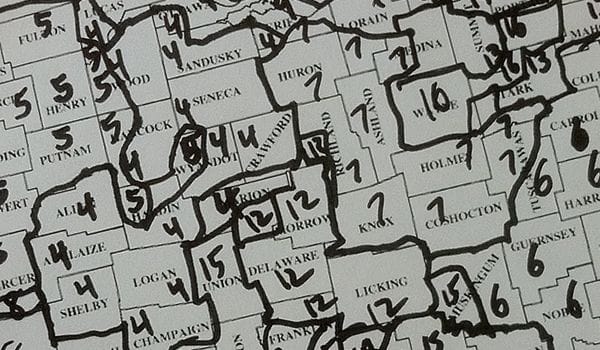
The road to the presidency has frequently been through Ohio. Since 1960, no Republican has won the presidency without winning this state. The top two candidates have criss-crossed through Ohio the entire election cycle— Romney was there over the weekend and Obama is poised to head there this upcoming week (even leaving DC early to avoid Hurricane Sandy and ensure he can make it to the Buckeye State).
To much of the nation, all the attention on the presidential race has obscured the other issues Ohio is undertaking in the all-important November 6th election— including Issue 2.
Issue 2 in Ohio would place the power of redistricting with an independent commission, shifting its current onus from elected officials to a commissioned panel. The panel would mandate an even number of representatives from the two largest political parties and also non-affiliates, or independents. To be approved, seven of the twelve members would need to agree on a plan.
Ohio makes this innovative suggestion amid controversial redistricting plans in other states. In Wisconsin for example, the newly-elected Republican majority quickly moved to draw a new electoral map after the historic 2010 election and before any recalls that proved imminent after the eruption of massive protests just two months into the new administration.
The new map came under intense scrutiny after it was drawn to dilute the growing minorities, particularly around Milwaukee, and making districts more heavily Republican with odd or even bizarre boundaries. The measure was also pushed through the legislative process with almost no consultation or public debate, which drew even more criticism for the plan.
Ohio’s suggestion is a breath of fresh air from the partisan wrangling that is often seen in the redistricting process. Yet a new poll by Public Policy Polling suggests that the measure is headed for defeat. Ohio Issue 2 2012 polls reveal 37% of voters say they will support the measure, but 48% are opposed. Independents oppose it by a 47/41 margin and although Democrats support it (55/30), Republicans are even more united in their opposition to the measure (12/72). The question remains as to why.
One explanation might be the influence of the high amount of donations coming in to defeat the measure. A recent article in the Columbus Dispatch reports that six and seven figure donations from business groups and corporate interests have raised over $7.2 million to fight the ballot issue. Proponents of the measure, by contrast, have raised only $4.1 million to educate voters as to the issue’s benefits.
These opposition groups include “Protect Your Vote Ohio,” which argues that Issue 2 is flawed. Picking up endorsements from the Ohio State Bar Association and the Ohio Judicial Conference, these groups claim that Issue 2 will unnecessarily involve Ohio’s judiciary in a political process since a group of appellate judges will be selecting the twelve-member commission.
Further, these groups say that the commission will be unaccountable, unlike elected officials, and the commission therefore will not be less partisan, but has the possibility of actually being more politically influenced.
The initiative's supporters, however, find these claims preposterous since the judiciary will be required to pick both independents and an even number from the major political parties. In addition, they counter these groups’ claims that the commission would be hyper-political by pointing out that an independent commission will take politicians out of the process of designing districts that will benefit their own interests, especially if there is a unique moment of political dominance when redistricting occurs.
Despite these arguments by the ballot initiative's supporters, money speaks. As of September, the Dayton Daily News reports that many Ohioans have not even heard of the initiative. With most of the news since coming from the anti-Issue 2 groups, the current polling suggests that their message has come across loud and clear to the detriment of an improved political process that might make redistricting more fair and rational in this polarizing political climate.